
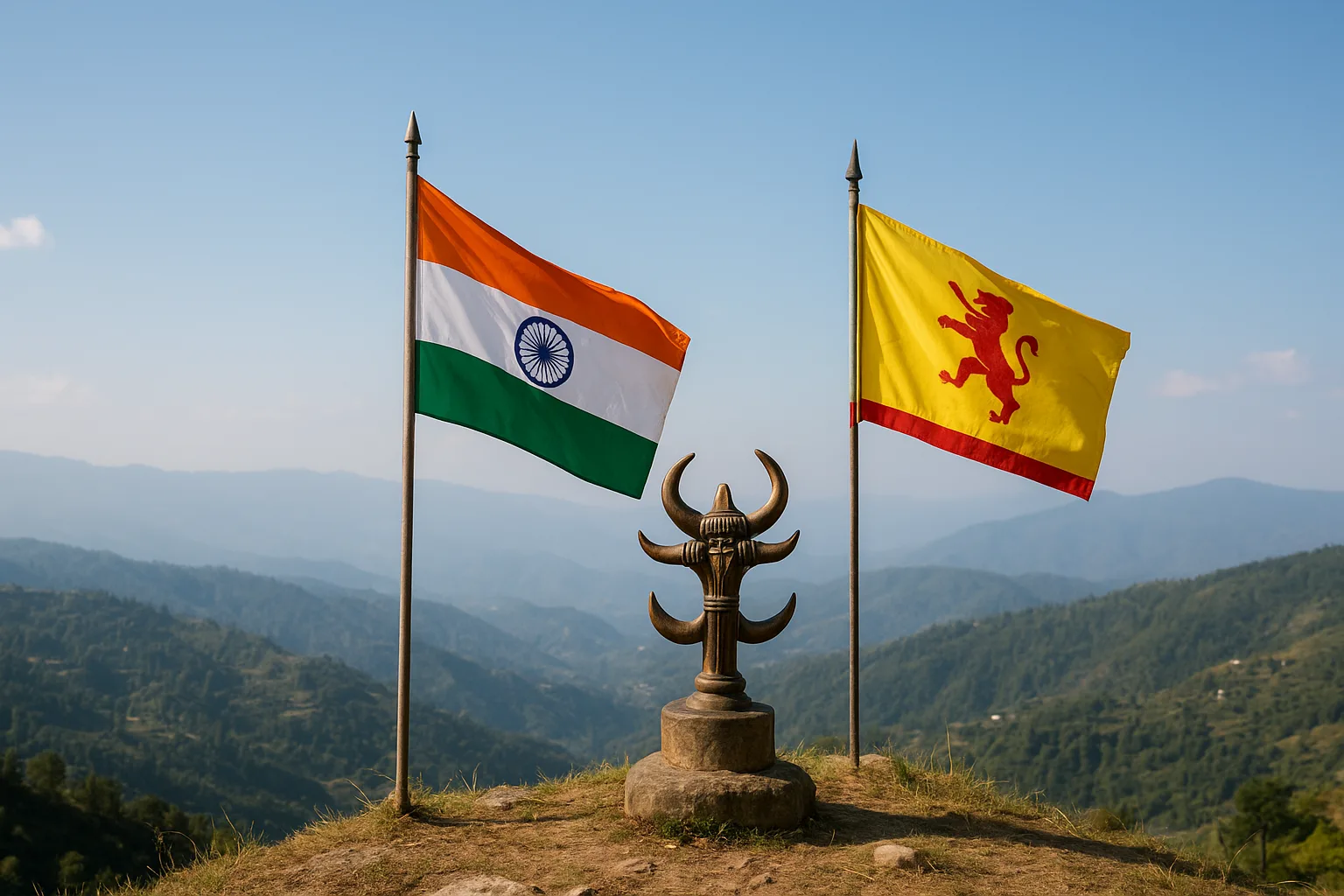
Series: History of Sirmaur, Himachal Pradesh, India
Phase 4: British Period — Part 20 of 30
This article is part of a wider series tracing the transformation of the western Himalayas under colonial influence. As British authority extended into the hills, existing political systems were restructured through treaties, administration, and new forms of governance. This phase considers how colonial rule reshaped society, economy, and space while leaving lasting imprints on local identity.
March Winds in Nahan: 1930
On a crisp morning in March 1930, the winding bazaar of Nahan—Sirmaur’s hill capital—bustled with whispers. Merchants arranged their goods under fluttering awnings as students, voices low, hurried between alleys. News had arrived from the plains: Mahatma Gandhi’s Salt March was underway, and the British authorities in Punjab were on edge. For Sirmaur, perched between the power centers of the Raj and the surging energy of India’s awakening, the moment was quietly electric. Here, surrounded by pine forests and overlooked by the ancient fort of Nahan, the contours of loyalty and resistance would be traced in subtle acts and determined silences alike.
The Hill State’s Place in the Colonial Mosaic
Historically, Sirmaur’s story was entwined with shifting allegiances. From its earliest chronicles—preserved in regional gazetteers and echoed in palace records—Sirmaur has been a land of semi-autonomous rule, its rajas maintaining a delicate balance between local tradition and external power. In the late 18th and early 19th centuries, Sirmaur’s rulers faced the challenge of both Gurkha aggression and the rising influence of the British East India Company. By the time of the 1857 revolt, Sirmaur, like other princely states in the hills, had pledged loyalty to the British Crown, a decision that would shape its political fortunes for decades.
Oral Traditions and the Memory of Subjugation
Yet, beneath the surface of officialdom, oral traditions told a different story. Village elders recalled the days when the Sirmauri peasantry, taxed heavily and subject to the whims of local jagirdars, found subtle ways to resist. Folklore, sung in the region’s Pahari dialects, spoke of secret meetings in forest clearings and coded songs that mocked the excesses of authority—both indigenous and colonial. These tales, while embroidered by generations, held a kernel of historical truth: Sirmaur was not merely a passive spectator to the tides of empire, but a place where memory and dissent found expression in everyday acts.
Emergence of Political Consciousness
The early decades of the twentieth century brought new winds of change. The spread of education—through missionary schools in Nahan and Paonta Sahib—and the arrival of newspapers from the plains exposed Sirmaur’s youth to nationalist ideas. Teachers, many trained in Lahore or Delhi, quietly circulated pamphlets and hosted discussions on the teachings of Gandhi, Nehru, and Lala Lajpat Rai. Though overt protest was rare, the seeds of discontent were sown. In the 1920s and 1930s, the first local associations emerged, often under the guise of social reform societies or youth clubs, but with the tacit aim of questioning both feudal authority and colonial oversight.
Communities at the Crossroads
Sirmaur’s population was a tapestry: Rajputs and Brahmins formed the traditional elite, with a substantial presence of Gujjars, Gaddis, and other pastoral communities. Sikh settlers clustered along the Yamuna and Giri river valleys, their gurdwaras serving as hubs of both faith and political discussion. Paonta Sahib, in particular, became a meeting ground for reformers and revolutionaries traveling between Punjab and the hills. Trade routes linking Shimla, Dehradun, and Ambala carried not just salt and grain, but also seditious pamphlets and coded letters, blurring the lines between commerce and resistance.
Rebellion and Reticence: Sirmaur During the 1942 Quit India Movement
The Quit India Movement of 1942 marked a turning point. While the Sirmauri raja, steadfast in his allegiance to the British, ordered the suppression of gatherings and the surveillance of known agitators, a new generation of students and minor officials began to test the boundaries of dissent. In Nahan, hand-written leaflets appeared overnight, calling for solidarity with the movement sweeping the subcontinent. The authorities responded with arrests and curfews. Yet, as regional reports from the period note, the resistance in Sirmaur was measured—anxious to avoid outright confrontation, but determined to keep the flame of protest alive.
Women and the Silent Defiance
Women played a quiet but critical role. Oral accounts from the villages surrounding Shillai and Rajgarh recall how women smuggled messages and food to those in hiding, their actions shielded by the rhythms of daily life. The memory of these acts endures in family stories, even if the official records remain silent. The contradiction between the public calm of the hill towns and the invisible undercurrents of rebellion remains a defining feature of Sirmaur’s freedom struggle.
The Path to Accession and the End of Princely Rule
As independence approached, Sirmaur, like other princely states, faced the question of accession. The debate was heated: while some court officials favored continued autonomy or even a separate status within the new Indian Union, the pressure from the Indian National Congress and the local Praja Mandal (People’s Association) grew. In August 1947, after tense negotiations and mounting demonstrations in Nahan, the Maharaja of Sirmaur signed the Instrument of Accession, merging his kingdom with the new Indian state.
This act marked not just the end of royal rule, but also the beginning of Sirmaur’s participation in the democratic experiment. The first elections, held in the shadow of the old palace, set the stage for the region’s integration into Himachal Pradesh and, eventually, the Republic of India.
Legacy of the Freedom Movement in Sirmaur
Today, the echoes of those years linger in Sirmaur’s institutions and public memory. Statues of national leaders stand alongside memorials to local heroes, while annual celebrations in Nahan and Paonta Sahib recall the sacrifices—both spoken and unspoken—of the region’s freedom fighters. Schools teach the story of Sirmaur’s journey from princely state to democratic district, and family histories preserve the quieter acts of resistance that official chronicles often overlook.
As we look ahead to the next part of this series, we will explore how the aftermath of independence reshaped Sirmaur’s society, politics, and landscape, forging a new identity from the legacies of loyalty and dissent that defined its passage through the crucible of the Indian freedom movement.
Previous: Life of Ordinary People in British-Era Sirmaur
Next: Sirmaur’s Accession to Independent India