
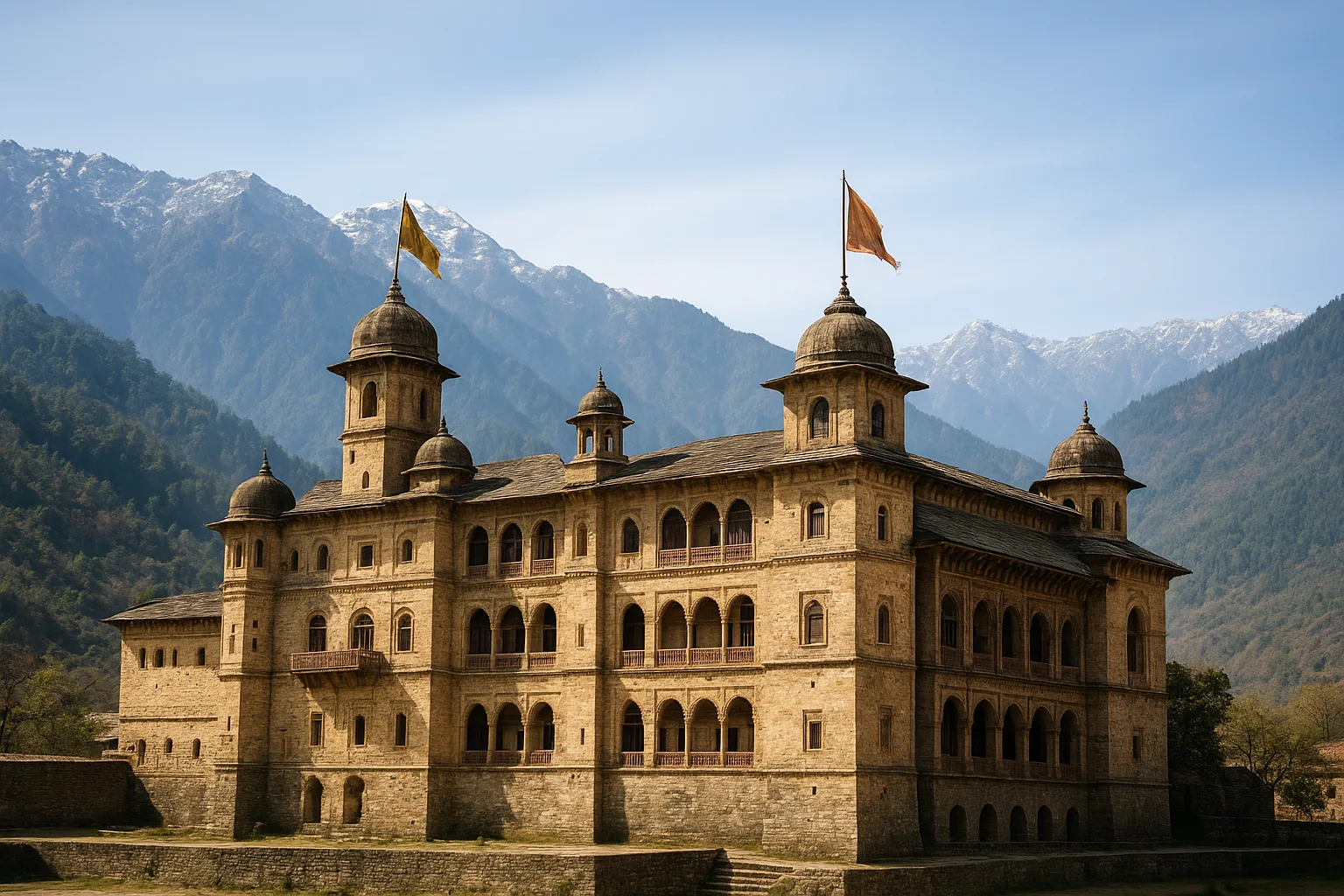
Series: History of Chamba, Himachal Pradesh, India
Phase 4: British Period — Part 20 of 30
This article is part of a wider series tracing the transformation of the western Himalayas under colonial influence. As British authority extended into the hills, existing political systems were restructured through treaties, administration, and new forms of governance. This phase considers how colonial rule reshaped society, economy, and space while leaving lasting imprints on local identity.
Twilight in the Palace: Chamba, August 1947
On a humid August afternoon, the marble corridors of Chamba’s ancient palace echoed with hurried footsteps and anxious whispers. Outside, the Ravi River moved with its usual indifference, while inside, the world was changing. Maharaja Lakshman Singh gazed out over the town’s slate rooftops, his mind torn between the legacy of his forebears and the uncertain dawn rising over a newly independent India. For centuries, the rulers of Chamba had presided over their verdant valley, guardians of tradition and patrons of a unique Himalayan culture. Now, as 1947’s summer waned, the end of princely rule approached with the inevitability of a monsoon storm.
Chamba’s Princely Heritage: A Factual Anchor
Chamba’s status as a princely state was no accident of history. The region’s royal line claimed descent from Raja Sahil Varman, who—according to both oral tradition and the earliest written chronicles—moved his capital to the town of Chamba in the 10th century CE. Over the following centuries, Chamba’s rulers navigated a complex world of shifting alliances, mountain rivalries, and the ever-present challenge of external invaders. By the dawn of the British Raj, Chamba was recognized as a salute state, its sovereignty preserved—at least on paper—by treaty, tribute, and diplomacy.
Throughout the 19th and early 20th centuries, British colonial gazetteers recorded Chamba as one of the more stable and culturally distinct hill states. Its rulers, while subordinate to the Raj, exercised considerable autonomy in local governance, customs, and law. The palace was both a seat of power and a symbol: a place where ancient rites mingled with the protocols of empire, and the rhythms of rural life were overseen by a lineage that claimed a thousand years of legitimacy.
Between Tradition and Change: The British Era
The British period brought profound shifts to Chamba’s political landscape. While the Maharajas retained their titles and a measure of control, British Residents and Political Agents grew more assertive in shaping policy, trade, and even courtly ceremony. The hill states—Chamba among them—became buffers in the imperial game, valued as much for their loyalty as for their strategic position on the northwestern frontier of British India.
Yet, in villages and markets, life retained its old cadence. Oral traditions, passed from elders to children beside hearths and temple courtyards, spoke of legendary ancestors and miraculous deeds. These stories, interwoven with the stone-and-wood architecture of Chamba’s temples and homes, provided continuity as the outside world crept ever closer. The state’s celebrated miniature painting tradition, its fairs and festivals, and its hybrid administrative systems all reflected this balance—part adaptation, part quiet resistance.
Communities at the Crossroads: Society in Late Princely Chamba
Chamba’s population in the early 20th century was a mosaic of Pahari-speaking communities: Rajputs, Brahmins, Gaddis, Gujjars, and artisans whose livelihoods were shaped by the land and the seasons. The princely court was the apex of a layered society, its legitimacy reinforced by ritual, kinship, and patronage.
Beneath the surface, however, social currents were shifting. Education—once the preserve of the elite—was slowly expanding. The colonial administration’s encouragement of infrastructure and legal reform brought both opportunity and tension. Networks of trade, running from the Kangra Valley to the passes of Lahaul and Ladakh, made Chamba a crossroads of goods, ideas, and conflicting expectations. The modern world was pressing in, and the palace could not remain immune.
Countdown to Independence: Political Upheaval
As the 1940s unfolded, the larger currents of Indian nationalism began to reach the hills. The All India States Peoples’ Conference, the Quit India Movement, and the promise of independence inspired new voices and new demands. Younger Chamba residents, educated in Lahore and Delhi, returned home with a vision of citizenship and democracy at odds with the old order.
British withdrawal from India in August 1947 set the stage for a new drama. The fate of the princely states was one of the thorniest issues facing the leaders of independent India and Pakistan. Chamba, like its neighbors, was asked to decide: accede to India, join Pakistan, or attempt a precarious independence. For Maharaja Lakshman Singh, the weight of a millennium balanced on a single signature.
Integration and the End of Sovereignty
On 15 August 1947, the Union Jack was lowered from government buildings across the subcontinent. In Chamba, the tricolor of a new nation flapped above the palace, as the Maharaja signed the Instrument of Accession to the Indian Union. The act was both pragmatic and poignant: it guaranteed certain privileges in the short term, but it also marked the end of the state’s independent identity.
In the years that followed, Chamba was integrated into the newly formed state of Himachal Pradesh. Royal titles became ceremonial; the palace’s role shifted from government to heritage. Land reforms, the abolition of jagirdari rights, and the extension of Indian law brought new freedoms—and new challenges—to Chamba’s people. The old order faded, but not without echoes of resistance and nostalgia. Oral traditions now spoke of the last Maharaja not as a distant ruler, but as a figure caught in the whirlwind of history, a symbol of all that had changed.
Chamba’s Legacy: Roots in the Present
Today, Chamba’s palaces and temples still dominate the skyline, their stones bearing witness to the valley’s layered past. The end of princely rule did not erase the memory of a thousand-year dynasty. Instead, it became another chapter in a story that continues to shape local identity, politics, and culture. The annual Minjar fair, royal processions now led by elected officials, and the preservation of art forms once patronized by the court all speak to a living heritage.
As the series continues, we will step into the early years of democratic Chamba—tracing how the region’s unique history shaped its place in the Indian republic and how the echoes of princely rule still shape the aspirations of its people.
Previous: Chamba and the Indian Freedom Movement
Next: Chamba’s Accession to Independent India