
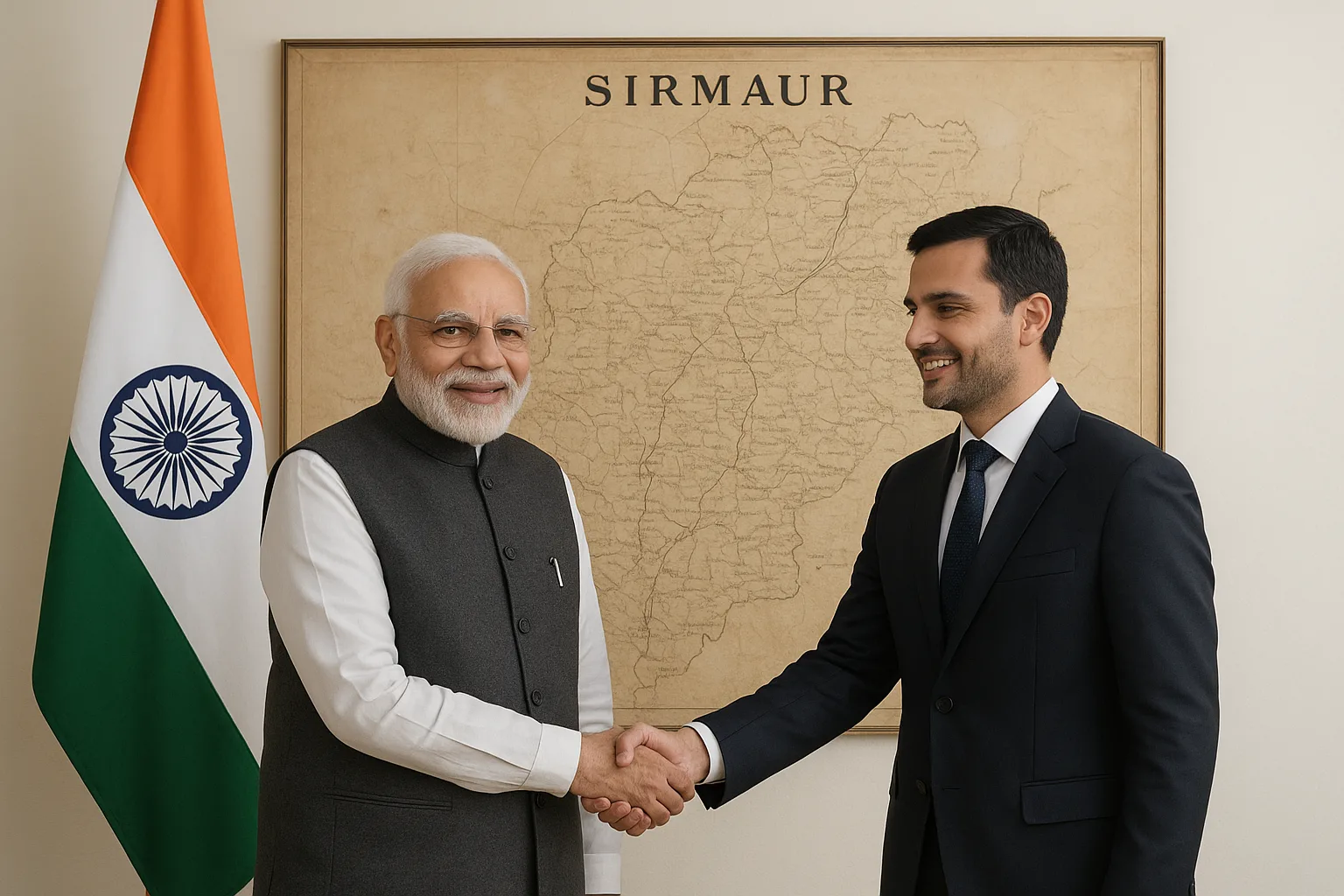
Series: History of Sirmaur, Himachal Pradesh, India
Phase 5: Modern Era — Part 21 of 30
This article appears within a continuing historical series that follows the western Himalayas into the modern era. With the end of princely rule and the integration into independent India, long-standing social and political patterns were reconfigured. This phase examines how development, state formation, and memory interact with inherited landscapes, shaping contemporary life while carrying forward echoes of the past.
Monsoon Shadows over Nahan, 1947
The monsoon clouds hung low over Nahan’s palace as August 1947 approached, their shadows pooling across the old town’s red rooftops. Inside, the corridors of Sirmaur’s administration buzzed with anxious conversation. The world outside was transforming: British India was ending, and the subcontinent trembled with hope and violence. In these closing days of empire, Sirmaur’s fate—like so many princely states—lay uncertain. Would it join the newborn Indian Union, cling to sovereignty, or seek some other path?
Centuries of Autonomy: Sirmaur’s Historical Standing
Though the palace drama unfolded in 1947, its roots stretched back centuries. Sirmaur, nestled in the lower Shivaliks, had been a recognized hill state since at least the early 17th century, when Raja Karam Prakash shifted his capital to Nahan. The region’s rulers, tracing their lineage to Rajput traditions, cultivated a distinct sense of identity—one shaped by geography, local customs, and the intricate politics of the hills.
Unlike some of its neighbors, Sirmaur maintained a relative autonomy, balancing Mughal, Sikh, and later British influences while retaining its own courtly rituals and codes. By the late 19th century, colonial gazetteers described the state as both remote and sophisticated, its valleys home to a tapestry of communities—Rajputs, Brahmins, traders, artisans, and the indigenous Jaunsari peasantry. Their stories, preserved in folk memory and chronicles alike, speak of centuries of adaptation and resilience.
Between Tradition and Modernity: The Winds of Change
As the British grip tightened in the 19th and early 20th centuries, Sirmaur’s rulers adapted. Roads snaked through the hills, markets grew busier, and education slowly spread. The court at Nahan—once a symbol of feudal sovereignty—became increasingly drawn into the colonial world. The Raja, while still addressed with royal deference, now received British Residents and attended imperial durbars. Yet, beneath the ceremonial surface, the state’s political autonomy had narrowed: British India’s shadow loomed large.
The region’s population, meanwhile, was changing. Oral traditions recount how local fairs and religious festivals—such as the Renuka and Trilokpur gatherings—remained vital, binding mountain communities together. Yet, new ideas seeped in. The freedom struggle, though more muted here than in the plains, found echoes in student circles and among the growing class of officials educated in British-run schools.
The Last Days of the Princely Order
By the mid-1940s, the ground was shifting. The British Raj, exhausted by war and internal dissent, prepared to leave. In Delhi, the debate over India’s future raged: what place, if any, would there be for the princely states? Sirmaur, like over 500 others, faced a stark decision. Some local elites, steeped in generations of royal service, feared the loss of prestige and security. Others, particularly among the educated youth, saw independence as an overdue dawn.
The palace at Nahan became a microcosm of these tensions. Raja Amar Prakash, the last ruling monarch, consulted with advisors and watched the tides of history with a wary eye. British officials, now more preoccupied with partition and withdrawal, offered little guidance. Meanwhile, in the bazaars and villages, rumor and hope mingled freely. Would Sirmaur be swallowed by neighboring Punjab? Would it join a future Himalayan federation? Or would it, as some whispered, seek an impossible independence?
Negotiations and Uncertainty: August 1947
As independence neared, events accelerated. The Indian National Congress and Lord Mountbatten’s interim government urged the princely states to accede to India, promising internal autonomy within the new union. For Sirmaur, the choice was fraught. Memories of British manipulation—especially after the 1857 uprising, when Sirmaur’s loyalty to the Crown was rewarded—remained vivid. But there was also pragmatism: the state was small, landlocked, and dependent on the surrounding Indian territories for trade and movement.
In the end, after weeks of deliberation and mounting pressure, Raja Amar Prakash signed the Instrument of Accession to the Indian Union in late August 1947. The act itself was quiet—no grand ceremonies, just a document dispatched to Delhi. Yet, for Sirmaur, it marked the end of royal sovereignty and the beginning of a new era.
From Statehood to Integration: Sirmaur in the Indian Union
The first years after accession were marked by both anxiety and hope. Sirmaur’s administration was gradually integrated into the nascent state of Himachal Pradesh, itself a patchwork of former hill states. Land reforms, the extension of Indian law, and the arrival of elected representatives began to reshape daily life. Oral accounts recall both excitement and confusion as new officials arrived and old systems faded.
The palace’s role diminished, but its legacy lingered in rituals, festivals, and the pride of place. The communities of Sirmaur—whether in the bustling streets of Nahan or the remote villages above Renuka Lake—faced the future with a mixture of nostalgia and ambition. The trade routes that once linked the hills to the plains now became arteries of a larger, democratic republic.
Remembering the Turning Point
Today, the echoes of 1947 still shape Sirmaur’s identity. The old palace stands as both a reminder of royal heritage and a witness to historic change. Oral traditions—stories of accession, adaptation, and endurance—continue to circulate among families, recounted at festivals and in quiet conversations. The legacy of Sirmaur’s accession is not just political; it is woven into the region’s sense of self, its relationship to the wider Himachal, and the ongoing negotiation between tradition and change.
In the next part of this series, we will follow Sirmaur through the early decades of democratic India, tracing how local communities adapted to the challenges and opportunities of integration—setting the course for the region’s modern identity.
Previous: Sirmaur and the Indian Freedom Movement
Next: Administrative Reorganisation of Sirmaur District