
Series: History of Sirmaur, Himachal Pradesh, India
Phase 4: British Period — Part 19 of 30
This article is part of a wider series tracing the transformation of the western Himalayas under colonial influence. As British authority extended into the hills, existing political systems were restructured through treaties, administration, and new forms of governance. This phase considers how colonial rule reshaped society, economy, and space while leaving lasting imprints on local identity.
An Early Morning in Nahan, 1850
The mist clings to the stone-paved lanes of Nahan as dawn breaks over the steep ridges of Sirmaur. A faint chorus of temple bells mingles with the measured footsteps of traders already making their way toward the bazaar. In the shadow of the Raj’s cantonments and the high walls of the Raja’s palace, everyday life pulses quietly—distinct from the world of politics and treaties chronicled in official records.
By the mid-nineteenth century, Sirmaur stood at a crossroads. Annexed as a princely state under the British Crown, it retained a degree of autonomy but answered to the distant authority of Shimla and the Punjab administrators. Yet, for the farmers, artisans, and traders who formed the lifeblood of the region, change arrived more subtly, woven into the patterns of their daily existence.
Rooted Landscapes: Settlements and Social Fabric
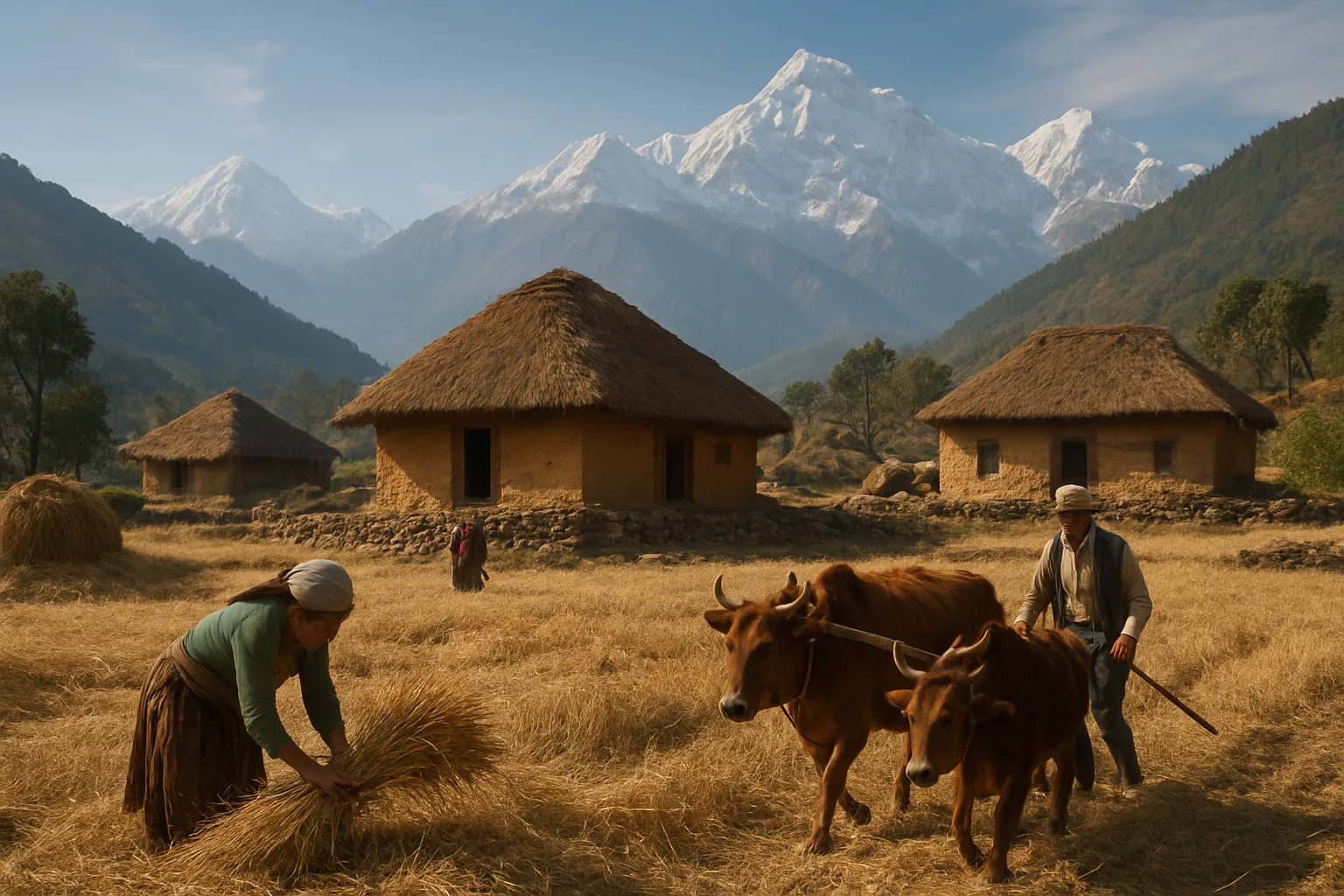
Historical gazetteers and oral traditions agree: the villages of Sirmaur, scattered across terraced hills and river valleys, were old and deeply rooted. Their names—often ending in “-wala” or “-pur”—echoed the family lineages and legendary founders, blending myth with memory. While political boundaries shifted above, the rhythm of village life remained anchored in the land: wheat and barley in the Rabi season, paddy and maize when the monsoon clouds arrived.
Communities clustered around reliable springs or along ancient trade paths. Brahmin priests, Rajput landholders, and communities like the Kanets, Gujjars, and artisans shaped the social mosaic. The caste order was present but less rigid than in the plains; necessity often blurred boundaries in the demanding mountain environment. Oral traditions remembered migrations—families fleeing wars or droughts, settling where the forest gave way to arable ground.
Belief, Ritual, and the Sacred Landscape
Villagers in British-era Sirmaur lived by a calendar punctuated with festivals, rituals, and the cycles of the agricultural year. The region’s temples—often ancient stone structures perched on hilltops—were both spiritual and social centers. Each deity, from Shirgul and Bhangayani to the local village gods, was believed to watch over crops, cattle, and health.
While British officials recorded these as “superstitions,” the people themselves saw them as essential: invoking rain, warding off disease, or negotiating with the unseen world. Every spring, processions and fairs brought together scattered hamlets, renewing bonds and resolving disputes. Oral tales, sung at night in front of chulhas, preserved both the miraculous and the mundane—how a goddess saved the valley from famine, or how a clever villager outwitted a tax collector.
Trade, Travel, and the Marketplace
Sirmaur’s position—straddling routes from the plains to the upper Himalayas—shaped its economic life. Salt, jaggery, and cloth arrived from the south, while local produce—timber, ghee, wool—flowed outward. The weekly haat (market) at Nahan or Rajgarh was a crossroads not just for goods, but for news and rumor: the arrival of new taxes, the outbreak of smallpox, or tales of distant wars.
Caravans of mules and goats, led by hardy Pahari traders, wound their way through narrow passes. Travel was arduous, and banditry a constant danger. Still, the old trade routes persisted, their paths mapped in the collective memory of generations. British rule brought some new roads, built mainly for military and administrative needs, but the age-old trails remained vital for local people.
Hardship and Adaptation: Life under the Raj
The British period brought visible change but also hardship. New taxes, sometimes imposed through Sirmaur’s own Raja on behalf of the colonial administration, strained already precarious livelihoods. Gazetteers note episodes of famine and crop failure; in such times, entire villages might migrate temporarily, seeking work in the plains or at British construction sites in Shimla.
Yet, adaptation was the hallmark of Sirmaur’s people. Some learned new skills—carpentry, masonry, even basic English—to serve in the colonial bureaucracy or in cantonments. Others clung to old crafts: weaving wool, making iron tools, or brewing sura (local liquor) for festivals. Despite the growing presence of British officials and soldiers in Nahan and Paonta, most villagers encountered the Raj only indirectly—through the visit of a tax collector, the arrival of a new police post, or news of distant reforms.
Women’s Worlds: Labor, Ritual, and Resilience
Women’s labor formed the backbone of rural life. From dawn to dusk, they tended fields, fetched water, spun wool, and kept households running. Oral traditions and early British records alike remark on the strength and resilience of Sirmaur’s women. Festivals and rituals offered rare moments of collective joy and agency: singing folk songs, leading processions, or invoking the blessings of the goddess for a good harvest.
Outside the formal chronicles, their stories survive in the songs and memories passed down—of love, hardship, loss, and laughter. In many households, it was the mother or grandmother who preserved the family’s oral history, ensuring that even in times of upheaval, the links to ancestral lands and customs endured.
Memory and Modernity: Enduring Legacies
By the final decades of the nineteenth century, Sirmaur was neither untouched by modernity nor wholly subsumed by it. The old and the new coexisted: ancient rituals performed beneath the gaze of British officials, traditional councils resolving disputes while new courts rose in the towns. The ordinary people of Sirmaur, their names mostly lost to written history, carried forward the knowledge of their forebears—adapting, enduring, and shaping the region’s destiny in quiet ways.
Today, echoes of this era remain palpable. Festivals still draw communities together; terraced fields trace the hillsides as they have for centuries. The stories of resilience and adaptation, preserved in families and villages, continue to inform Sirmaur’s identity in a rapidly changing world.
In the next part of our series, we will step further into the era of reform and resistance—exploring how the people of Sirmaur responded to new ideas, policies, and challenges as the British period unfolded.
Previous: Administrative and Revenue Reforms in Colonial Sirmaur
Next: Sirmaur and the Indian Freedom Movement