
Series: History of Sirmaur, Himachal Pradesh, India
Phase 5: Modern Era — Part 29 of 30
This article appears within a continuing historical series that follows the western Himalayas into the modern era. With the end of princely rule and the integration into independent India, long-standing social and political patterns were reconfigured. This phase examines how development, state formation, and memory interact with inherited landscapes, shaping contemporary life while carrying forward echoes of the past.
Nightfall in the Hills: Voices Across Time
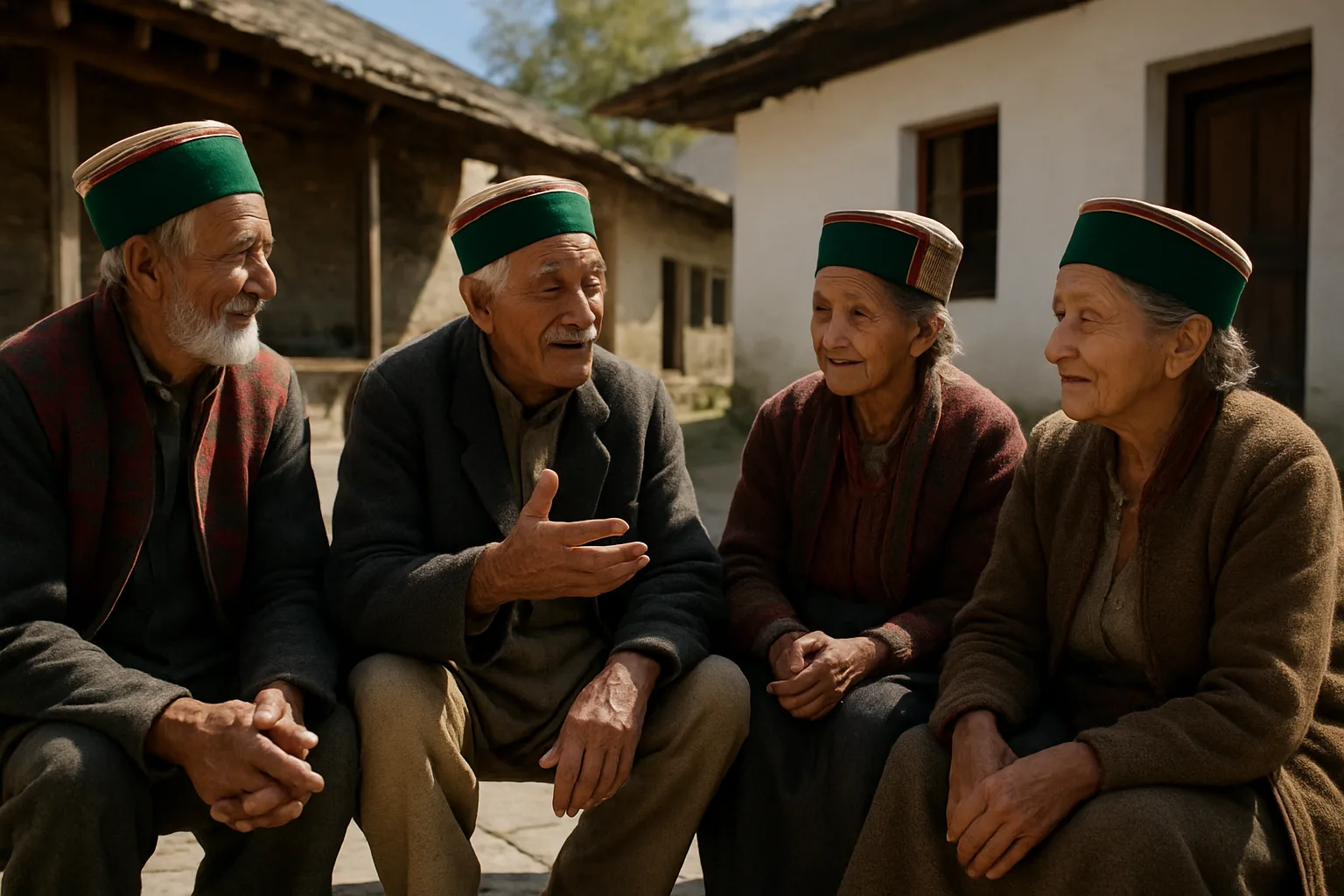
As twilight softens the pine-studded ridges above Nahan, the evening air carries the lilt of stories told and retold. In courtyards and around crackling hearths, Sirmaur’s elders pause over steaming cups of chai to share tales their own grandparents once heard. These are not simply diversions for long winter nights—they are the living memory of a land whose roots twist deeper than any written record.
Today, oral traditions in Sirmaur do more than preserve the past: they sustain a sense of place, binding generations to the hills and valleys their ancestors called home. But how do these spoken histories fit alongside chronicles, gazetteers, and the official lineages of kings? The answer lies in the careful weaving of memory, myth, and material fact—a tapestry as intricate as the region’s terraced fields.
An Ancient Crossroads: Factual Anchors in Sirmaur’s Early Past
Sirmaur’s position, along the southern slopes of the Shivalik range, made it both a natural sanctuary and a vital crossroads. The earliest known settlements—traced by archaeological finds and supported by folk memory—clustered along the Giri and Bata rivers. Here, the land was generous: dense forests teemed with game, and the rivers carried stories as well as water.
Documents like the Imperial Gazetteer and the earliest British accounts place Sirmaur’s emergence as a hill polity by the 11th century, though the oral traditions reach further back. These stories rarely mention dates. Instead, they anchor themselves in the landscape—naming sacred groves, ancient wells, and stones said to mark the footsteps of legendary founders. The distinction between legend and verifiable history is sometimes blurred, but memory remains rooted to place.
Myths of Origin: Oral Traditions and the Shape of Belief
Many elder Sirmauris speak of a time when the land itself was wild and unclaimed, inhabited only by spirits and wandering yogis. In these tales, the arrival of the Rajputs—especially the Sirmauri dynasty, said to descend from Raja Rasaloo or even from the Sun—marks the dawn of settled life. The founding of Rajban and, later, Nahan, is wrapped in legend: divine omens, miraculous springs, and encounters with wise ascetics who foretold the area’s destiny.
Yet, within these stories, kernels of historical reality persist. The worship of local deities like Shirgul Maharaj and Bhangayani Maai—whose shrines dot the region—reflects a continuity of belief that predates even the earliest Hindu dynasties. These oral traditions, often performed as songs or dramas during village festivals, serve as intergenerational bridges and repositories of unwritten law. They offer insight into the pre-literate societies that shaped Sirmaur’s spiritual geography.
Early Communities: Castes, Clans, and Hill States
As the stories shift from myth to memory, they begin to echo the formation of the first structured communities. The elders recall the settlement patterns of pastoral Gujjars and Gaddis, the arrival of artisan castes, and the establishment of small villages along trade routes linking the plains to the highlands of Himachal. The oral record often details disputes over grazing grounds, the forging of alliances through marriage, and the emergence of panchayats (village councils)—all essential elements in the slow crystallization of Sirmaur’s political order.
According to both oral memory and regional chronicles, the hill states of Sirmaur, Jubbal, and others developed in tandem, sometimes as rivals, sometimes as allies against invading forces from the south or west. The consolidation of Sirmaur as a princely state, with its capital at Nahan, is described in terms both grand and intimate: the construction of forts, the carving of water channels, and the complex rituals marking royal ascension.
Memory and Material: Trade Routes, Migration, and Change
Stories handed down in Sirmaur do not shy away from hardship. Elders remember, or claim to remember, migrations triggered by drought, floods, or conflict. The oral tradition is rich with references to the old salt routes—paths that wound from the Punjab plains up into the hills, bringing not only goods but new ideas and peoples. Merchants, wandering mendicants, and even bands of fugitives became part of the region’s evolving identity.
These recollections are echoed in early administrative records, which describe Sirmaur as a zone of passage and negotiation. The boundaries of the state were never fixed for long; they shifted with the fortunes of its rulers and the resilience of its people. The elders’ stories, layered with emotion, serve as a corrective to the sometimes dry precision of official history, reminding listeners of the everyday realities beneath the surface of political change.
The Persistence of Memory: Oral History in the Modern Era
Even as literacy spread and written chronicles multiplied—from Mughal records to colonial gazetteers—the oral tradition in Sirmaur remained vibrant. Family histories were recited at weddings and funerals; songs of migration and longing were sung during harvest. Notably, during the turbulent years of British annexation and the upheavals of the twentieth century, these spoken histories provided a sense of continuity and belonging.
Younger generations, too, have begun to record these voices, recognizing that the memories of elders are themselves a precious inheritance. Initiatives in schools and local museums now seek to capture the dialects, idioms, and narratives that textbooks often overlook. Oral history, once the only history, has become a respected companion to the written word.
Continuity and Change: The Roots that Still Hold
In Sirmaur, a conversation with an elder is never just about the past. It is an invitation to see the present—its festivals, its rituals, its fierce pride in local identity—as the living outcome of centuries of remembered experience. The ancient roots, nourished by both myth and fact, continue to hold firm in the shifting soils of modern life.
As this series moves forward, we will turn from the voices of memory to the documents and decisions that shaped Sirmaur in the era of reform and independence—tracing how these living histories informed the struggle for self-determination and the forging of a new identity in independent India.
Previous: Preserving Folk Traditions in a Changing Society
Next: Sirmaur’s Past, Present, and Future