
Series: History of Mandi, Himachal Pradesh, India
Phase 5: Post-Independence & Modern Mandi — Part 29 of 30
This article appears within a continuing historical series that follows the western Himalayas into the modern era. With the end of princely rule and the integration into independent India, long-standing social and political patterns were reconfigured. This phase examines how development, state formation, and memory interact with inherited landscapes, shaping contemporary life while carrying forward echoes of the past.
Twilight Along the Beas: An Ancient Town Awakens
As the sun sets behind the rugged Dhauladhar ranges, shadows stretch across Mandi’s ancient stone stairways and wooden balconies. The town’s heart pulses with a quiet resilience, guarded by the swirling Beas river below and crowned by centuries-old shrines above. It is here, amidst the cacophony of temple bells and the muted bustle of evening bazaar traders, that Old Mandi’s architectural heritage is most alive—a living testament to the region’s layered past.
Rooted in Time: The Birth of a Hill Settlement
Oral traditions among local families recall the days when the valley was a forested crossroads, watched over by spirits and deities that predate written history. Elders speak of the legendary sage Mandavya, whose penance on the riverbanks gave Mandi its name. While these stories breathe life into the stones, it is the documented emergence of the Suket and Kullu principalities in the early medieval period that first anchors Mandi in the historical record.
By the 16th century, under the rule of Raja Ajbar Sen, Mandi began to coalesce as a fortified urban centre. Early chronicles and the Himachal Pradesh District Gazetteer note the deliberate relocation of the capital from Bhiuli to the present site—a strategic move, influenced as much by trade and defense as by spiritual geography. The result was a town that fused sacred purpose with pragmatic design, a tradition that continues to shape its built environment.
Temples in Stone and Wood: Faith as Foundation
The earliest surviving structures are the temples that cluster along the Beas. The Triloknath and Panchvaktra shrines, with their elaborate shikhara spires and stone reliefs, trace their origins to the 16th and 17th centuries. Here, faith and architecture intertwine: the forms echo the Nagara style prevalent across North India, but local masons adapted these forms to withstand earthquakes and monsoon rains.
Perhaps most distinctive is the use of timber. Unlike the massive stone temples of the plains, Mandi’s shrines often feature intricately carved wooden doorways and sloping slate roofs—a hallmark of Himalayan craftsmanship. The Bhootnath Temple, dedicated to Lord Shiva and considered the spiritual center of Mandi, is a prime example. Its sanctum, wrapped in centuries of incense smoke, stands as a silent witness to the town’s shifting rulers and relentless seasons.
These temples are not isolated monuments but part of a living landscape. Annual festivals, such as Shivratri, transform the town’s byways into processional routes, reaffirming the close bond between Mandi’s people and their sacred architecture.
Royal Imprints: Palaces, Forts, and Urban Planning
With the consolidation of the Mandi state, the rulers left their mark in grander forms. The Raj Mahal, with its colonnaded verandas and ornate wooden balconies, became the symbolic heart of royal authority. While much of the original fortifications have faded, the palace complex still commands the old town, its architecture blending Rajput motifs with local building traditions.
Political shifts are inscribed in stone: the advent of Sikh and later British influence brought new materials and styles, including the introduction of brick and stucco, and the adaptation of colonial administrative buildings. Yet, the royal quarters remained rooted in the indigenous idiom, emphasizing courtyards, latticed screens, and protective walls that echo the defensive needs of a hill state perennially poised between alliance and autonomy.
Bazaars, Bridges, and Everyday Life
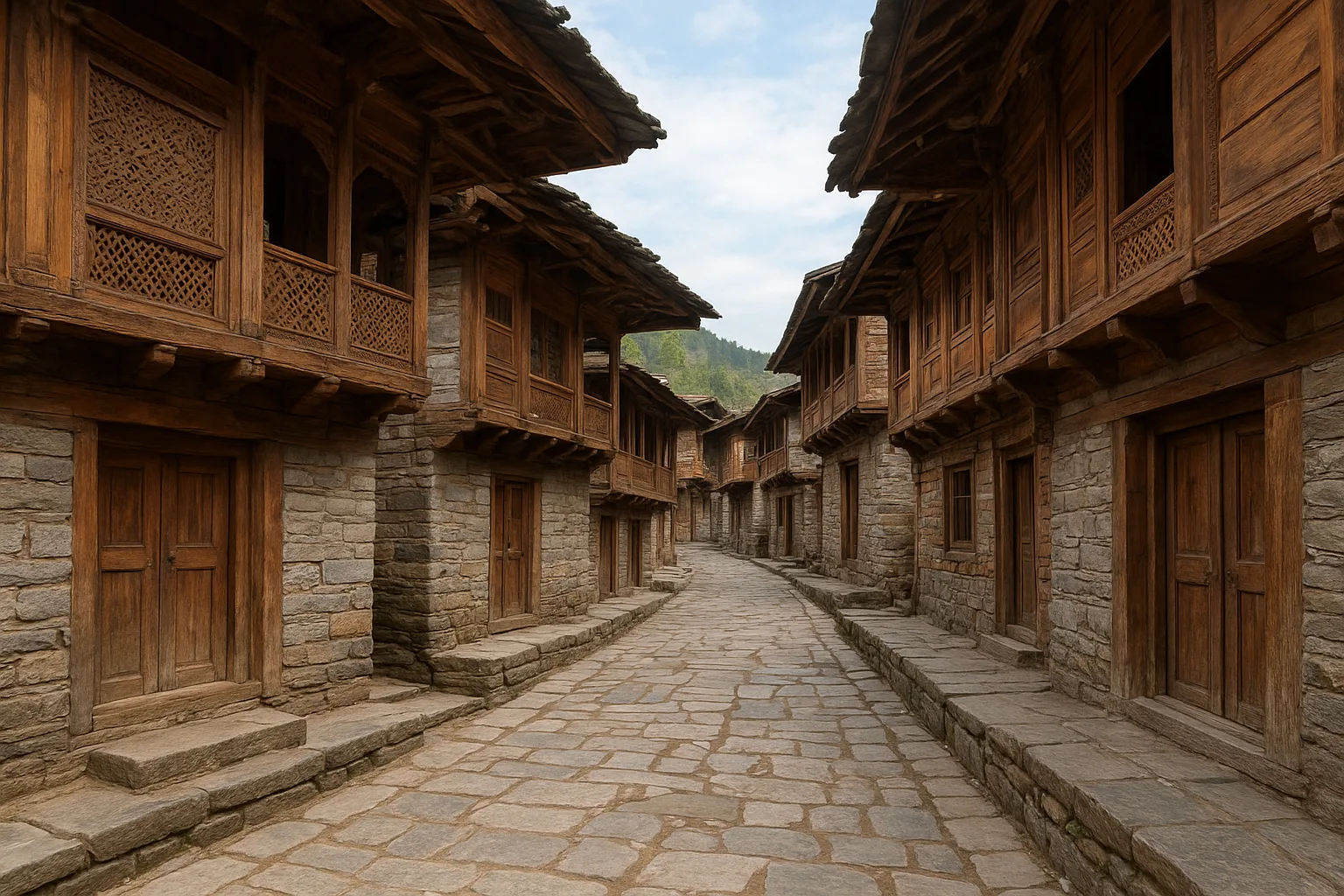
Life in Old Mandi has always thrived in its public spaces. The town’s compact design, dictated by the steep valley slopes and the river’s course, encouraged the growth of bustling bazaars. Timber-framed shopfronts lean over stone-paved lanes, their carved brackets and overhanging eaves offering shelter from rain and sun.
The Victoria Bridge, an iron span built during the British era, connects the old town to new neighborhoods, symbolizing both continuity and change. Yet, the older footbridges—constructed of wood and stone—remain vital arteries, linking shrines, markets, and homes as they have for centuries. The architecture of the everyday, from humble houses to communal wells, is unified by a careful adaptation to landscape and climate, reflecting a pragmatic ingenuity passed down generations.
Belief and Community: Interwoven Traditions
Mandi’s architectural story is incomplete without its people. For centuries, the town has been a crossroads of belief systems: Shaivism and Vaishnavism, local animist traditions, and later Sikh and Buddhist influences. Each left subtle marks—shared courtyards, multi-faith shrines, and vernacular motifs—that signal a negotiated coexistence.
Communities of artisans, traders, and priests have shaped the town’s skyline as much as its rulers. Stone carvers from the Kangra valleys, woodworkers from Chamba, and itinerant merchants along the old salt and wool routes all found their place here, leaving behind a mosaic of architectural styles and techniques. The result is a townscape that resists easy classification—at once sacred and secular, royal and democratic, ancient and continuously renewed.
Resilience in Stone and Story
The architectural heritage of Old Mandi is not a fossilized relic but a living palimpsest. Earthquakes, fires, and floods have tested the endurance of its buildings, yet the core traditions persist, adapted by each generation. Restoration projects in recent decades, often driven by local initiatives, seek not just to preserve structures but to keep their stories relevant for a changing world.
As we walk these winding lanes today, it is impossible not to sense the weight of accumulated memory—the prayers whispered in ancient sanctuaries, the bargains struck in timbered bazaars, the proclamations issued from palace balconies. Old Mandi’s architecture is both a shelter and a statement: a testament to the creativity and resilience of its people.
Echoes into the Present
These ancient roots continue to shape Mandi’s identity as the town navigates modernity. The coexistence of old and new, the annual rhythms of festival and market, and the ongoing reverence for craft and community remain defining features. In the next part of this series, we will explore how post-independence transformations—and the pressures of urban growth—have challenged, threatened, and sometimes revitalized Mandi’s unique heritage, setting the stage for its future as a living hill town.
Previous: Oral Histories and Folk Traditions of the Mandi Region
Next: Preserving Mandi’s History in a Rapidly Changing World