
Series: History of Mandi, Himachal Pradesh, India
Phase 5: Post-Independence & Modern Mandi — Part 28 of 30
This article appears within a continuing historical series that follows the western Himalayas into the modern era. With the end of princely rule and the integration into independent India, long-standing social and political patterns were reconfigured. This phase examines how development, state formation, and memory interact with inherited landscapes, shaping contemporary life while carrying forward echoes of the past.
Echoes at Dusk: Where Story and Memory Meet
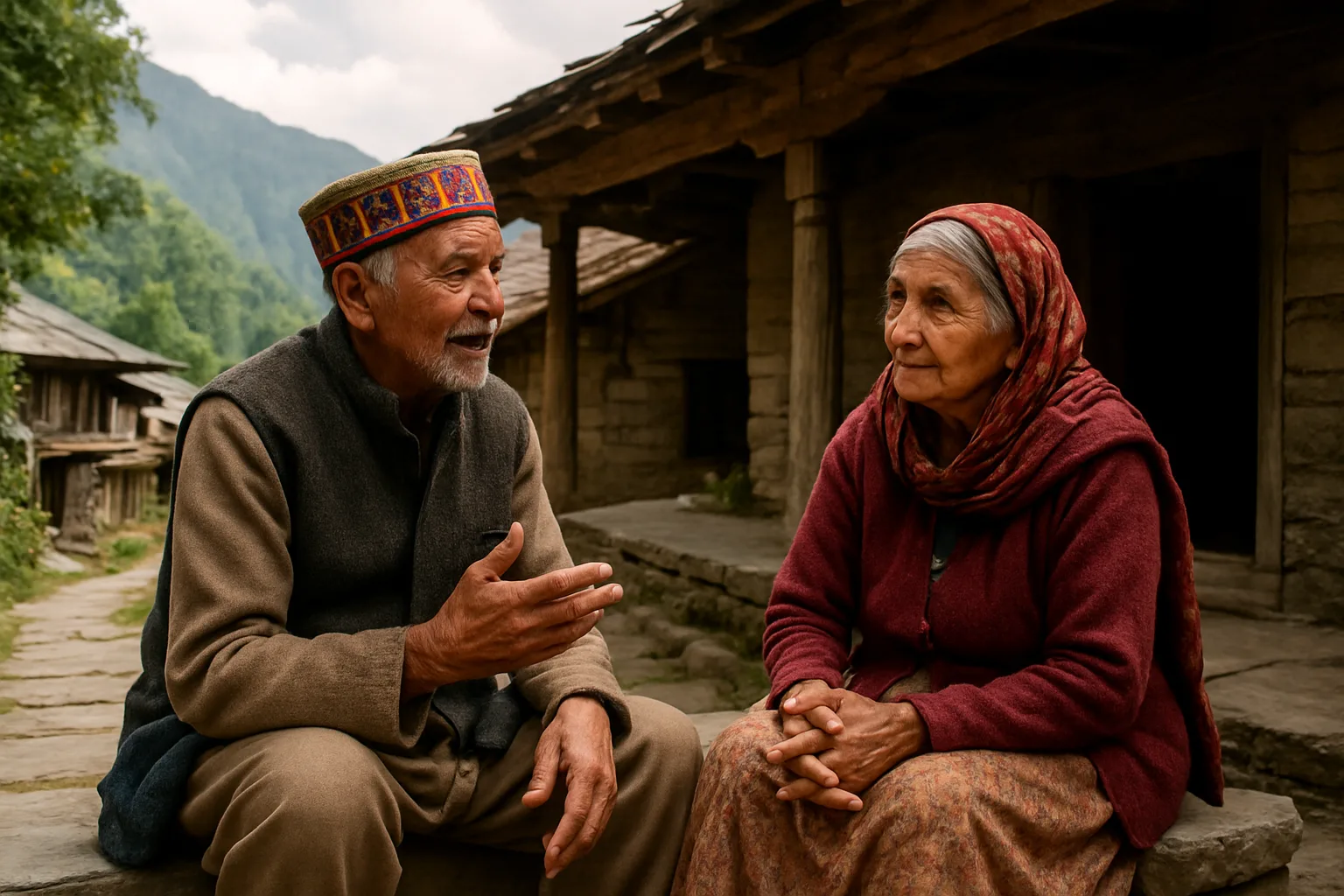
As dusk settles over the Beas River valley, the air in Mandi fills with the scent of pine and the rhythmic chirr of crickets. In a quiet courtyard, elders gather around a crackling fire, their voices weaving stories older than the stones of the ancient Tarna temple. These are not simply tales for idle nights; they are the living memory of a region whose identity long preceded the written page.
In this land—cradled between the Himalayan foothills and river gorges—oral tradition has preserved fragments of a past still visible in local customs, dialects, and the very names of hills and streams. Long before the rise of Mandi as a political entity, these tales served as both entertainment and a binding social force, infusing daily life with meaning and context.
Before the Chronicles: Myth, Memory, and Early Settlement
The earliest centuries of the Mandi region are not illuminated by royal inscriptions or elaborate chronicles. Instead, they survive in fragments: a folk ballad sung at a marriage, a story whispered on a festival night, a local proverb whose origins are half-remembered. These oral histories often blur the line between myth and memory, yet they offer clues to the beliefs and anxieties of the people who first settled these hills.
One such thread speaks of the ancient Naga cults—serpent deities believed to inhabit springs and riverbanks. The veneration of Nag Devtas, still evident in village shrines, hints at a time when nature worship dominated and animist beliefs shaped daily life. These traditions suggest that early communities, likely of indigenous origin, found both sustenance and spiritual awe in the daunting landscape. Over generations, as Indo-Aryan groups moved into the region, these beliefs blended with new gods and rituals, producing a tapestry unique to the hills of present-day Mandi.
Hill Communities and the Flow of Trade
While the great plains below saw the rise and fall of empires, the hill communities of Mandi followed a rhythm set by the seasons and the shifting trade routes that threaded through the passes. Oral lore from villages along the Uhl and Suketi rivers recalls ancient caravans—traders from Ladakh, Tibet, and the Punjab plains—bringing salt, wool, and stories from distant lands.
Such exchanges did more than move goods; they shaped languages and customs. The local dialect, Mandeali, carries traces of these encounters, enriched by words and songs borrowed from travelers. Folk stories often feature traders or wandering mendicants as bearers of wisdom—or warning—reflecting the region’s openness to outside influence while fiercely guarding its own traditions.
Gazetteers compiled during the colonial era, such as the late nineteenth-century accounts of Sir James Lyall, record the prevalence of these oral narratives and their remarkable consistency across valleys and generations. They reveal a society that prized memory and skillful storytelling as much as martial prowess or political power.
Emergence of Hill States: Legend and Historical Inference
Through the fog of oral tradition, glimpses emerge of the founding of small hill states. According to local lore, the earliest chieftains of Siokot and Bhiuli—the antecedents of modern Mandi—were semi-legendary figures, their deeds immortalized in epic songs and ritual performances.
While these tales often attribute supernatural origins to early rulers, historical inference suggests a pattern common across the western Himalayas: locally powerful families, perhaps with roots in older tribal lineages, consolidating authority over river valleys and controlling strategic passes. The story of Ajbar Sen, regarded as the founder of the Mandi state in the 16th century, is one such blend of legend and fact. Folk narratives amplify his wisdom and valor, while court records and early chronicles anchor his rule to a specific historical moment, marking the gradual shift from clan-based structures to organized polities.
Throughout, oral traditions acted as both record and justification—legitimizing the authority of rulers by linking them to divine mandate or legendary ancestors. In this way, myth and history walked hand in hand, each reinforcing the other.
Belief Systems: Gods, Goddesses, and Festival Lore
The spiritual life of Mandi has always found its richest expression in oral tradition. Each village maintains its own pantheon of deities—some with roots in pan-Indian myth, others fiercely local and tied to a single grove or spring. The annual Shivratri festival in Mandi town, now a major event, is still accompanied by processions and songs whose origins lie in the oldest folk celebrations. These performances are living archives: their lyrics, melodies, and rituals preserve social hierarchies, historical grievances, and alliances.
Stories of the goddess Parvati and the sage Mandavya (after whom the region is named, according to local legend) are told with reverence and pride. Yet alongside these, tales of lesser-known spirits—Yakshas, Rakshasas, and village guardians—populate the oral landscape, reflecting both fear and reverence for the unknown. Such stories reveal the elasticity of belief, as old animist practices were woven into the fabric of Hinduism over the centuries.
Memory in Song and Performance
Perhaps the most enduring vessel for Mandi’s oral traditions is song. From the lilting jagaras sung to mark the harvest, to the haunting ballads of lost loves and battles, music carries the emotional memory of the region. Professional bards, known locally as Gaddis and Bhats, once traveled from village to village, their repertoires spanning genealogies, moral tales, and coded commentaries on current events.
Even today, these traditions persist, though often transformed. At weddings, elders still sing verses recalling migrations, famines, or the founding of a temple. During the annual fairs, dramatic performances—part theater, part ritual—bring ancient stories to life, inviting both laughter and solemnity. Such oral performances bridge the gap between past and present, ensuring that history is not merely studied but experienced.
Oral Traditions and Written History: Intersections and Divergences
With the advent of written chronicles in the 17th and 18th centuries, a new era of documentation began. Yet, as the colonial administrators would later note, the oral traditions of Mandi did not fade; rather, they adapted, sometimes challenging, sometimes complementing the official record. Discrepancies between folk memory and royal archives often reflect deeper truths—about contested successions, erased communities, or shifting political boundaries.
Modern historians, drawing on both the careful work of gazetteers and the tenacious memory of village storytellers, recognize that neither record alone is sufficient. Together, they offer a fuller, richer account of Mandi’s past—one that honors both the resilience of its people and the complexity of their history.
Roots That Still Nourish: The Living Legacy of Oral Tradition
Mandi today is a bustling crossroads—its ancient temples rubbing shoulders with marketplaces and universities, its valleys echoing with both old songs and new ambitions. Yet beneath the surface, the oral traditions and folk histories of the region remain a vital force. They shape how communities understand themselves, how festivals are celebrated, and how the landscape is interpreted by each new generation.
The living memory of Mandi is not confined to museums or archives; it is recited, sung, and enacted in countless ways. As we move forward in this series, the next chapter will explore how these traditions evolved during the tumultuous years of political change, and how Mandi’s modern identity continues to be shaped by its ancient voices.
Previous: Markets of Mandi: From Ancient Trade to Modern Commerce
Next: Architectural Heritage of Old Mandi Town