
Series: History of Shimla, Himachal Pradesh, India
Phase 3: British Era — Part 17 of 30
This article belongs to a historical series examining how expanding empires and regional powers reshaped life in the western Himalayan hills. As external influences pressed into the mountains, local rulers navigated diplomacy, resistance, and accommodation. This phase explores how wider political currents intersected with entrenched hill traditions, altering governance without entirely displacing older structures.
The Ridge: Where Decisions Echoed Across a Continent
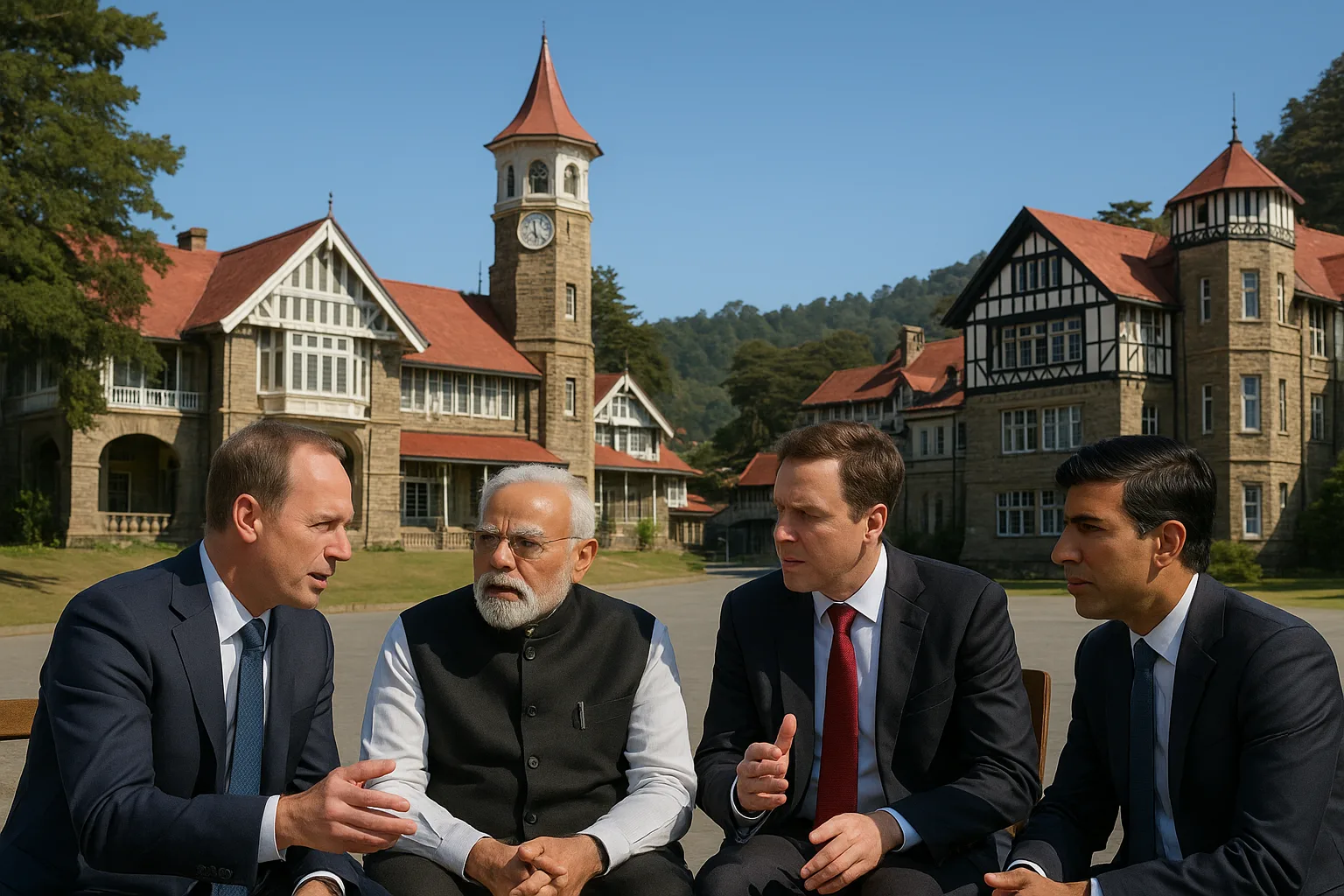
It is early summer in the shadowed years of the 19th century. Mists rise from the cedar-clad slopes of Shimla, then a modest hill station, its newly built bungalows and Gothic spires perched on the Ridge. The air is brisk, far removed from the humid plains below, and the town—cobbled, orderly, and still half-wild—throbs quietly with the presence of imperial power. Here, in the heart of the Himalayas, British officials, Indian princes, and emissaries converge each year when the government of British India shifts from Calcutta to its summer seat. The decisions made in these cool corridors would ripple across the subcontinent, shaping India’s course for generations.
Shimla Ascendant: From Hill Station to Imperial Capital
Documented history anchors Shimla’s transformation to the early 19th century, when it was ceded to the British East India Company following the Anglo-Gorkha War (1814–1816). The Treaty of Sugauli fixed the region’s political boundaries, and the British, seeking respite from the punishing heat of the plains, soon recognized Shimla’s strategic and climatic advantages. By the 1830s, the site had evolved from a remote wooded ridge into the Raj’s summer capital—a seat of governance, diplomacy, and decision-making.
Shimla’s cosmopolitan character deepened in these years. While the British elite established their presence, earlier communities—local hill folk, migrant artisans, and traders—continued to shape the town’s character. Hindu shrines and modest bazaars coexisted alongside mock-Tudor edifices and Anglican chapels, a visible testament to the region’s layered histories. The Ridge, Christ Church, and the Viceregal Lodge became not just architectural icons, but the very stage on which India’s political future was debated and decreed.
The Great Game and the Himalayan Diplomatic Theatre
By mid-19th century, Shimla was positioned at the crossroads of imperial strategy. The so-called ‘Great Game’—the shadow contest between the British and Russian empires—imbued the town’s annual gatherings with urgency. Historical records from regional gazetteers and colonial memoirs describe how the Viceregal Lodge became a hive of diplomatic activity, where envoys from Tibet, Afghanistan, and Bhutan met with British officials.
Shimla’s role as a diplomatic hub was not limited to formal treaties. Inferences drawn from contemporary chronicles suggest that informal negotiations, intelligence sharing, and backchannel communications all shaped the subcontinent’s shifting power dynamics. The Simla Convention of 1914, negotiated here, attempted to define the boundaries between British India, Tibet, and China. Though its legitimacy remains contested, the convention’s legacy endures in the geopolitics of the region to this day.
Administrative Milestones: Laws Forged on the Hills
Throughout the late 19th and early 20th centuries, a succession of viceroys used Shimla as their legislative laboratory. The Indian Councils Act of 1861, which marked the beginnings of Indian representation in the legislative process, was deliberated here in the shadow of the Himalayas. The Government of India Act of 1919—ushering in limited self-governance and diarchy in the provinces—too bore the imprint of discussions held on the Ridge.
Decades of legislative files and correspondence reveal how Shimla became the crucible for reforms: land revenue codes, criminal procedure amendments, and the foundational debates on Indian civil services were all shaped in these chambers. The town’s relative isolation, paired with its administrative centrality, allowed for both reflection and rapid decision-making—a feature noted by British chroniclers and Indian nationalist leaders alike.
The Fateful Summer of 1945: Shimla Conference and the Partition
No political decision taken in Shimla would have greater consequence than those of the momentous summer of 1945. The Second World War had ended, and the British government summoned Indian leaders to the Viceregal Lodge for urgent negotiations. Historical records, memoirs, and press accounts of the time describe the tense atmosphere as Jawaharlal Nehru, Muhammad Ali Jinnah, Sardar Patel, and other luminaries arrived in the town. The so-called ‘Shimla Conference’ aimed to resolve the deadlock over India’s constitutional future and the question of communal representation. Despite long hours of debate in the panelled rooms of the Lodge, the conference failed to reconcile the Congress and the Muslim League—an impasse that would hasten the partition of British India two years later.
The echoes of these decisions—debated, deferred, and sometimes forced—still reverberate in the politics of the subcontinent. The files, minutes, and personal letters from this period, preserved in archives and recounted in later histories, bear witness to the gravity and complexity of the moment.
Shimla’s Political Mosaic: Local Agency Amid Imperial Edicts
Yet the story of political decisions in Shimla is not solely one of imperial fiat. Regional chronicles and oral traditions alike recall how local rulers and communities navigated the pressures of British rule. The princely states of the hills—such as Bushahr, Keonthal, and Jubbal—sent emissaries to Shimla, negotiating autonomy and privileges. Town elders, traders, and administrators engaged with colonial authorities in matters ranging from municipal governance to education and land rights.
Over time, nationalist sentiment began to stir among Shimla’s residents. The town played host to sessions of the Indian National Congress, as well as to smaller, more radical gatherings in its winding lanes and private drawing rooms. The stratified order of the British Raj was never absolute; beneath the formal decisions, a thousand acts of negotiation, resistance, and adaptation unfolded in the everyday life of the town.
Reflections: Enduring Legacy and the Road Ahead
Today, the echoes of those formative political decisions linger in Shimla’s streets and institutions. The Ridge remains a gathering place for protest and celebration; the Viceregal Lodge, now the Indian Institute of Advanced Study, houses scholars and policy-makers who continue to debate the nation’s course. The town’s legacy as a site of negotiation—between empires, communities, and visions for the future—endures in the civic life of both Shimla and the country at large.
As the series continues, we will turn to the social and cultural transformations that accompanied political change in Shimla—tracing how ideas, customs, and everyday life were shaped by the town’s unique history of power and negotiation.
Previous: The Mall Road: Social and Political Heart of British Shimla
Next: Shimla Conferences and Imperial Politics