
Series: History of Shimla, Himachal Pradesh, India
Phase 3: British Era — Part 16 of 30
This article belongs to a historical series examining how expanding empires and regional powers reshaped life in the western Himalayan hills. As external influences pressed into the mountains, local rulers navigated diplomacy, resistance, and accommodation. This phase explores how wider political currents intersected with entrenched hill traditions, altering governance without entirely displacing older structures.
On the Ridge: Dawn over Colonial Shimla
The first rays of a June sun touch the stone balustrades of Shimla’s Mall Road, tracing a golden line along its length. The air is brisk, tinged with pine and distant woodsmoke. In the haze, booted silhouettes emerge—civil servants, memsahibs with parasols, native orderlies—each swept into the morning ritual of the “Promenade.” Here, at nearly 2,200 meters above sea level, the Mall Road is not merely a street but an axis of power, society, and spectacle, set against the shifting Himalayan horizon.
From Ancient Ridge to Colonial Stage
Before the British arrived, the ridge that would become the Mall Road was part of a rugged, forested landscape, traversed by local shepherds and traders. Oral traditions among the indigenous communities—the Bushahris, the Kinners, and the Gaddis—speak of sacred groves along the ridge, where deities such as Shyamala Devi were venerated. Regional gazetteers point to an early network of footpaths connecting nearby villages, forming the arteries of a modest but enduring hill economy. These were not yet roads, but they threaded through a landscape shaped by belief and necessity.
By the early nineteenth century, as the expanding Sikh and Gurkha polities pressed into the hills, Shimla’s ridge remained peripheral, its settlements small and its strategic value largely overlooked. It was only in the aftermath of the Anglo-Gurkha War (1814–1816), with the signing of the Sugauli Treaty, that the region drew imperial attention. Captain Charles Pratt Kennedy, the first British officer to build a house here in 1822, established what would become the nucleus of Shimla’s transformation.
The Rise of the Mall: Imperial Blueprint
Historical records from the 1830s show that the British conceived of the Mall Road as the main artery of their summer capital—a deliberate, linear promenade tracing the ridge’s highest contour. The term “Mall” itself, borrowed from the fashionable avenues of London, signaled both recreation and control. By mid-century, the Mall Road connected the Viceregal Lodge at one end with the bustling bazaar at the other, its course punctuated by churches, clubs, and government offices.
This was no accidental growth. The Mall was designed as a zone of exclusion and order. Indian residents and traders were largely confined to the lower bazaar, while the Mall became the preserve of British officials, their families, and select Indian elites. Stone benches, cast-iron railings, and carefully planned vistas reinforced an aesthetic of authority and leisure. The very act of walking the Mall became a performance of status—an unspoken code in stone and space.
Social Theatre: Encounters and Exclusions
Life along the Mall Road unfolded as a kind of public theatre. Mornings brought the slow pageant of government officers in their starched uniforms; afternoons echoed with the chatter of card games in the Gaiety Theatre or the clink of teacups in the Coffee House. The United Service Club, the Town Hall, and Christ Church became focal points for social gatherings, dances, and debates. Each season, the British “season” arrived with its own rhythms—balls, amateur theatricals, and the daily promenade, observed and sometimes subverted by local onlookers.
Yet beneath the surface, the Mall also became a site of negotiation and subtle resistance. Indian clerks, doctors, and merchants—some invited, others by necessity—found ways to traverse or skirt its boundaries. Accounts from the period reveal a gradual but persistent Indian presence: Parsi hoteliers, Kashmiri shopkeepers, and local Himachali porters became integral to the Mall’s daily life, even as they navigated its exclusions. Over time, the Mall Road mirrored the evolving politics of colonial society, with its rules both enforced and quietly contested.
Architecture and Urban Form: Shaping the Colonial Imagination
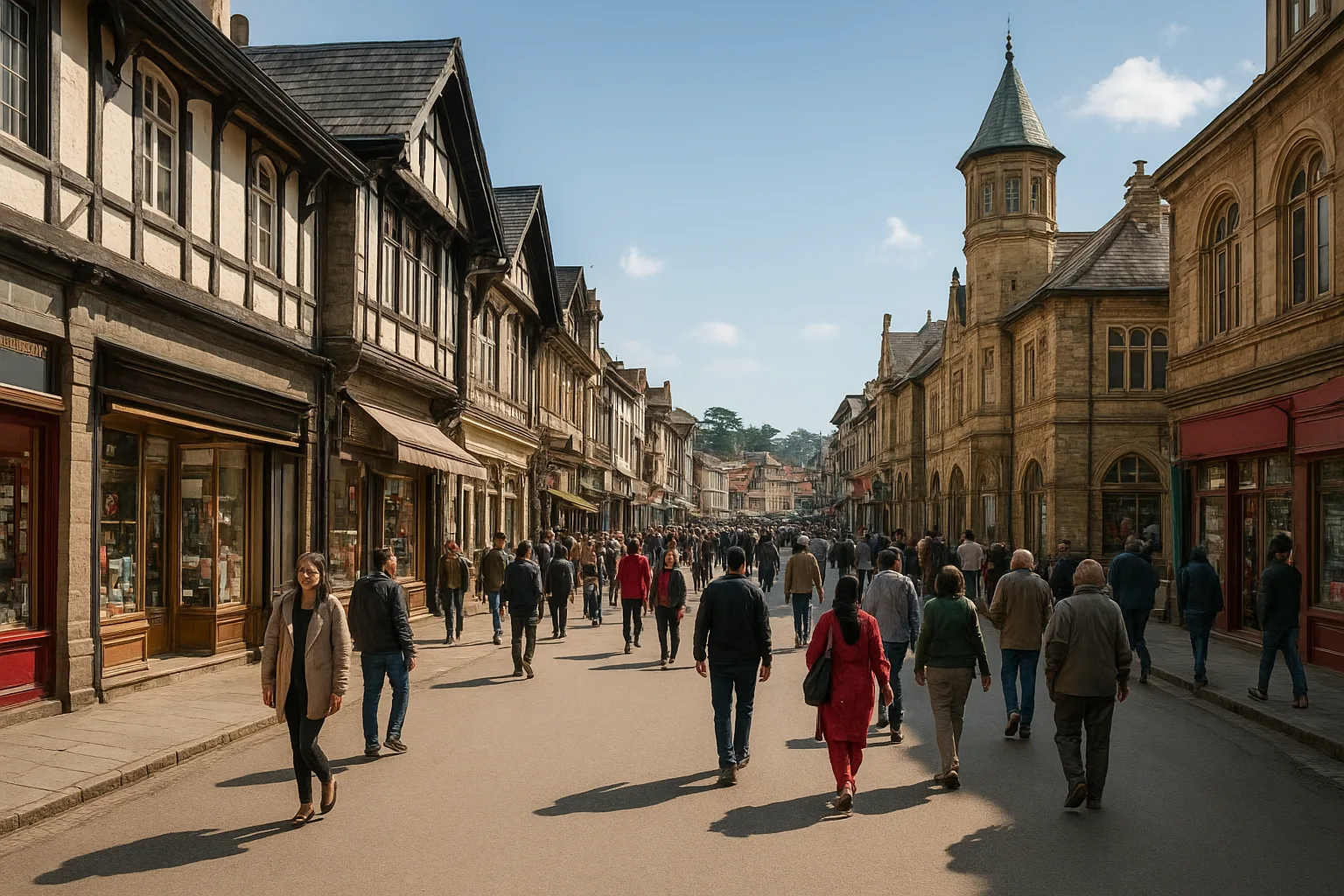
The buildings that rose along the Mall Road bore the imprint of British architectural ideals, adapted to the Himalayan context. Timbered facades, steep gables, and colonnaded verandas evoked the English countryside, while local stone and slate roof tiles anchored them to the hills. The Town Hall, completed in 1908, symbolized the administrative heart of the city; nearby, the Gothic spire of Christ Church dominated the skyline, its bells marking the passage of time for all below.
In these structures, the British sought both to reproduce and to reinvent the idea of “home.” Yet the Mall Road remained a liminal space—open to the winds and the gaze of the mountains, always shaped by the rhythms of Himalayan weather and the quiet persistence of local culture. The shops that lined the Mall—selling imported teas, woolens, and books—testify to a cosmopolitan ethos even as they reveal the economic hierarchies of the colonial order.
Political Nerve Centre: Decisions and Dissent
The Mall Road was not only the scene of social spectacle; it was the axis along which colonial power turned. Here, the annual migration of the Indian government from Calcutta (and later, Delhi) brought with it the machinery of imperial rule. The Secretariat, the Viceregal Lodge, and the offices along the Mall became sites of decision-making that shaped not only Shimla but the subcontinent beyond.
Yet, as the twentieth century progressed, the Mall also echoed with new voices. Indian nationalists, students, and reformers found subtle ways to challenge colonial authority—through meetings, pamphlets, and the symbolic act of walking where they were once forbidden. The Mall Road, meant as a bastion of imperial order, became a stage for the first stirrings of dissent and the complex negotiations of a society on the verge of change.
Continuity and Change: The Mall Road Today
Even now, the Mall Road remains Shimla’s beating heart. Its colonial buildings endure, weathered but resilient, while its benches and balustrades host generations of new visitors. The boundaries that once divided have softened, but the legacy of the British era persists in the city’s rhythms, architecture, and public life.
As we continue this series, the next part will follow the expansion of Shimla beyond the Mall—into its bazaars, outlying settlements, and the diverse communities that shaped the hill station’s unique urban character. The story of the Mall Road is thus not only a tale of the past, but a living thread connecting Shimla’s ancient ridges with its present-day pulse.
Previous: Architecture That Still Defines Shimla Today
Next: Political Decisions Made in Shimla That Shaped India