
Series: History of Mandi, Himachal Pradesh, India
Phase 3: Temples, Faith & Culture — Part 14 of 30
This article belongs to a historical series examining how expanding empires and regional powers reshaped life in the western Himalayan hills. As external influences pressed into the mountains, local rulers navigated diplomacy, resistance, and accommodation. This phase explores how wider political currents intersected with entrenched hill traditions, altering governance without entirely displacing older structures.
The Lake at Dawn: Where Mist Meets Legend
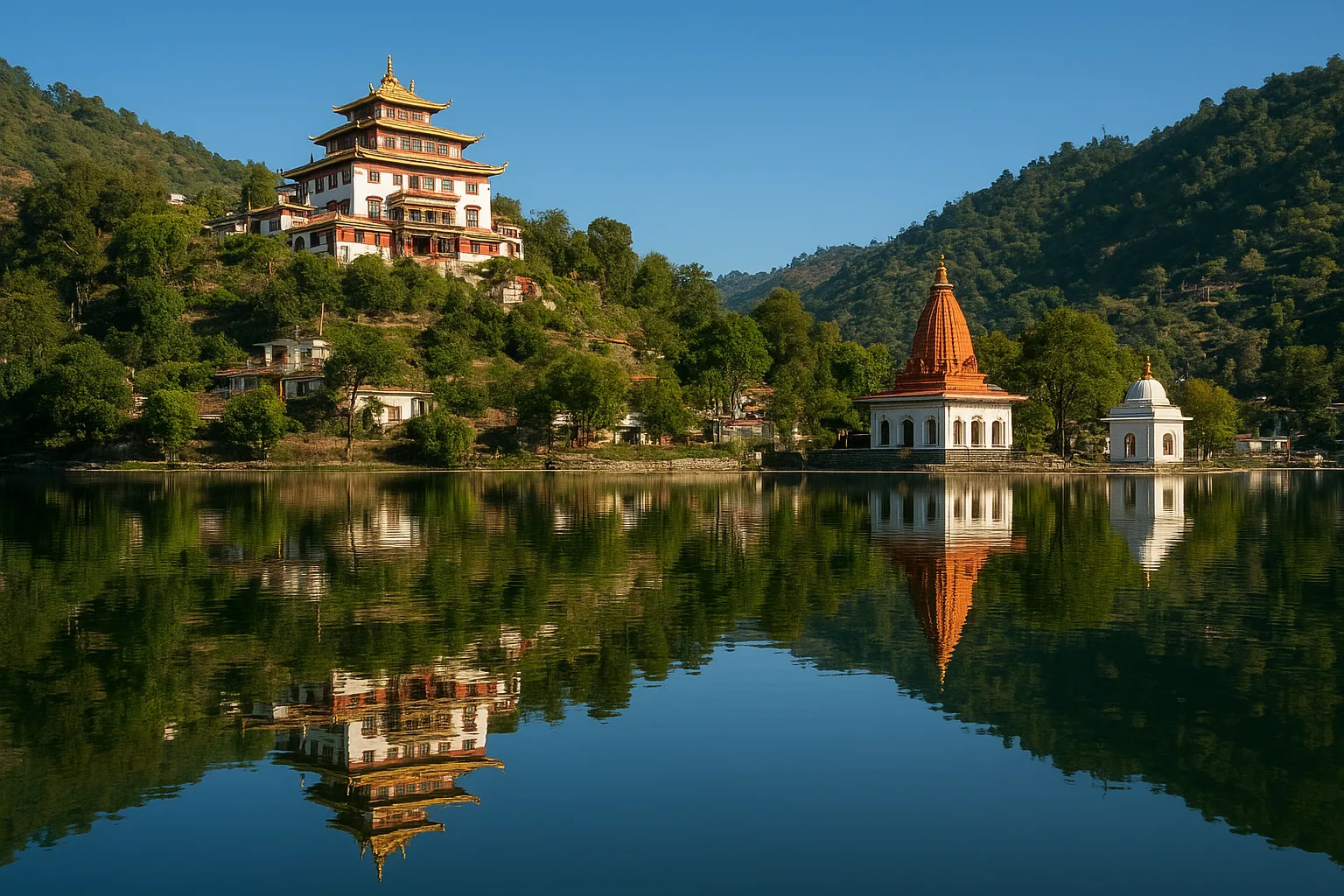
As the first rays of morning sun slip over the pine-clad ridges of Mandi district, the surface of Rewalsar Lake glimmers—a shifting mirror for clouds and prayer flags. Even today, the low hum of chants, the clang of temple bells, and the slow footfalls of pilgrims blend with the cries of Himalayan birds. It is a landscape thick with memory. Here, at nearly 1,360 meters above sea level, myth, history, and faith have converged for over a thousand years, shaping not only the spiritual identity of Mandi, but the very patterns of settlement, trade, and power across the Western Himalayas.
Mountains, Valleys, and the Cradle of Early Settlement
Long before the rise of the princely state of Mandi, these hills were home to indigenous clans—shepherds, farmers, and traders whose lives were bound to the rhythms of the Beas River and the forested slopes above. Archaeological finds in the wider region—stone tools, pottery shards, and terraced fields—hint at a continuum of habitation stretching deep into the prehistoric past. Oral traditions, passed down in Pahari dialects, speak of yak herders and forest spirits, echoing an era when nature worship and animist rites predominated.
With the gradual emergence of organized chiefdoms, the valleys around Rewalsar became a passageway between the Punjab plains and Tibet—the arteries of Himalayan exchange. Caravans laden with salt, wool, and turquoise would pause at the lake, a natural waystation before tackling higher passes. Already, Rewalsar had begun to draw travelers and seekers in greater numbers, its waters rumored to be blessed, its location auspicious.
Rewalsar in the Age of Faith: Myth, Memory, and Monument
The lake’s sanctity is woven from a tapestry of legend. According to local Buddhist tradition, it was here that Padmasambhava—known as Guru Rinpoche—performed miracles in the 8th century. The story, cherished by Tibetans and Himalayan Buddhists, tells of the king’s daughter, Mandarava, who chose the ascetic life despite her father’s wishes. When the king tried to burn Padmasambhava alive for his influence, a lake emerged miraculously from the pyre, and the guru reappeared, unharmed, upon a lotus. Hence the Tibetan name: Tso Pema, the ‘Lotus Lake.’
Hindu mythology, meanwhile, claims the sage Lomas meditated by these waters, and that the Pandavas of the Mahabharata wandered here during their exile. Centuries later, Sikh chronicles recount Guru Gobind Singh’s visit in the late 17th century, seeking support from local rulers against Mughal oppression. Each faith layered new meanings and monuments—stupas, shrines, gurdwaras—onto the landscape, yet none erased the stories that came before.
Documented Encounters: Chronicles and the Shaping of Place
By the 16th and 17th centuries, the hills around Rewalsar entered the record of Persian chroniclers and Rajput bards. Regional gazetteers—such as those compiled under British rule—describe the lake as a pilgrimage center attracting “lamas from Tibet, sadhus from the plains, and Sikh devotees from the Punjab.” The Mandi rulers, keen to legitimize their authority, patronized temples and monasteries, forging ties with both Buddhist lamas and Hindu ascetics. Stone inscriptions and copper plates, some still preserved in local archives, attest to grants of land and revenue for religious establishments.
These interactions were not always harmonious. Competing claims over sacred space sometimes led to conflict or negotiation. Yet more often, communities found ways to coexist, sharing festival days and rituals, maintaining the delicate balance that gave Rewalsar its unique character as a crossroads of faiths.
Trade, Transit, and the Making of a Hill State
The rise of the Mandi principality in the early modern period—first under the rule of Raja Ajbar Sen in the 16th century—brought new stability and patronage to the region. The Mandi rulers recognized the strategic and symbolic importance of Rewalsar. Control of pilgrimage routes meant not only spiritual capital, but economic and political advantage. The town of Mandi, with its bustling bazaar, grew as a hub for goods moving between Kashmir, Ladakh, and the Ganges plains.
Religious institutions benefited from royal endowments, and the eclectic spiritual life of Rewalsar was mirrored in the cosmopolitan atmosphere of Mandi itself. Tibetan merchants, Kashmiri artisans, Punjabi traders, and local Pahari farmers mingled in the shadow of the hills, their stories and faiths inscribed in the region’s architecture and oral lore.
Negotiating Identity: Rewalsar’s Living Heritage
Despite the tides of invasion, colonial intervention, and modernity, Rewalsar has maintained its magnetic pull. Annual fairs and processions continue to draw thousands—Buddhist monks circumambulating the lake, Hindu sadhus offering lamps, Sikh pilgrims reciting the Guru Granth Sahib. The air is thick with incense, the water shimmering with floating diyas. At the heart of it all stands the enormous statue of Padmasambhava, gazing serenely over the water—a 21st-century addition to an ancient landscape.
Yet, beyond the spectacle, Rewalsar remains a place where everyday life and sacred tradition intertwine. Local families recall tales of miraculous healings and generations of service at shrines. The weaving of prayer flags and ringing of gongs continue as they have for centuries, linking present to past in subtle, persistent ways.
Ancient Roots, Enduring Influence
To walk the shores of Rewalsar today is to sense the deep currents of history beneath the surface. The coexistence of Buddhist, Hindu, and Sikh communities is no accident—it is the product of centuries of dialogue, negotiation, and shared reverence for this remarkable place. The crosscurrents of belief and trade that shaped Rewalsar also shaped the wider Mandi region, setting the stage for the cultural and political developments that followed.
As we move forward in this series, we will turn our attention to Mandi’s architectural heritage—the temples, monasteries, and shrines that rose in the wake of this spiritual ferment, and the ways they continue to define the city’s landscape and soul.
Previous: Triloknath Temple: Architecture, Mythology, and History
Next: Mandi Shivratri Fair: Royal Origins and Cultural Legacy