
Series: History of Mandi, Himachal Pradesh, India
Phase 3: Temples, Faith & Culture — Part 15 of 30
This article belongs to a historical series examining how expanding empires and regional powers reshaped life in the western Himalayan hills. As external influences pressed into the mountains, local rulers navigated diplomacy, resistance, and accommodation. This phase explores how wider political currents intersected with entrenched hill traditions, altering governance without entirely displacing older structures.
The Riverbank Awakens: An Ancient Festival’s Dawn
In the chill of late winter, as dusk settles over the serpentine Beas River, the town of Mandi comes alive with a luminous spectacle. From temple courtyards to bustling market lanes, a tide of devotees, mendicants, and curious travelers converge, their voices rising in ancient hymns. The Shivratri Fair—Mandi’s annual heart—transforms the town into a tapestry of lights, deodar incense, and the pulse of drums echoing across stone ghats. It is a festival whose origins, though veiled by centuries, are deeply entwined with the rise of Mandi as a royal center, and with the faith traditions that have shaped Himachal’s hill societies for over a millennium.
Between Kingdoms and Rivers: Mandi’s Early Foundation
The valley that would become Mandi was, for centuries, a crossroads. Oral tradition speaks of clusters of small settlements, their houses perched above the river, connected by winding paths to the broader Himalayan world. The earliest written gazetteers—such as the Imperial Gazetteer of India—refer to the Beas valley as a fertile, strategic zone, home to diverse Pahari-speaking communities long before Mandi emerged as a capital.
By the 14th and 15th centuries, as the great trade routes between Central Asia and the plains of Punjab funneled wealth, ideas, and pilgrims through these hills, a mosaic of hill states began to crystallize. Among these were the princely domains of Suket, Kullu, and the fledgling state of Mandi, each ruled by dynasties claiming descent from ancient Kshatriyas. It was a landscape shaped by both oral myth and the slow accumulation of documented political power.
Myth, Memory, and the Deities of the Hills
The soul of Mandi’s Shivratri Fair lies in its devotion to Shiva—the ascetic lord of the mountains, revered by both villagers and kings. Yet the region’s religious landscape was never monolithic. From the earliest times, local traditions honored a pantheon of deotas (deities), each with their own shrines, processions, and legends. These deotas, according to oral accounts preserved in jagar songs and temple records, were often regarded as protectors of the land, their favor essential for the well-being of both crops and rulers.
It is against this backdrop that the cult of Shiva, embodied in the form of the Mahashivratri celebration, gained ascendancy. Early chronicles suggest that the royal house of Mandi, seeking both legitimacy and divine sanction, allied itself with the regional cult of Shiva, weaving together local and pan-Indian religious practices.
The Royal Mandate: From Palace to Procession
Historical records of the Mandi royal court—especially from the reign of Raja Ajbar Sen (c. 16th century)—describe a conscious effort to centralize both temporal and spiritual authority. The founding of the Mandi town itself, with its grid of temples and palaces, reflected this ambition. The annual Shivratri Fair, it is said, was formalized as a royal observance, with the king presiding over the gathering of hundreds of local deotas, each arriving in elaborate processions from surrounding valleys.
The earliest documented references to the fair as a political and religious summit appear in later Mughal-period accounts, which note the attendance of rajas, traders, and pilgrims from as far as Chamba and Kangra. The fair became a stage upon which the power and piety of Mandi’s rulers were displayed, their legitimacy reinforced by the visible blessings of Shiva and the assembled deities.
Shivratri as Cultural Epicenter: Rituals, Markets, and Music
Over the centuries, the Shivratri Fair grew beyond its royal and religious roots. By the 18th and 19th centuries, as documented in regional gazetteers and the journals of visiting British officials, the week-long festival had become a magnet for traders, musicians, artisans, and storytellers. Temporary bazaars crowded the riverbanks, offering silks, spices, and local crafts. Folk dramas—nautanki and raslila—enthralled audiences into the night, while ritual processions wound their way from temple to temple, culminating in grand assemblies at the Raj Mahal.
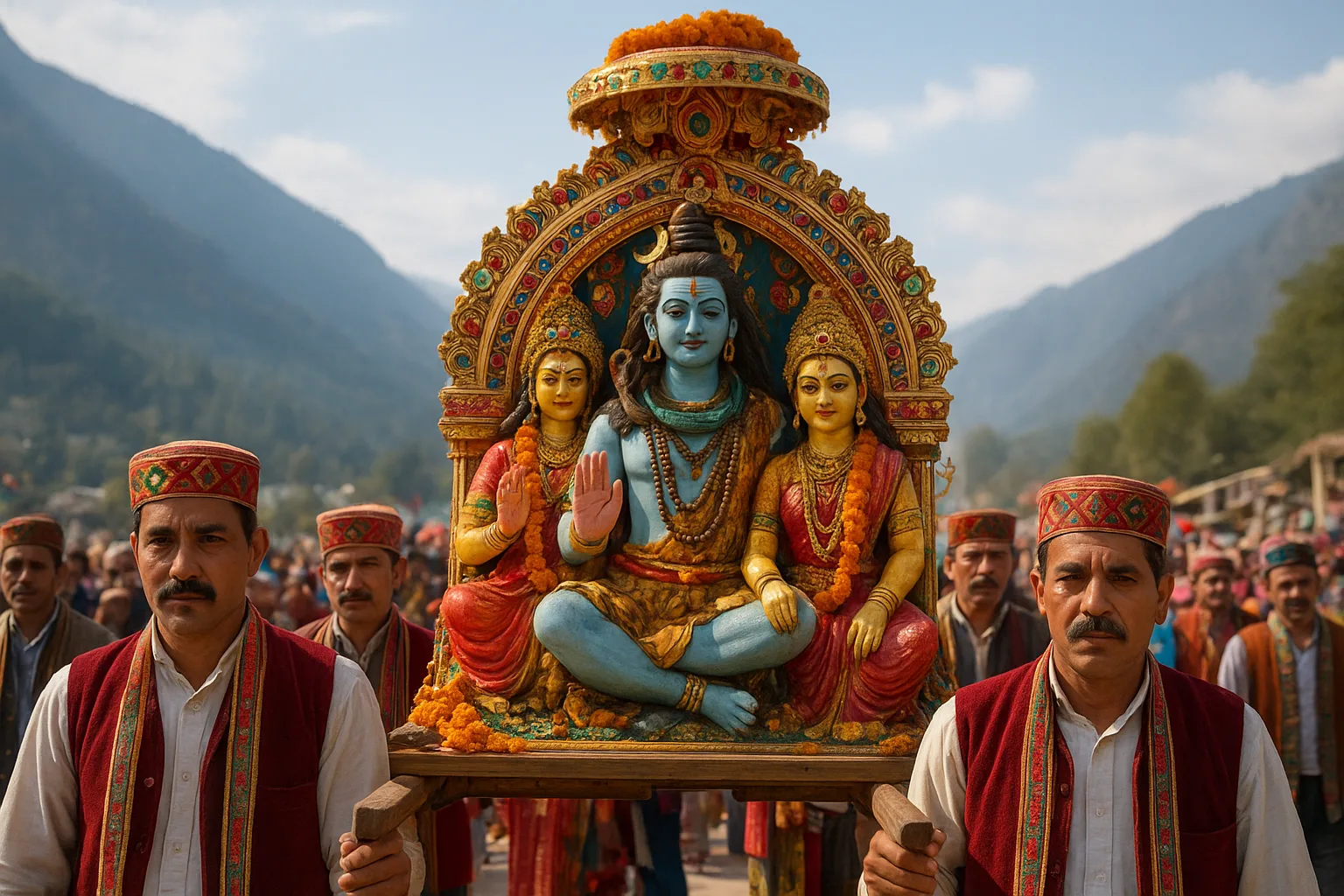
Yet even amid these festive excesses, the spiritual core of the fair endured. The arrival of the Shivling from the sacred Bhootnath temple, accompanied by the beating of nagada drums, was a moment of collective awe. For many, the fair was as much about reaffirming social bonds and ancestral loyalties as about commerce or spectacle.
Continuity and Change: Shivratri in the Modern Imagination
The 20th century brought profound transformation. The abolition of princely states after Indian Independence in 1947 altered the political landscape, but the Shivratri Fair survived, adapting to new realities. Local administrative bodies—often guided by old royal families—continued to oversee its rituals, ensuring that the ancient procession of deities, the fair’s most iconic tradition, remained unbroken.
Today, the fair draws thousands from across Himachal and beyond, blending the old with the new. Modern sound systems mingle with the chants of priests; smartphones capture moments once preserved only in memory. Yet the core ritual—the gathering of dozens of deotas in Mandi’s heart, each borne in palanquins and honored with offerings—remains deeply evocative of a time when local identity, royal patronage, and faith were indivisible.
Legacy on the River: The Fair’s Enduring Significance
The story of Mandi’s Shivratri Fair is, at its core, a story of continuity—of how the interplay between royal ambition, collective faith, and regional culture forged an institution that still shapes the town’s identity. To walk through the fair today is to hear echoes of ancient processions, to witness the living dance between history and myth that has defined Mandi for centuries.
As we move forward in this series, we will delve deeper into the living traditions of Mandi’s temples, exploring how their rituals and art forms preserve the memory of dynasties and deotas alike. The Shivratri Fair stands as both a monument to the past and a vibrant force in the present—an enduring testament to the power of belief in the Himalayan heartland.
Previous: Rewalsar (Tso Pema): A Sacred Crossroads of Three Faiths
Next: Mandi and the Mughals: Diplomacy, Conflict, and Survival