
Series: History of Shimla, Himachal Pradesh, India
Phase 3: British Era — Part 15 of 30
This article belongs to a historical series examining how expanding empires and regional powers reshaped life in the western Himalayan hills. As external influences pressed into the mountains, local rulers navigated diplomacy, resistance, and accommodation. This phase explores how wider political currents intersected with entrenched hill traditions, altering governance without entirely displacing older structures.
Stone, Fir, and Fog: Shimla’s Architectural Story Begins
On a brisk spring morning in the heart of the mid-19th century, the steep ridges of Shimla echoed with the sound of masons’ hammers and the scent of freshly hewn deodar. Yet, long before the British set their sights on this Himalayan outpost, these hills bore the quiet imprint of earlier settlements—each leaving subtle, enduring marks on the landscape. Shimla, perched at an altitude of over 2,000 meters in what is now Himachal Pradesh, has always been defined by its topography, its climate, and its evolving communities. The region’s distinctive architecture, now so closely associated with steep gables and timber-framed facades, is in fact the cumulative result of centuries of adaptation, negotiation, and cultural layering.
Ancient Patterns: Early Settlements and Sacred Spaces
Oral traditions in the Shimla hills recount the presence of small communities living in harmony with their rugged surroundings long before the British era. These were not cities in the modern sense, but clusters of wooden dwellings—often scattered along ridges, sheltered from fierce winds, and oriented toward sources of water. Early chronicles and regional gazetteers mention the presence of the Thakurs and Ranas, local chiefs whose authority was rooted in land and lineage. Their homes, constructed from timber and stone, were functional responses to seismic tremors and heavy winter snows. The temples they sponsored—such as the Jakhu Temple, whose origins are enveloped in myth—remained modest in scale but deeply significant to local belief systems.
Wood, drawn from abundant cedar forests, became both shelter and symbol. Carved panels and intricately notched beams, still visible in a handful of surviving shrines outside the modern city, speak to a tradition where architecture was inseparable from ritual and ecological necessity. These early structures rarely survive in their original forms, but their influence is still evident in the region’s vernacular buildings: sloped roofs, deep eaves, and raised platforms to protect from damp and snow.
Hill States and Trade: The Making of Regional Styles
By the late medieval period, Shimla lay within a patchwork of hill states—small but fiercely independent polities like Keonthal, Bushahr, and Koti. Political authority was diffuse, but each chieftain’s seat was marked by a fort or palace, often perched on a defensible knoll and surrounded by terraced fields. The architecture of these seats reflected a blend of indigenous forms and imported ideas, brought by itinerant craftsmen and traders who plied the old trans-Himalayan routes from the Sutlej valley to the plains below.
Gazetteers from the Raj record that local rulers favored stone and timber for their residences—materials that balanced strength with resilience. These structures, often rectangular or square, featured heavy wooden doors, small deeply set windows, and open courtyards. Temples from this era—such as those dedicated to the goddess Kali—were sometimes adorned with slate roofs and wooden balconies, their ornamentation revealing the slow infusion of motifs from neighboring regions. The arrival of Buddhist influences from the north and west is visible in some surviving iconography, though Hindu traditions remained dominant.
British Arrival: The Dawn of the ‘Queen of Hills’
Documented history records 1815 as a turning point, when the British East India Company asserted control over the Gurkha-held territories of the Western Himalaya. Shimla, then a sparsely populated village, entered the colonial imagination as a retreat—first for convalescence, then for the exercise of power. By the 1820s, British officers began building simple cottages, employing local craftsmen but borrowing heavily from home. These early bungalows, with their broad verandas and high-pitched roofs, were designed less for show and more for survival: to withstand monsoon rains, biting winters, and the ever-present risk of earthquake.
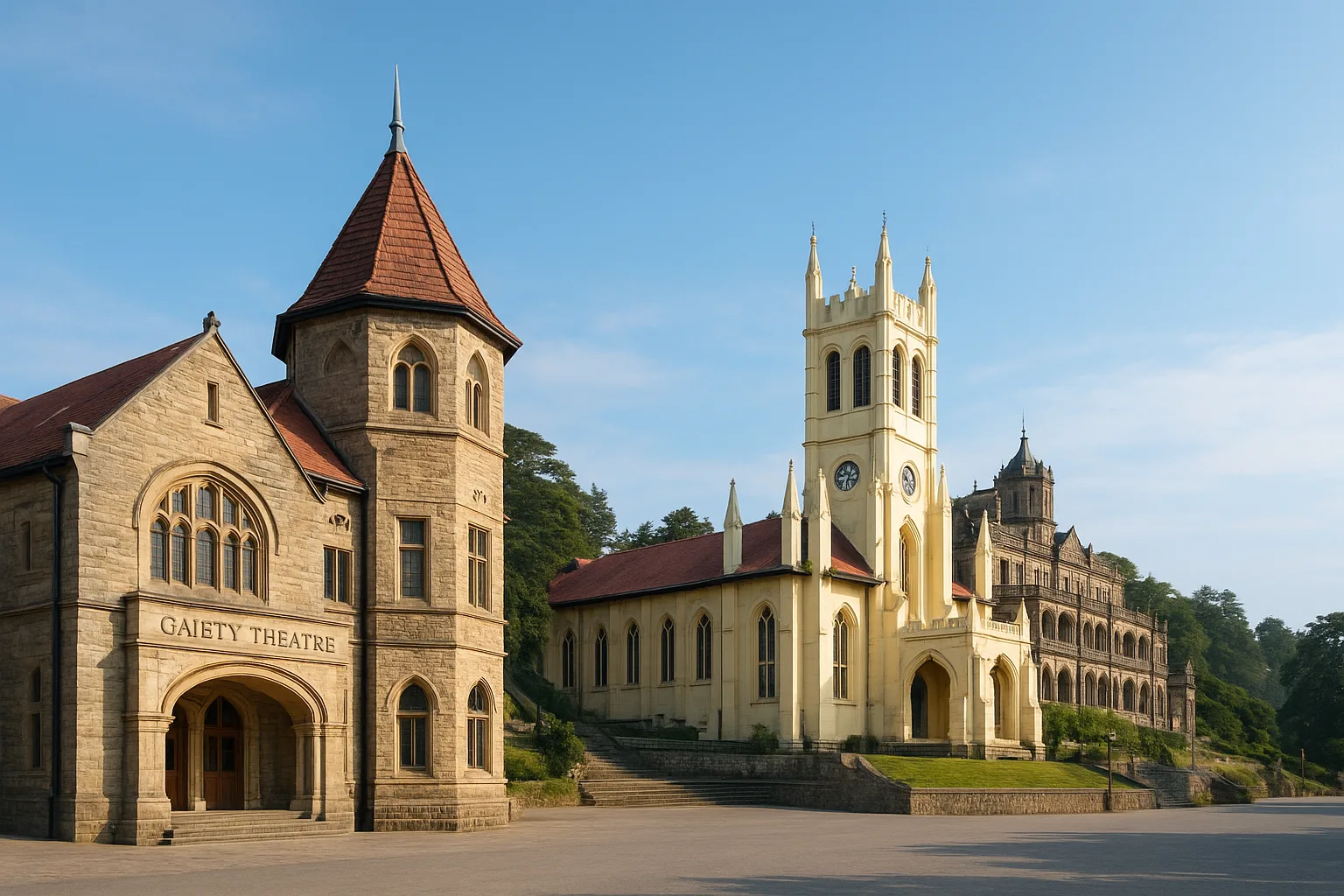
As Shimla’s stature grew and it became the summer capital of British India in 1864, its architectural landscape underwent a dramatic transformation. The town’s steep slopes became a canvas for ambitious public works: the imposing Viceregal Lodge (now the Indian Institute of Advanced Study), the Gothic spire of Christ Church, and the half-timbered facades of the Mall. Each drew inspiration from contemporary British trends—Tudor, Gothic Revival, Swiss Chalet—yet each was subtly modified by local builders to suit Himalayan realities. Stone retaining walls, deep foundations, and wide overhangs became the rule rather than the exception.
Craft, Labor, and the Hill Artisans
Behind the grandeur of Shimla’s colonial buildings stood generations of Pahari artisans—masons, carpenters, and laborers whose skills had been honed over centuries. Historical records indicate that many of these craftsmen were brought in from neighboring hill states and the plains, their knowledge of local materials and techniques proving indispensable in an environment both beautiful and unforgiving.
It was their hands that shaped the intricately carved doors of the Gaiety Theatre, their ingenuity that allowed the construction of the Kalka-Shimla Railway’s arched stone bridges. British architects may have drawn the plans, but it was local labor that realized them—often adapting European designs to ensure that buildings could endure the unique stresses of mountain life. This collaboration, sometimes fraught, sometimes generative, is evident in the subtle fusion of forms that characterizes Shimla’s built environment to this day.
Institutions, Civic Life, and the Growth of the Modern City
By the final decades of the 19th century, Shimla had become a city of institutions: government offices, schools, churches, clubs, and markets, each claiming its place along the contours of the ridge. The Ridge itself, now an iconic public space, was originally a parade ground, its flat expanse created by enormous human effort and careful engineering. The Town Hall, Gorton Castle, and the General Post Office—each stand as examples of how civic architecture in Shimla was designed to embody both imperial authority and a sense of community.
Yet the city’s architectural identity was not shaped exclusively by the British elite. Pahari, Punjabi, and Anglo-Indian communities all left their mark on the city’s neighborhoods, from the bustling bazars of Lower Bazaar to the quieter lanes of Chhota Shimla. Their homes and shops, while less grand than the public buildings, reflected the same imperatives: adaptation to climate, efficient use of space, and a deep respect for the landscape.
Continuity and Change: The Living Legacy of Shimla’s Architecture
Today, the skyline of Shimla remains defined by the silhouettes of its colonial-era buildings, but the rhythms of daily life unfold in structures both old and new. Many of the earliest wooden cottages have vanished, lost to fire or the demands of modern expansion, but the principles that guided their construction persist. Deep eaves, steep roofs, and the judicious use of local stone continue to inform new architecture, even as glass and concrete make their quiet incursion.
Shimla’s architectural legacy is thus a living one—rooted in ancient traditions, shaped by centuries of political change, and continually adapted by each new generation. The city’s buildings bear witness to a history of encounter, negotiation, and resilience: from the first clustered dwellings on wind-swept ridges, to the grand halls of empire, to the crowded streets of the present day. As we continue this series, the next part will explore how Shimla’s architectural heritage withstood the upheavals of the late colonial period, and how the transition to independence redefined the city’s built environment for a new era.
Previous: Life of the British Elite in Colonial Shimla
Next: The Mall Road: Social and Political Heart of British Shimla