
Series: History of Shimla, Himachal Pradesh, India
Phase 3: British Era — Part 18 of 30
This article belongs to a historical series examining how expanding empires and regional powers reshaped life in the western Himalayan hills. As external influences pressed into the mountains, local rulers navigated diplomacy, resistance, and accommodation. This phase explores how wider political currents intersected with entrenched hill traditions, altering governance without entirely displacing older structures.
Autumn in the Hills: Imperial Shadows Over Shimla
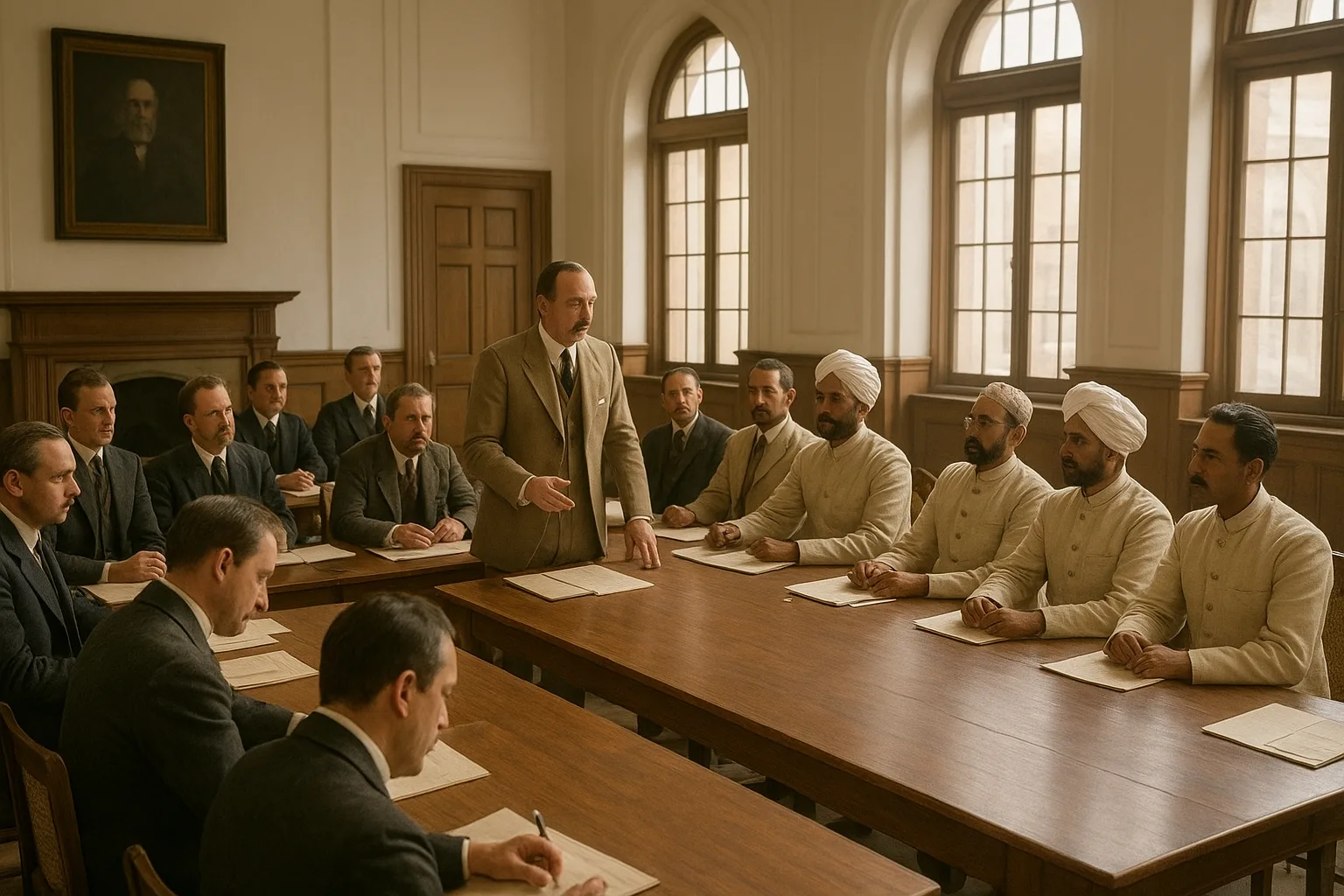
The air in Shimla during the autumn of 1914 carried a distinctive chill—not merely from the Himalayan winds, but from the tension that accompanied the arrival of British officials, Indian princes, and plenipotentiaries. The town’s narrow ridges, already transformed by decades of colonial architecture and etiquette, became the backdrop for some of the most consequential political gatherings in the subcontinent’s modern history. The grand salons of Viceregal Lodge flickered with lamplight as the future of millions was debated behind closed doors, while the forested slopes below bore silent witness to a new kind of imperial theatre.
Shimla’s Place in the Imperial Geography
By the early twentieth century, Shimla had been established as the summer capital of British India—a role it acquired formally in 1864, but which had deepened with every passing decade. The British administration’s seasonal migration to Shimla brought with it not only clerks and consular staff, but also political gravity. Official records from the Punjab Gazetteers and British administrative reports confirm that, by the 1900s, the town was the seasonal nerve centre of decision-making for both domestic governance and imperial strategy. The choice of Shimla as the venue for landmark conferences was thus neither accidental nor merely convenient; it was a deliberate assertion of colonial authority amid the serenity of the hills.
The First Shimla Conference: 1914 and the Frontier Question
The first of what would be known to history as the “Shimla Conferences” convened in the summer of 1914. This gathering, often shrouded in the language of diplomatic protocol, was in fact a high-stakes negotiation over the fate of the northern frontiers. British officials, representatives of the Chinese government, and delegates of Tibet assembled at the stately Viceregal Lodge. The matter at hand was the demarcation of boundaries between Tibet and British India, a question that had grown urgent with the shifting tides of Central Asian politics and the shadow of the Great War looming over Europe.
Contemporary chronicles and official minutes detail the protracted discussions that led to the drawing of the so-called McMahon Line—a boundary whose legacy continues to shape Asian geopolitics to this day. The conference ended without full Chinese ratification, yet it set a precedent for Shimla’s role in determining not just local, but transnational destinies.
Shimla as the Theatre of Imperial Negotiation
The selection of Shimla for such pivotal talks was itself a statement. The colonial administration sought to impress upon Indian leaders, foreign emissaries, and local rulers alike the majesty and order of British rule—a message reinforced by the imposing architecture, regimented social life, and the air of exclusivity that surrounded the town. In the eyes of contemporaries, as recounted in memoirs and gazetteers, Shimla stood as both a retreat and a crucible: a place where policy was crafted far from the turbulence of the plains, yet with consequences that would ripple across the subcontinent.
Beyond the diplomatic salons, Shimla’s bazaars and neighborhoods were alive with the routines of local communities—traders from the hills, workers from distant regions, and the indigenous Pahari inhabitants whose own histories and traditions had long defined the slopes and valleys of the region. While the great conferences played out above, the rhythms of daily life below offered a quiet counterpoint, reminding visitors that imperial politics unfolded upon older, deeper foundations.
The 1945 Simla Conference: A Nation at the Crossroads
If the first Shimla Conference was about borders, the most famous—the Simla Conference of 1945—was about the very notion of an independent India. By then, the war-weary British state was preparing for the possibility of withdrawal, and Shimla was again called into service as the venue for high-level talks. Lord Wavell, the Viceroy, invited the major political parties of India to negotiate a path forward for self-government. The Indian National Congress, the All-India Muslim League, and representatives of other communities arrived amid an atmosphere thick with expectation and anxiety.
Historical accounts and participants’ memoirs agree that the conference ultimately failed to yield consensus. The Muslim League’s insistence on exclusive representation for Muslims, and the Congress’s refusal to accept such terms, brought negotiations to a standstill. Yet the Simla Conference marked a critical turning point: it was one of the last, great attempts to find a constitutional settlement before Partition. The town’s hotels, gardens, and promenades became, for a brief summer, the crossroads of India’s political future.
Local Responses and the Unseen Majority
While the eyes of the world were on the negotiations, life in Shimla’s lower wards continued, largely untouched by the high politics of empire. Oral traditions preserved among the old families of Sanjauli, Summer Hill, and Kaithu recall the excitement, confusion, and sometimes the indifference that accompanied the arrival of dignitaries and their entourages. For many residents, the conferences were less about constitutional theory than about the disruptions—and occasional opportunities—brought by imperial attention. Local officials and merchants found themselves pressed into service for logistics, catering, and security, while the town’s infrastructure bore the strain of sudden influxes of visitors.
Yet even in the margins, the memory of these conferences has lingered in the collective consciousness of Shimla’s people. The hill town’s reputation as a site of history—where the fate of nations was debated over tea and telegrams—became part of its civic identity, shaping how later generations would understand their place in the broader narrative of India’s transition.
The Legacy of the Conferences in Postcolonial Shimla
In the decades since independence, Shimla’s grand halls and colonial facades have endured as reminders of the town’s imperial past. The Viceregal Lodge, now the Indian Institute of Advanced Study, continues to host scholars and seminars, while the echoes of high diplomacy linger in the city’s memory. The boundaries drawn and the decisions deferred in Shimla’s salons have had lasting consequences—not only for the political map of India and its neighbors, but for the rhythms of life and identity in the hills themselves.
Many Shimlaites today walk the same promenades as those who once shaped the course of empires, aware that the politics of the past remain woven into the fabric of the present. The debates that once filled the air—about representation, borders, and belonging—continue to resonate, transformed but not forgotten, in the stories told in marketplaces, schools, and homes.
Continuity and Change: Towards a New Shimla
The story of the Shimla Conferences is not merely one of imperial intrigue and diplomatic maneuver. It is a testament to the ways in which global history can be anchored in a particular place—a town in the Himalayan foothills whose fate became entwined with that of nations. As our series continues, we will trace how the end of empire and the dawn of independence reshaped Shimla’s society, politics, and cultural life, setting the stage for the modern era that followed. The legacies of those conference days endure, not as relics, but as living threads in the ongoing narrative of Shimla.
Previous: Political Decisions Made in Shimla That Shaped India
Next: Rise of Nationalist Sentiment in Colonial Shimla