
Series: History of Mandi, Himachal Pradesh, India
Phase 2: Medieval Kingdom & Dynasties — Part 9 of 30
This article forms part of a continuing series that follows the gradual emergence of organised power in the western Himalayas. As small communities gave way to clans, chieftainships, and hill states, patterns of rule, alliance, and conflict began to take shape. This phase examines how authority was negotiated through land, ritual, and warfare, laying the groundwork for regional kingdoms that would dominate the medieval landscape.
Twilight on the Beas: Echoes of Hill Kingdoms
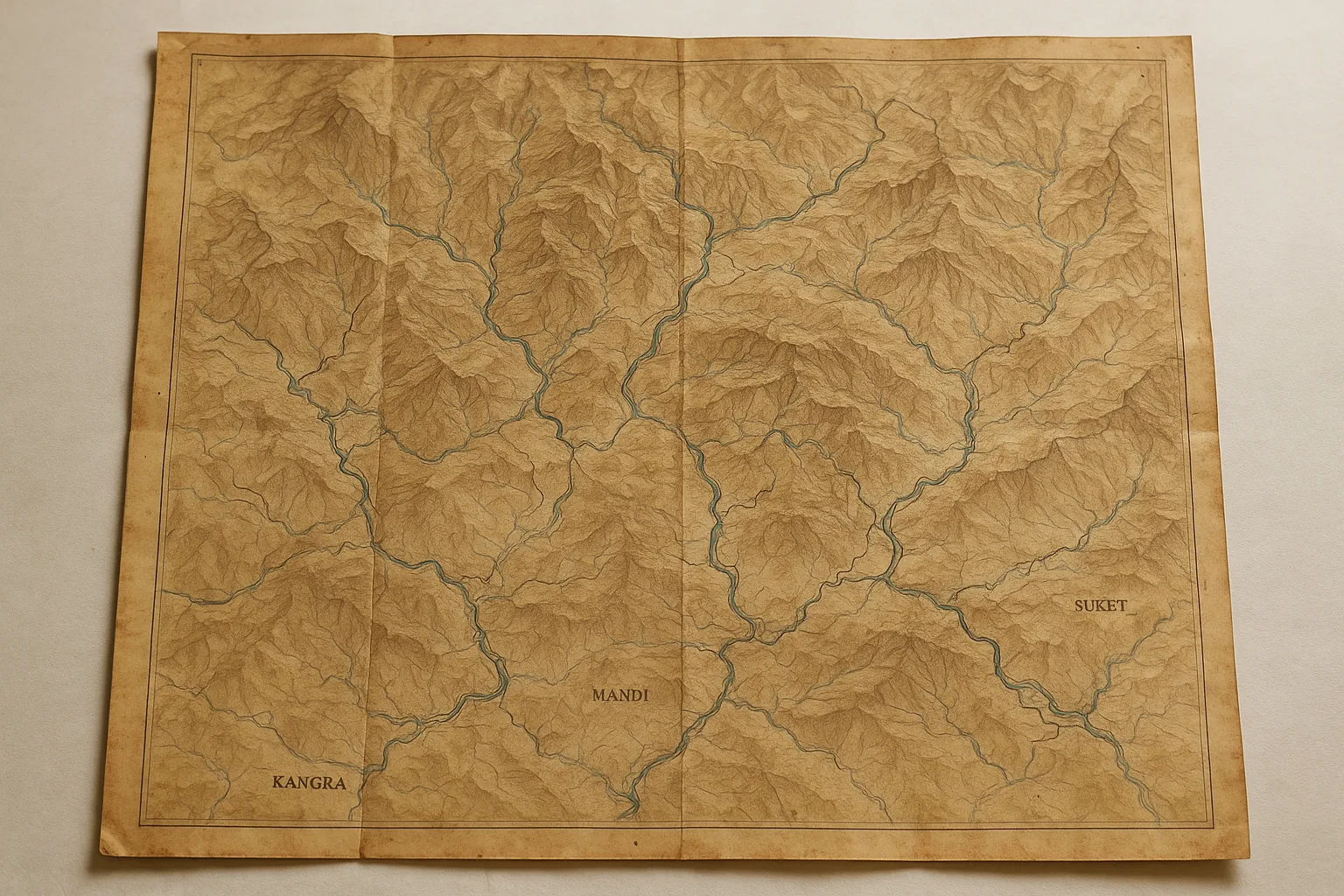
The air on the banks of the Beas River cools swiftly after sunset. In the shadow of steep pine hills, the town of Mandi stirs with memories older than its temples and stone ghats. For centuries, these valleys were crossroads—narrow passes and forested ridges connecting ambitious chieftains, pilgrims, and merchants. At the heart of it all was Mandi, whose fortunes rose and fell in rhythm with its neighbors: Kangra, Kullu, and Suket.
Origins: Myth, Memory, and Early Settlements
Long before stone palaces, the Mandi region was a tapestry of small settlements, river crossings, and sacred groves. Oral traditions among local communities speak of legendary founders and wandering ascetics. Some stories, still retold in village gatherings, link the early rulers to ancient Rajput lineages or even mythic figures—the Pandavas, or sage Mandavya, after whom Mandi is sometimes said to be named. Yet, historians caution that these tales, though cherished, are echoes of identity rather than verifiable fact.
What is clearer is that by the early medieval period—around the 10th to 12th centuries—a web of small principalities had emerged. The valleys were shaped by migration, clan alliances, and the slow spread of Hinduism and Buddhism. Early settlements clustered near rivers and trade routes, their life defined by seasonal fairs and the rhythms of agriculture. Over time, the region’s strategic location between the plains and the high Himalayas gave Mandi and its neighbors outsized significance in the politics of the hills.
The Rise of Neighboring Kingdoms
Kangra, to the northwest, was already famed for its fort and ancient temples at Nagarkot. Chronicles and regional gazetteers describe Kangra as a seat of power since the early medieval period, its rulers—descendants of the Katoch dynasty—commanding both fear and respect. To the east, Kullu’s lush valleys became an axis of trade and pilgrimage, with legends describing its founding as early as the 1st millennium CE. Suket, nestled between Mandi and Bilaspur, emerged as a smaller but tenacious state, its boundaries often fluid.
Mandi’s own political identity was shaped by these neighbors. As the hill states matured, rivalries and alliances constantly shifted. Marriages between royal families, tributary pledges, and the occasional border raid were all part of a delicate dance. While the earliest rulers of Mandi are partly shrouded in legend, chronicles such as the Gazetteer of the Kangra District and the writings of British administrators in the 19th century confirm that by the late medieval period, Mandi’s chieftains had asserted a distinct, if contested, authority.
Belief Systems and Cultural Exchange
The rivers and forests between Mandi, Kangra, Kullu, and Suket were as much spiritual frontiers as political ones. Pilgrims walked the same paths as traders and soldiers; deities from one valley became household gods in another. The worship of Shiva, Durga, and local deities like Kamaksha or Hadimba reflects centuries of syncretism. Buddhist influences, too, survived in place-names and ritual, a testament to the region’s ties with Tibet and Ladakh via high passes to the north.
Seasonal fairs—such as the Shivratri of Mandi and the Dussehra of Kullu—became occasions for both diplomacy and devotion. Rulers would host their counterparts from neighboring states, exchanging gifts and negotiating treaties in the shadow of temple spires. These gatherings fostered a shared hill identity, even as rivalries simmered beneath the surface.
Trade, Travel, and the Shaping of Boundaries
Medieval Mandi was never isolated. Ancient trade routes snaked through its valleys—north to Lahaul and Tibet, west to the Kangra plains, eastward toward Kullu and the Sutlej basin. Pack animals carried salt, wool, and precious metals; itinerant monks and storytellers brought news of distant courts. The control of these routes was a source of both wealth and conflict. Mandi’s rulers levied tolls, maintained waystations, and sometimes clashed with Suket or Kullu over lucrative passes.
Travel, however, was rarely without risk. Banditry and flash floods were common. Yet, these perils did little to break the web of exchange that bound the hill states together. The landscape itself—steep, forested, and unpredictable—shaped not only the politics but also the psychology of its people, fostering both independence and interdependence.
From Oral Tradition to Documentary History
As we move deeper into the medieval period, the sources become richer but also more complex. Royal genealogies, often written centuries after the events they describe, blend fact and legend. Persian chroniclers, Rajput bards, and later British officials each brought their own perspectives—sometimes admiring, sometimes dismissive—on the intricate diplomacy and warfare of the Himachali hills.
By the early 16th century, Mandi is reliably recorded as a semi-autonomous principality, its boundaries and status shifting in response to larger powers—first the Delhi Sultanate, then the Mughals. The interplay with Kangra, Kullu, and Suket was now documented in treaties, marriage alliances, and the occasional battle. Yet, the old rhythms persisted: trade caravans, pilgrim processions, and the ceaseless negotiation of identity on the frontier between kingdoms.
Legacies: The Roots of a Hill State
The story of Mandi’s relations with its neighbors is not just a chronicle of rulers and borders. It is a story of enduring connections—of communities linked by faith, commerce, and kinship, as well as rivalry. Modern Mandi still bears the imprint of these ancient ties: in its festivals, its dialects, and the resilience of its people.
As the series continues, we will turn to the age when Mandi’s independence was repeatedly tested by outside empires, and new dynasties left their mark on palace and temple alike. The echoes of Kangra, Kullu, and Suket will remain, a reminder that the fate of one hill state was always entwined with the destiny of the others.
Previous: How Mandi Emerged as a Powerful Hill Principality
Next: Fortifications and Military Strategy of the Mandi Kingdom