
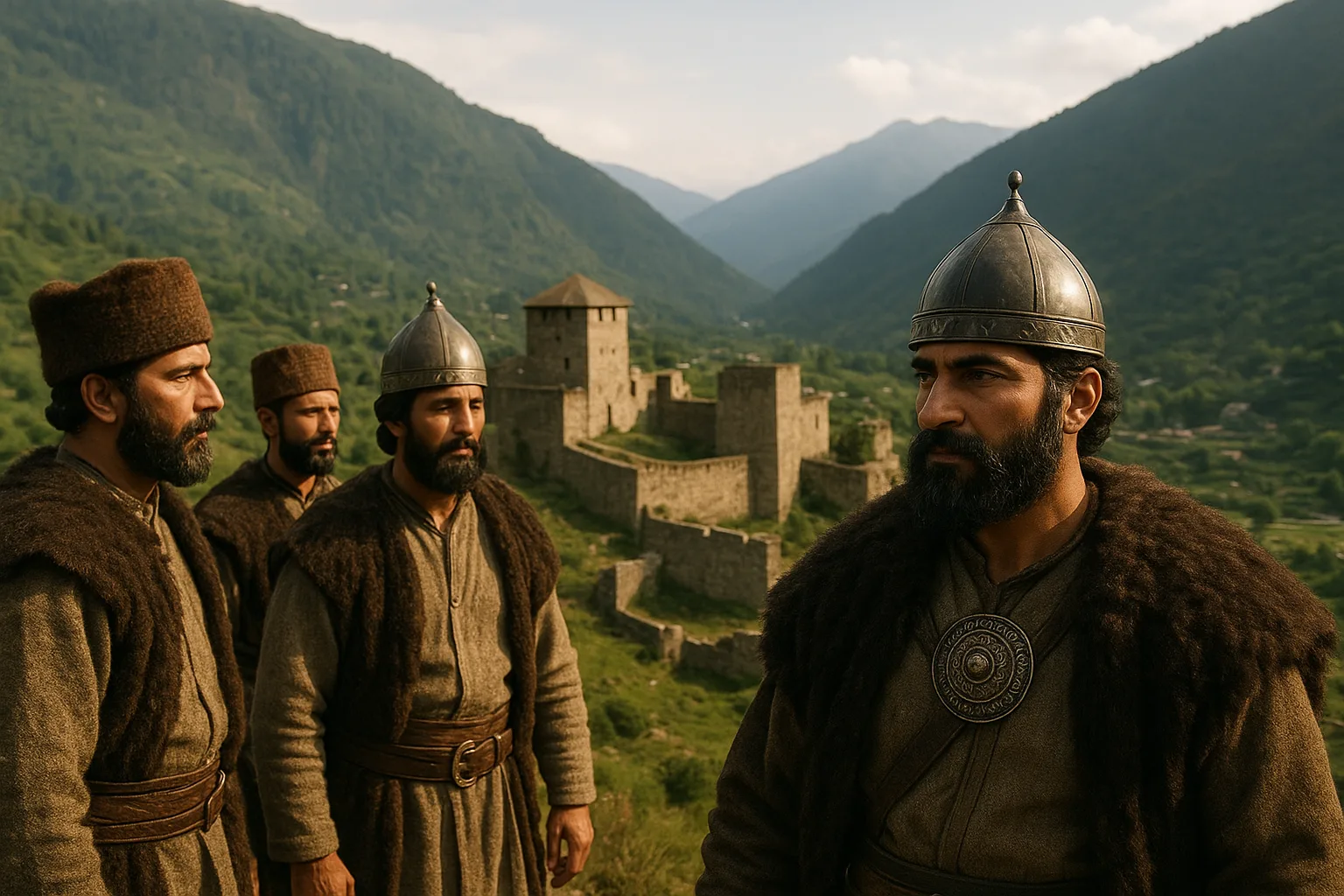
Series: History of Kullu, Himachal Pradesh, India
Phase 2: Medieval Kingdom — Part 7 of 30
This article forms part of a continuing series that follows the gradual emergence of organised power in the western Himalayas. As small communities gave way to clans, chieftainships, and hill states, patterns of rule, alliance, and conflict began to take shape. This phase examines how authority was negotiated through land, ritual, and warfare, laying the groundwork for regional kingdoms that would dominate the medieval landscape.
Twilight Among Cedars: Kullu’s Early Medieval World
As dusk settles across the winding valley, the sound of temple bells mingles with the chill wind that tumbles down from the higher snows. In the shadow of the Pir Panjal, villagers gather by the fire, repeating the names of ancestors—hill rajas, legendary warriors, and wise priests whose deeds still shape the rhythm of Kullu life. Somewhere between the world of myth and record, these figures form the roots of a region that, by the early medieval period, was already a crossroads of faith, commerce, and power.
Anchoring the Valley: Kullu’s Setting in Early History
Kullu’s strategic importance began long before any written chronicle. Cradled by the Beas River and hemmed in by snow-laden ranges, this valley offered both sanctuary and passage. By the 6th century CE, as the wider Indian subcontinent saw the decline of the Gupta Empire and the rise of regional powers, Kullu was emerging as a distinct hill domain. Early settlements, from the terraces above the river to high-altitude pastures, clustered around trade routes linking Tibet, Ladakh, and the Punjab plains. The valley’s remoteness fostered unique local identities, even as it drew influences from Buddhist, Shaivite, and animist traditions that crossed its mountain passes.
Echoes of Myth: Oral Traditions and the Shaping of Identity
Much of what we know about Kullu’s earliest rulers survives in the form of oral tradition, epics, and ritual performance. Local bards, or bajgi, recount the founding of the region by Vihangama, a mythical king sometimes linked to the Pandavas of Mahabharata fame. The legendary Raja Bahadur Singh, whose memory is celebrated during the Dussehra festival, is said to have invoked the favor of the valley’s tutelary deity, Raghunathji. These tales, while not strictly historical, provided a shared narrative for diverse clans and communities, reinforcing legitimacy and social cohesion in a land where kinship and ritual were often as binding as law.
From Legend to Record: The Rise of Hill Chiefs
By the 7th and 8th centuries, patterns of hill polity began to crystallize. Early references in Tibetan chronicles and later in Mughal-era gazetteers describe a patchwork of chieftaincies, each claiming descent from ancient lineages. The Kullu rajas emerged as first among equals, their authority rooted in both military prowess and the guardianship of sacred sites. Dynastic continuity, though often disrupted by internecine strife or external invasions, was maintained through careful alliances—marriages between noble houses, shared festivals, and oaths before local deities.
Documented history becomes clearer with the copperplate inscriptions and land grants (locally known as devta patras) from the 10th to 12th centuries. These reveal a society organized around village councils, temple trusts, and the authority of the thakur (chief), whose seat was often both a fortress and a place of worship. The Kullu rajas’ court, first at Jagatsukh and later at Sultanpur, became a focal point for administration, ritual, and dispute resolution.
Faith and Power: Belief Systems and Ritual Authority
More than in many neighboring regions, the rule of Kullu’s dynasties was inseparable from religious function. The valley’s deities, especially Raghunathji and Hadimba, were not distant cosmic powers but active participants in governance. Chiefs traced their legitimacy to the favor of specific gods, who were believed to speak through gur (oracles) during council. Decisions about war, alliance, and even taxation were often preceded by ritual consultation, binding the spiritual and temporal realms.
Meanwhile, Buddhist influences from nearby Lahaul and Ladakh introduced new practices and iconography. Stupas and monasteries dotted the upper valleys, coexisting with ancient Shaivite shrines and animist sacred groves. The syncretic nature of Kullu’s faith traditions gave rise to a resilient society, able to absorb outside influences while fiercely protecting its distinct customs.
Trade, Tribute, and the Web of Hill States
While Kullu’s isolation fostered independence, its prosperity depended on careful negotiation with neighbors and outsiders. The valley was a natural conduit for caravans carrying salt, wool, and precious stones from Tibet to the markets of Kangra and Punjab. Control of trade routes brought both wealth and vulnerability, as rival chiefs from Mandi, Lahul, and Spiti vied for access and tribute.
By the 13th century, Kullu had established itself as a principal hill state in the Western Himalaya. Yet its autonomy was always subject to the shifting politics of the region. Mandi’s rajas, for instance, often pressed their advantage through both diplomacy and force. The Mughal emperors, and later the Sikh chieftains, sent envoys and troops to extract tribute, though direct rule remained elusive due to the region’s forbidding terrain and strong local loyalties.
Communities and Social Fabric: Early Settlements and Kinship
Beneath the intrigues of high politics, the ordinary people of Kullu—herders, farmers, artisans—wove a fabric of daily life that was both pragmatic and deeply ritualized. Villages organized themselves around panchayats (councils) and seasonal festivals. The thakuri aristocracy coexisted with Brahmins, Rajputs, and the indigenous Kanet and Gaddi communities. Social mobility was limited, but not wholly absent; valor in battle or service to a powerful chief could elevate families across generations.
Settlement patterns followed the contours of the land: compact hamlets along river terraces, isolated monasteries on high ridges, and bustling fairs at crossroads. The rhythm of sowing and harvest, pilgrimage and trade, created a sense of order even as dynastic fortunes waxed and waned.
Legacy in the Stones: Kullu’s Medieval Roots Today
The legacy of Kullu’s medieval dynasties is inscribed in more than ruined forts or palace walls. It lives in the annual Dussehra, when the valley’s gods are paraded as sovereigns through Sultanpur. It echoes in the rights claimed by village councils, in the stories sung by bajgi, and in the cautious diplomacy that still marks Kullu’s relationship with neighboring valleys. The resilience, adaptability, and spiritual fervor of those early hill chiefs continue to shape the region’s sense of self.
As we follow the arc of Kullu’s history, the next chapter will draw us deeper into the era of consolidation—when the medieval rajas faced new threats and opportunities from expanding empires and shifting faiths. The valley’s story, like its rivers, flows on—shaped by the memory of chiefs who once ruled beneath the cedars.
Previous: Foundation of the Kullu Kingdom
Next: Political Relations Between Kullu and Neighbouring Hill States