
Series: History of Chamba, Himachal Pradesh, India
Phase 5: Modern Era — Part 29 of 30
This article appears within a continuing historical series that follows the western Himalayas into the modern era. With the end of princely rule and the integration into independent India, long-standing social and political patterns were reconfigured. This phase examines how development, state formation, and memory interact with inherited landscapes, shaping contemporary life while carrying forward echoes of the past.
Twilight in the Valley: Voices Around the Hearth
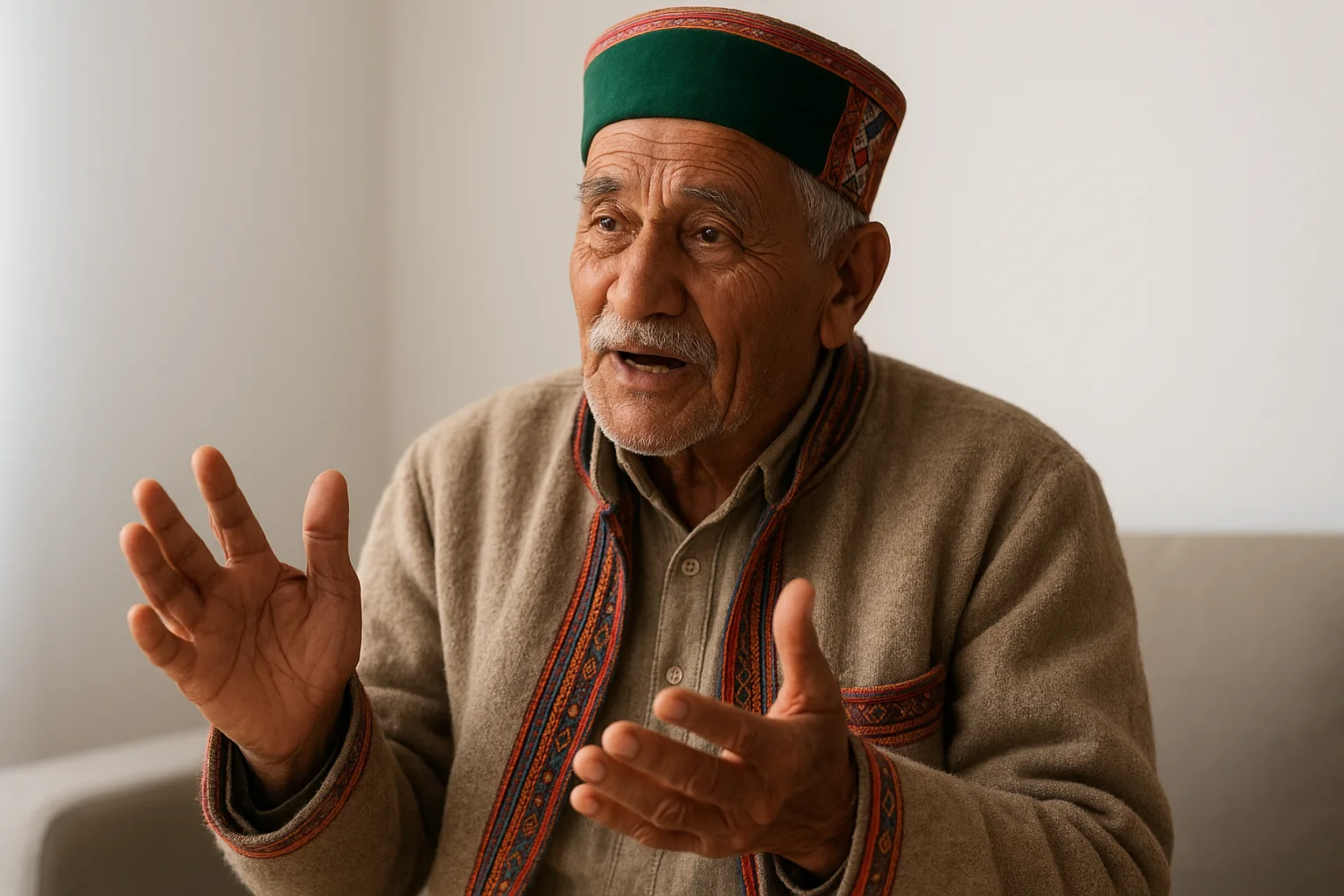
The sun slips behind the serrated peaks of the Dhauladhar range, casting a quiet glow over the old stone villages of Chamba. In the gentle hush of dusk, elders gather in courtyards and under sloped slate roofs, their voices carrying stories older than memory itself. Their words, shaped by mountain winds and centuries of tradition, offer a living archive—one that bridges the misty gap between myth and lived reality.
Here, in these Himalayan foothills, history was not always written in ink. It was spoken, sung, and handed from tongue to ear, generation after generation. The tales that echo tonight are both shield and mirror: protecting identity, reflecting change, and anchoring Chamba’s people to their land. To listen is to walk the boundary between the known and the imagined, where fact and fable intertwine.
The Land Before Scripts: Chamba’s Earliest Inhabitants
Long before the stone temples of Bhuri Singh rose and the records of British gazetteers chronicled the region, Chamba’s valleys teemed with communities whose names survive only at the edge of legend. The elders speak of the Khasas—their presence attested both in oral memory and in the earliest Sanskrit sources—who are said to have settled these hills, tending cattle and cultivating terraced fields as far back as the first millennium BCE.
These early inhabitants left no written chronicles. Instead, their legacy survives in the rhythms of seasonal festivals, in the meandering paths that once served as trade routes, and in the ancient place-names that still dot the landscape. Elders recall stories of mysterious stone menhirs and burial cairns on remote ridges, remnants of a culture that honored its dead with rituals echoing those found across the greater Western Himalayas. While the archaeological record is fragmentary, these oral traditions often align with what little material evidence remains.
Myth and Memory: The Founding Legends of Chamba
Among the most cherished tales is the origin of Chamba itself. According to local lore—told with pride and reverence by every generation—the region was once ruled by a king named Sahil Varman, who founded the town of Chamba in the late 10th century CE. The story goes deeper, entwined with the goddess Chamunda, who is said to have guided Sahil Varman to the site where the Ravi river bends and the valley opens—deemed auspicious for the new capital.
These founding myths, while rich in symbolism, are not mere flights of imagination. Early chronicles like the Rajatarangini and regional records such as the Tarikh-e-Riyasat Chamba reference a Varman dynasty and hint at the spiritual significance of the landscape. Yet, as elders recount the story, the boundary blurs: the goddess’s voice, the king’s vision, and the land’s destiny become inseparable. For the people of Chamba, these tales are not just allegories—they are lived truths that shape everyday identity.
Trade, Pilgrimage, and the Weaving of Connections
Chamba’s strategic position at the crossroads of ancient trade and pilgrimage routes is a theme that recurs in both oral history and written record. The elders recall ancestors who led caravans laden with salt, wool, and precious stones, traversing high passes to Lahaul, Ladakh, and beyond. These journeys brought not just prosperity, but new ideas, faiths, and technologies—stitching Chamba into a wider Himalayan tapestry.
Stories abound of itinerant sadhus, Buddhist monks, and traders who found sanctuary in Chamba’s valleys. The oral memory preserves not only the names of distant lands—Kashmir, Tibet, the Punjab plains—but also the customs and words they left behind. In these narratives, the Ravi river is both a physical artery and a symbol of flux, carrying the region’s people—and their stories—outward while drawing the world in.
Belief Systems and the Power of Place
Spirituality in Chamba is rooted as much in the stones and streams as in temples and texts. Elders tell of ancient deotas—local deities who inhabit forests, rocks, and springs—long before the rise of formalized Hindu or Buddhist worship. These beings, both feared and revered, still command a central place in village rituals and seasonal fairs.
With the arrival of new religious traditions, including Shaivism and later Vaishnavism, Chamba’s spiritual landscape became even richer. Oral traditions recall the building of shrines and the arrival of itinerant priests, while early chronicles and temple inscriptions from the 10th century onward provide a parallel, more concrete record of Chamba’s evolving faiths. Yet, the stories of the elders reveal how older beliefs were never fully erased—they were adapted, layered, and reinterpreted in ways that made sense to each new generation.
Emergence of Hill States: From Oral Tradition to Political Record
The transformation from loosely organized clans to structured hill states is a process woven through both memory and documented history. Elders recount tales of fierce chieftains—sometimes cast as demi-gods, sometimes as real men—who defended valleys and forged alliances through marriage, war, and ritual. These stories, passed down around winter fires, echo the events described in later chronicles and state records.
By the 10th and 11th centuries, the Chamba valley had emerged as a significant political entity, ruled by the Varman dynasty. The earliest copper plate inscriptions, preserved in local temples and referenced in regional gazetteers, confirm the existence of a centralized administration—tax collection, land grants, and the patronage of art and architecture. The elders’ stories are thus not just folklore: they are the living memory of a people who witnessed, and participated in, the birth of a state.
The Enduring Thread: Oral Histories in Modern Chamba
As the world outside Chamba changes with dizzying speed, the voices of the elders remain a vital link to the past. Their stories, shaped by centuries of hardship and hope, continue to provide meaning and identity for new generations. In village gatherings, at fairs, and in the quiet corners of old temples, these oral histories are still told—sometimes word for word, sometimes reshaped to meet the needs of the present.
Today, scholars, artists, and younger Chamba residents alike turn to these narratives for insight and inspiration. The blending of memory, myth, and fact that defines Chamba’s oral tradition is not a weakness, but a strength: it allows the region to hold onto its roots even as it grows and adapts.
Looking Forward: The Legacy of Living Memory
Chamba’s ancient roots, preserved in the words of its elders, continue to shape how its people see themselves and their place in the world. These stories—grounded in landscape, faith, and kinship—are as essential today as they were centuries ago. They remind us that history is not only written in stone or on the page, but also in the living voices of those who remember.
In the next chapter of this series, we will explore how these traditions and memories intersected with the arrival of colonial power, and how the encounter with the modern world transformed both the practice and meaning of oral history in Chamba.
Previous: Urbanisation and Cultural Identity
Next: Chamba’s Past, Present, and Future