
Series: History of Solan, Himachal Pradesh, India
Phase 5: Modern Era — Part 29 of 30
This article appears within a continuing historical series that follows the western Himalayas into the modern era. With the end of princely rule and the integration into independent India, long-standing social and political patterns were reconfigured. This phase examines how development, state formation, and memory interact with inherited landscapes, shaping contemporary life while carrying forward echoes of the past.
Twilight in the Hills: The Gathering of Memory
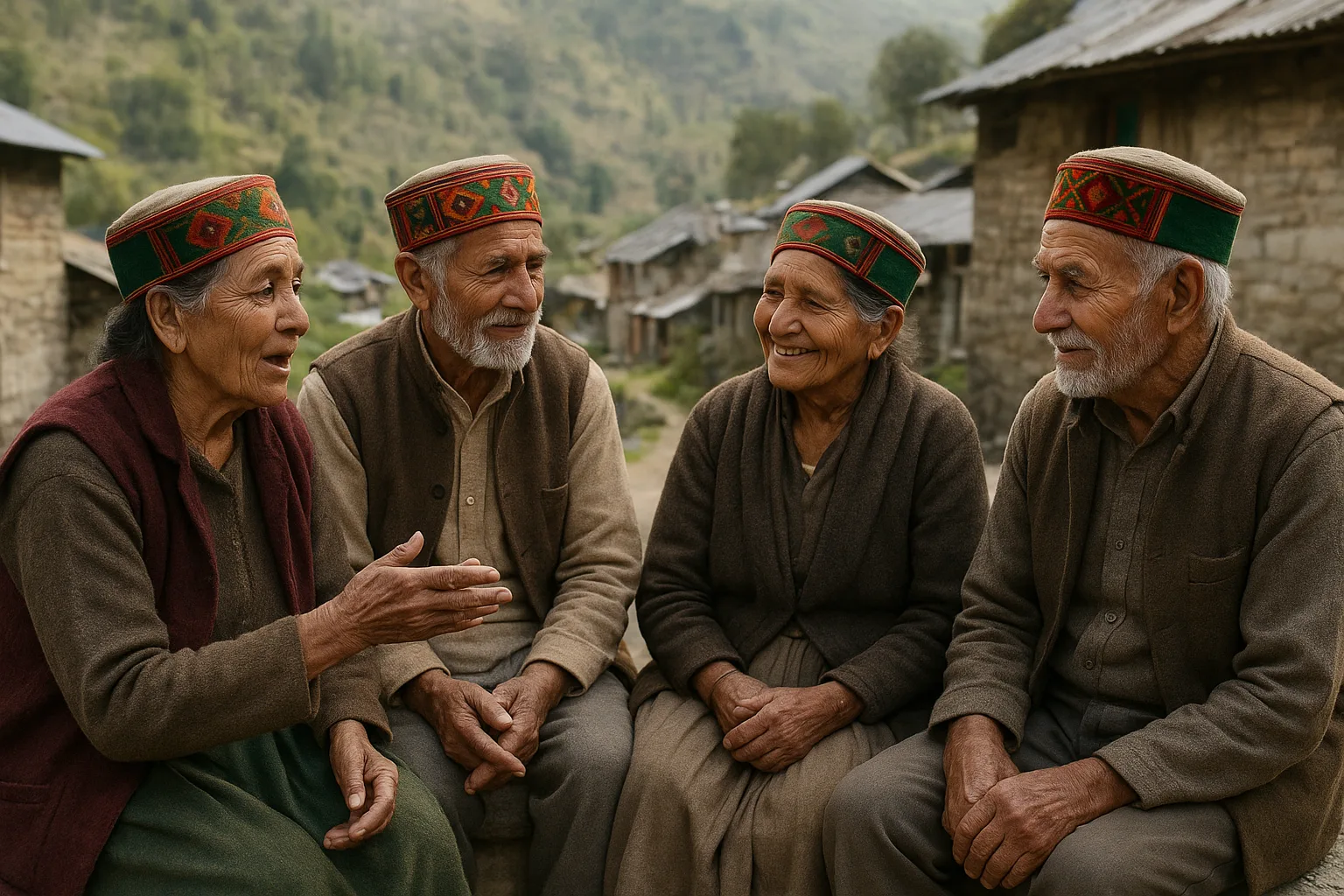
The sun dips behind the Shivalik foothills, casting a golden haze over the town of Solan. In the courtyard of a weathered colonial bungalow, a group of elders settle onto charpais, their voices rising and falling in the crisp air. Laughter mingles with the scent of pine and woodsmoke. Someone pours tea, and the oldest among them, Tula Ram, leans forward, his gaze steady. “Do you remember the day the train first whistled into town?” he asks. Heads nod. Someone hums the old tune played at the station that morning. In these moments, the town’s past—princely, colonial, tumultuous, and tender—comes alive through living memory.
The Princely Shadows of Baghat State
Before British rails and cantonments, Solan was a modest settlement at the edge of Baghat State’s domain. The elders recall tales told by their own grandparents—stories of Raja Amar Singh of Baghat and the grandeur of his durbar in Arki, then the princely capital. “My father spoke of the annual fairs,” shares Sushila Devi, her voice soft. “People would walk for miles to dance and trade under the watchful eyes of the Raja’s men.”
The Baghat rulers, though minor compared to their neighbors, shaped the rhythms of daily life. Taxes were collected in grain; justice was swift, dispensed under the shade of banyan trees. Oral accounts recall the devastation of the Great Famine of 1877, when villagers lined up outside granaries, and the Raja’s emissaries distributed what little rice remained. These stories, more than any document, color the lived realities of late-19th century Solan: a place both isolated and deeply connected to the pulse of hill politics.
Train Whistles and Tea Gardens: British Arrival
For many of Solan’s elders, the single most transformative event was the arrival of the Kalka-Shimla railway in 1902. “I was not there, but my uncle was a boy then,” says Prem Chand, eyes bright despite age. “He told me how the train’s whistle startled the monkeys and brought crowds from all the nearby villages. It changed everything.”
The British, eager for cool hill stations and strategic routes, transformed Solan into a cantonment and commercial node. Grand homes with sloping roofs rose beside the winding tracks. The establishment of the Solan Brewery in 1855, long before the railway, marked another turning point—stories abound of local workers learning new trades and of British officers hosting lavish parties. “We lived on the outskirts, but sometimes, when the wind was right, you could hear the music and laughter from the brewery,” laughs Ram Ditta, remembering tales passed down from his mother.
Tea gardens soon followed, carpeting the hills with neat, green rows. Women recall the labor—”baskets on our backs, sun on our necks, but at least the work was steady.” The elders’ memories capture both the hardship and the hope that came with these changes: new markets, new customs, and a town slowly waking to modernity.
Markets, Temples, and Everyday Rhythms
By the early twentieth century, Solan’s bazaar had become a vibrant artery of trade and gossip. Oral histories linger on the smells—fresh spices, hot jalebis, and the sharp tang of iron from blacksmiths’ forges. “My grandfather sold cloth in the old market square,” recalls Kamla Devi, her wrinkled hands miming the folding of fabric. “Business was good during festival time, especially when the Shoolini Mela brought everyone together.”
The Shoolini Devi Temple, perched above the town, is a recurring motif in every account. Elders remember walking barefoot up the stone steps, carrying garlands and offerings. “During the monsoon, the temple bells echoed across the valley,” says Hari Singh, his eyes misty. “It was sacred, but also our gathering place, where disputes were settled and news was shared.”
These memories frame Solan not as a static place, but as a living community—shaped by its rituals, its markets, and the slow, steady passage of time.
Winds of Change: Independence and Partition
The 1940s brought both excitement and fear to Solan’s quiet lanes. The elders’ stories echo with the tension of those years. As British rule waned, whispers of freedom and upheaval filtered up the hills. “We were children, but we knew something big was happening,” says Satya Prakash, recalling the night the tricolor was first hoisted in the bazaar. “Some danced, some wept. My father feared the violence in the plains would reach us.”
Partition brought refugees to Solan—families fleeing from Punjab and beyond. The elders remember the sudden influx of new faces, the hurried construction of shelters, the shared meals and whispered prayers. “My mother gave her only blanket to a woman who had lost everything,” recounts Sushila Devi. “We learned what it meant to truly share.”
Through their stories, the trauma and resilience of those years take shape—not in policy or maps, but in the stitching of new friendships and the forging of a broader Solan identity.
Building a Modern Town: Schools, Roads, and the Pulse of Progress
Post-independence, Solan changed rapidly. Oral accounts trace the construction of the first government schools, the arrival of electricity, and the paving of roads that linked the town more closely to Shimla and Chandigarh. “When the first bus came, it was like magic,” laughs Ram Ditta. “We piled in, all of us, just to ride up and down the main road.”
Education became a new beacon. Kamla Devi, among the first girls in her family to attend school, remembers the skepticism—”But my father insisted. ‘The world is changing,’ he said.” Their stories reveal the everyday struggles of modernization: learning to read and write, navigating new bureaucracies, and adjusting to the rapid growth of population and commerce.
The elders’ memories chart Solan’s transformation from a sleepy cantonment to a bustling district headquarters—a process marked not just by buildings and roads, but by changing aspirations and the slow emergence of a diverse, forward-looking community.
Stories of Resilience: Disasters, Recovery, and Hope
No account of Solan is complete without the shared memory of disasters—landslides that buried homes, fires that swept through markets, and the harsh winters that tested every family. “The landslide of ’77,” says Prem Chand, voice heavy, “we lost neighbours, but the whole town came together—digging, cooking, comforting. It was terrible, but it made us stronger.”
In these recollections, hope is a recurring theme. Memories of rebuilding, of neighbors helping neighbors, and of children playing in the ruins speak to the town’s enduring spirit. “We always rebuilt—sometimes with brick, sometimes with laughter,” Sushila Devi smiles. “No matter what came, Solan stood together.”
Passing the Torch: Elders as Living Archives
As twilight deepens, the stories wind down. The elders lean back, silent for a moment, each lost in their own memories. For the younger listeners, these tales are more than nostalgia—they are a living archive, carried in voices and gestures, in recipes and rituals, in the very streets and stones of Solan.
“Remember what we told you,” says Tula Ram, his gaze direct. “This is your story now.” The gathering disperses, but the stories linger—woven into the fabric of daily life, waiting to be retold on another cool evening.
The Living Legacy: Memory and Identity in Today’s Solan
Solan’s elders, with their troves of memory, have done more than preserve the past—they have shaped the present. Their stories remind us that a town’s history is not only found in books or monuments, but in the laughter around a courtyard, the rituals at a temple, the flavors of a market. Today, as Solan grows into a bustling hub, its sense of community and resilience owes much to these oral histories—a living bridge between what was, what is, and what might yet be.
Previous: Preserving Cultural Identity Amid Rapid Development
Next: Solan’s Past, Present, and Future