
Series: History of Solan, Himachal Pradesh, India
Phase 3: Religion & Culture — Part 15 of 30
This article belongs to a historical series examining how expanding empires and regional powers reshaped life in the western Himalayan hills. As external influences pressed into the mountains, local rulers navigated diplomacy, resistance, and accommodation. This phase explores how wider political currents intersected with entrenched hill traditions, altering governance without entirely displacing older structures.
A Dawn in Solan: Shadows on Cedar Beams
As the first rays of sunlight crest the pine-clad ridges above Solan, a hush settles over the old hamlets tucked beneath the hills. A gentle breeze stirs the prayer flags atop a centuries-old temple, and the scent of deodar wood mingles with the morning air. Here, in the heart of Himachal Pradesh, architecture is not only a matter of stone and timber—it is a living memory, a testament to generations who shaped their world with hands attuned to the rhythms of mountain life and the pull of faith.
Roots in Stone and Timber: Early Mountain Dwellings
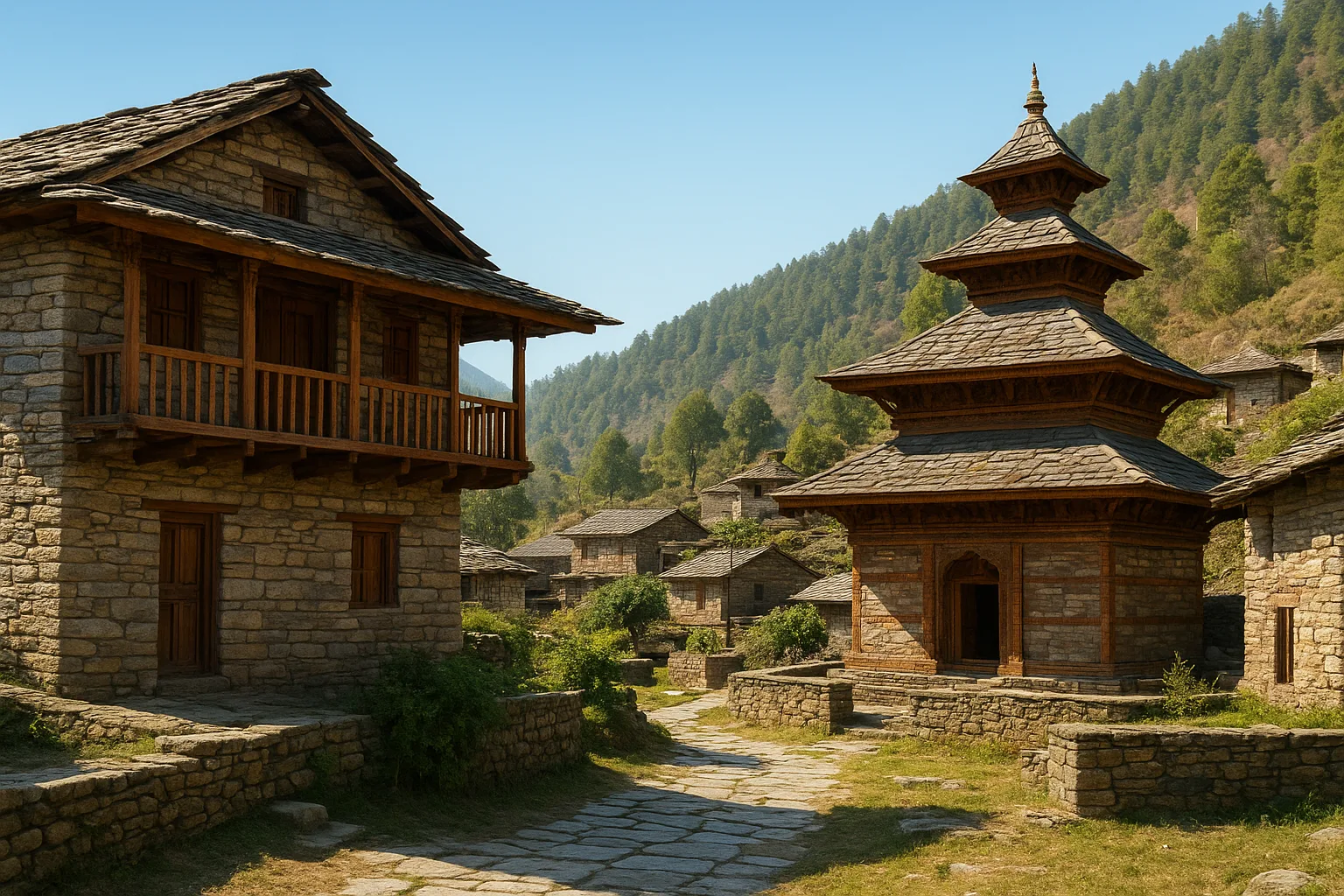
The story of Solan’s architecture begins centuries ago, when local clans carved a life from the slopes and valleys. The earliest homes, simple yet ingenious, responded directly to the land’s demands. Walls were built from abundant river stones, stacked carefully and mortared with mud. Roofs, pitched steeply to shed heavy monsoon rains and winter snow, were covered with thick shingles split from Himalayan cedar and slate. In the oldest villages—such as Kandaghat and Basal—you can still find these stone-and-timber structures, their foundations worn smooth by countless footsteps.
Family was at the heart of these homes. Interiors were compact, often comprising a single large room with a central hearth. Livestock might be housed beneath in a stable, their warmth rising through the floor during cold nights. Small wooden balconies overlooked terraced fields, and intricately carved brackets hinted at the skill of local carpenters. The house, in Solan, was not just shelter; it was a microcosm of community and tradition, shaped by the elements and the ancestral wisdom passed down through generations.
The Rise of the Kath-Kuni Tradition
By the 17th and 18th centuries, as trade routes expanded and communities grew, Solan’s architecture matured into a distinct vernacular known as kath-kuni. This style—meaning ‘wood corners’—wove together alternating layers of stone and timber, locked without nails or metal. It was resilient: houses flexed during earthquakes and stood firm against mountain winds. The method likely arrived with artisans from neighboring regions such as Kullu and Shimla, but Solan’s craftspeople made it their own, adapting the technique to the area’s specific needs and materials.
Wooden facades, ornately carved, became signatures of family pride. Motifs of lotus, peacocks, and mythical creatures adorned doorways and window frames, blending local folklore with Buddhist and Hindu symbolism. In the hamlet of Solan Gaon, elders still recall the legendary carpenter, Bhagat Ram, whose deft hands in the late 1800s left a legacy of homes renowned for their beauty and strength.
Temples: Guardians of Faith and Form
As faith threaded through daily life, temples emerged as both spiritual and architectural anchors in Solan. The earliest shrines were humble—simple stone circles, occasionally marked by a trident or sacred flag. But by the 18th century, grander vision took root. The Shoolini Devi Temple, dedicated to the town’s presiding goddess, became the centerpiece of religious and civic life. Its multi-tiered pagoda roof, wrapped in blue slate, reflected both Himalayan and Tibetan influences, a testament to centuries of cross-cultural exchange.
Temples in Solan were built not only to endure the elements but to embody cosmic order. Their sanctums faced east, catching the morning sun, while outer walls bore frescoes of epics and legends. Timber brackets and pillars, carved with stories of gods and heroes, supported roofs layered in protective tiers. During annual festivals, flames from countless lamps flickered across these carvings, bringing stone and wood to life in a dance of shadow and devotion.
Colonial Encounters: New Materials, Old Wisdom
The arrival of the British in the 19th century brought profound changes to Solan’s built landscape. As Solan became a waystation on the Kalka-Shimla railway in the 1900s, colonial bungalows and government buildings began to appear. These introduced brick, lime mortar, and corrugated iron, but even in these new forms, echoes of the region’s traditions persisted. British officers often hired local mistris (master builders), who adapted the classic kath-kuni methods to create hybrid structures—steep gabled roofs, broad verandas, and stone foundations, all attuned to the mountain’s temperament.
Perhaps none was as influential as Sir Henry Collett, the botanist who oversaw the founding of the Solan Brewery in 1855. His estate, with its careful blend of British and Himachali elements, became a model for future public buildings, including the stately Christ Church and the colonial-era schools that dot the town’s ridges to this day.
Modernity and Memory: Twentieth-Century Shifts
The decades following Independence in 1947 saw Solan’s population grow rapidly. Concrete and brick replaced much of the old stone and timber, as families sought more modern amenities and urban comforts. Yet, even as the skyline changed, a quiet reverence for traditional forms persisted. Many new homes, particularly in the old quarters, retained the classic sloped roofs and carved wooden balconies, blending utility with nostalgia.
Temples, too, evolved with the times. The construction of the Jatoli Shiv Temple in the late 20th century brought a revival of Himalayan architectural motifs, with its towering spire and intricate woodwork drawing pilgrims and visitors alike. Amidst the bustle of modern town life, these sanctuaries remained places of pause and continuity, where the sacred geometry of ancient designs still guided worship and celebration.
Craftsmanship and Community: The Human Touch
At the heart of Solan’s architectural story are its artisans—carpenters, masons, and painters whose skills were handed down like heirlooms. Their touch can be seen in the hand-carved eaves of village homes, the brightly painted temple doors, and the stone steps that wind through old neighborhoods. Festivals brought communities together to repair roofs, repaint shrines, and retell the stories etched in wood and stone.
In the 1970s and 80s, as urbanization threatened these traditions, local leaders and historians—such as Dr. Shyam Saran, whose tireless documentation preserved many oral histories—rallied to protect what remained. Their work inspired a new generation of builders and craftspeople to learn the old ways, ensuring that the architectural heritage of Solan would not fade quietly into memory.
Living Heritage: Solan’s Architecture Today
Walk through Solan today, and you’ll find a vibrant mosaic: gleaming modern apartments side by side with weathered village homes; ancient temples still alive with prayer, their cedar beams burnished by time. The legacy of traditional architecture shapes not only the town’s skyline, but its sense of self. Each carved balcony and temple spire is a reminder of the patience, creativity, and faith that define Solan’s story.
As development accelerates, debates continue over how to balance progress with preservation. Yet, the enduring presence of old homes and temples speaks to a deep-rooted resilience—a belief that the past is not a burden, but a foundation. In the next part of this series, we will explore the annual rituals and festivals that animate these sacred and domestic spaces, connecting architecture with living tradition in Solan’s ever-unfolding history.
Previous: Festivals That Shaped Community Life in Solan
Next: British Entry into the Solan Hills