
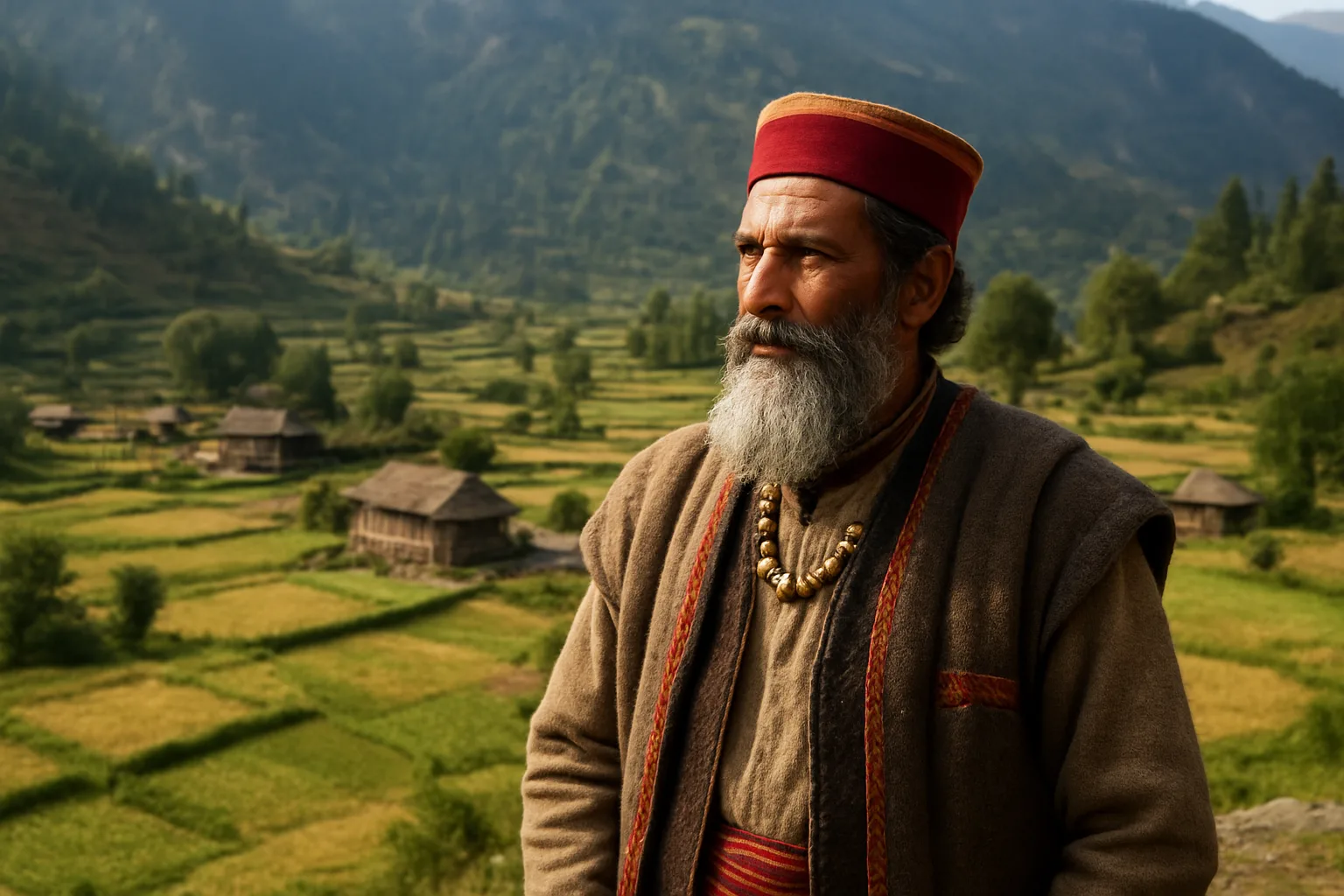
Series: History of Una, Himachal Pradesh, India
Phase 2: Medieval Period — Part 7 of 30
This article forms part of a continuing series that follows the gradual emergence of organised power in the western Himalayas. As small communities gave way to clans, chieftainships, and hill states, patterns of rule, alliance, and conflict began to take shape. This phase examines how authority was negotiated through land, ritual, and warfare, laying the groundwork for regional kingdoms that would dominate the medieval landscape.
Darkness Before Dawn: A Winter’s Night in Una
In the winter of 1378, as cold mist coiled along the banks of the Swan River, the fortress at Amb burst into life. Torches flared atop its ramparts. In the great hall, local chief Rana Shyam Singh weighed a message from his distant overlord—a demand for tribute and soldiers to support a looming campaign in the plains. Outside, villagers clustered in silence, their lives bound to the decisions made in that stone chamber. This single night, tense with uncertainty and ambition, reflected a pattern that would define Una for centuries: the delicate dance between local power and distant authority, between individual ambition and the grinding machinery of feudal administration.
The Roots of Regional Authority
Long before the Mughal Empire swept across northern India, Una’s identity was shaped by its position at the crossroads of the Shivalik foothills and the Punjab plains. As early as the tenth century, a mosaic of petty chieftains—known locally as ranas, thakurs, and chaudharys—emerged. Their domains clustered around strategic hilltops and fertile valleys, controlling trade routes snaking from Kangra to Anandpur Sahib.
These chiefs owed nominal allegiance to larger polities: the rulers of Kangra, and later, the powerful dynasties of Delhi. But in practice, the region’s fractured terrain and the ever-present threat of invasion demanded local initiative. Chiefs like those at Amb, Bangana, and Una town wielded near-autonomous authority over their subjects, combining judicial, military, and fiscal roles in a manner both pragmatic and personal.
Feudal Webs: Allegiance and Rivalry
The medieval world of Una was fundamentally feudal. Land was the currency of power, and its control was fiercely contested. Ranas and thakurs carved out estates—jagirs—by martial prowess or royal favor, granting plots to loyal retainers and extracting revenues from the peasantry. In return, these chiefs were expected to supply troops to their suzerains when called, a system that blurred the lines between landlord and military commander.
But loyalty, in Una as elsewhere, was never absolute. Chiefs frequently shifted allegiances, playing the ambitions of the Kangra rajas against incursions from Delhi or, in later centuries, against the rising Sikh principalities to the south. Oral traditions recall the bitter rivalry between the chiefs of Amb and the neighboring Jaswan estate, whose border disputes were legendary in the fourteenth and fifteenth centuries. These conflicts often spilled over into open skirmishes, reshaping the region’s boundaries and sowing seeds of inter-clan enmity that would echo for generations.
The Human Face of Feudal Rule
For the people of Una, the rule of local chiefs was both immediate and deeply personal. Justice was dispensed in open courtyards, where the chief sat beneath a neem tree or in the shadow of a mud-brick fortress. Taxes—primarily in grain, but sometimes in labor or livestock—were collected by a network of village headmen and retainers, many of whom were kin to the ruling family.
Yet feudal administration was not solely coercive. Chiefs were expected to protect their subjects from bandits, arbitrate disputes, and sponsor local temples. The building of water tanks, the organization of seasonal fairs, and the maintenance of trade paths all fell under their purview. In times of drought or famine, a chief’s generosity—or lack thereof—could make the difference between survival and ruin for entire hamlets.
Influence from Afar: Delhi, Kangra, and Beyond
Medieval Una did not exist in isolation. Its chiefs navigated a complex hierarchy that stretched from the local to the imperial. The region’s proximity to Kangra meant periodic oversight by Kangra’s rulers, whose courtly rituals and administrative reforms trickled down to local practice. When the Delhi Sultanate asserted control in the thirteenth and fourteenth centuries, Una’s chiefs walked a careful line: paying tribute when compelled, but jealously guarding their local prerogatives.
The chronicles of Timur’s 1398 invasion, as recounted in Persian histories, suggest that local chiefs like those of Una offered both resistance and accommodation, weighing their survival against the shifting tides of power. With the emergence of the Mughal Empire in the sixteenth century, the relationship between Una’s feudal lords and their distant masters became still more intricate—one marked by negotiation, adaptation, and, at times, open defiance.
Enduring Symbols: Forts, Customs, and Memory
The architectural legacy of Una’s feudal age is still visible today. The crumbling walls of forts at Amb and Bangana, the ruined stepwells, and the scattered temples all testify to the resources and ambitions of medieval chiefs. Even family names and local festivals preserve echoes of this era: many prominent clans trace their ancestry to the ranas and thakurs who once ruled these hills.
Traditional councils—panchayats—draw inspiration from the judicial assemblies presided over by feudal chiefs. Rituals of hospitality, the distribution of land, and patterns of social hierarchy all bear the imprint of centuries of feudal administration. Oral histories, passed from grandparent to child, still recount tales of wise or tyrannical chiefs and the battles that shaped village boundaries.
Legacy and Reflection: The Shape of Modern Una
As we reflect on the story of Una’s local chiefs and their feudal administration, the region’s present-day character comes into sharper focus. The bonds of kinship, the respect for local autonomy, and the persistent pride in ancestry all trace their roots to this formative period. Even as democratic institutions and modern governance have supplanted the authority of hereditary chiefs, the memory of their rule lingers—both as a source of local identity and as a cautionary tale of power’s responsibilities.
In today’s Una, the legacy of medieval chiefs can be glimpsed in the resilience of its communities, the symbolism of its festivals, and the landscape itself. The hills and rivers that once marked the limits of feudal domains now connect a region whose history continues to shape its sense of self—a reminder that the past is never truly past, but part of the living fabric of Una’s present.
Previous: Una During the Medieval Hill–Plains Interface Era
Next: Village Life and Economy in Medieval Una