
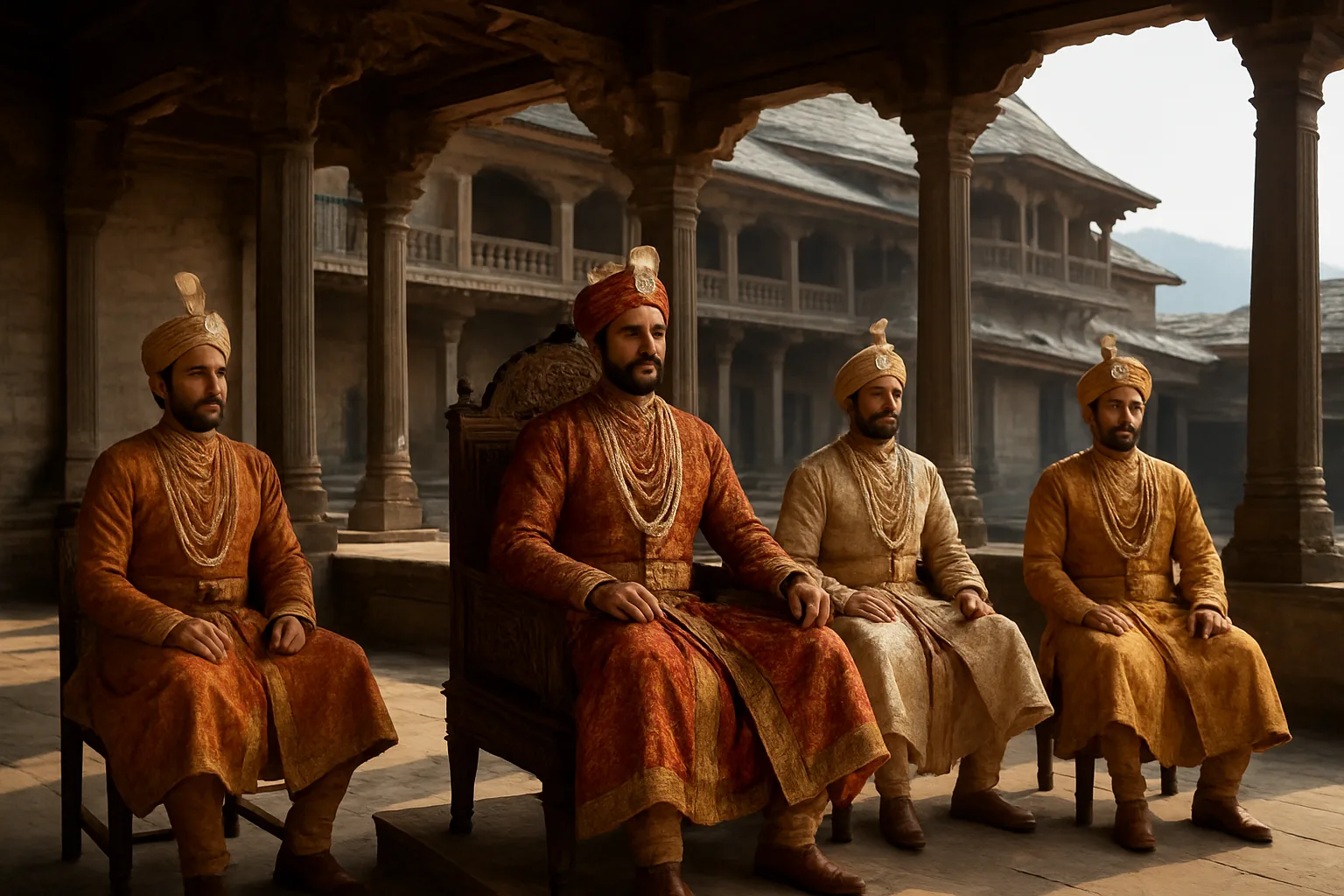
Series: History of Sirmaur, Himachal Pradesh, India
Phase 2: Medieval Kingdom — Part 7 of 30
This article forms part of a continuing series that follows the gradual emergence of organised power in the western Himalayas. As small communities gave way to clans, chieftainships, and hill states, patterns of rule, alliance, and conflict began to take shape. This phase examines how authority was negotiated through land, ritual, and warfare, laying the groundwork for regional kingdoms that would dominate the medieval landscape.
The Quiet Dawn Over Sirmaur’s Valleys
In the cool mists of a Himalayan morning, the valleys of Sirmaur stir with the echoes of a distant past. Picture the gentle slopes above the Giri and Tons rivers, where ancient footpaths once wound through cedar forests, connecting scattered hamlets to bustling trade routes below. It is the early second millennium CE—a time when the shadow of empires loomed over the plains, yet in these hills, a new chapter was quietly unfolding. Out of this landscape, the first Rajput chieftains would emerge, their rule woven into both legend and the stonework of crumbling forts still standing today.
From Myth to Memory: Sirmaur’s Early Foundations
The story of Sirmaur’s royal line is as much myth as it is memory. Oral traditions, still told in village courtyards, claim the region’s foundation by Raja Rasaloo, a figure both heroic and elusive, said to have arrived from distant Rajasthan. These tales—rich in adventure and moral lessons—reveal early aspirations for legitimacy and grandeur. But historians, drawing on regional gazetteers and the earliest recorded chronicles, find little direct evidence for such legendary kings. Instead, they trace Sirmaur’s roots to the gradual consolidation of local clans, likely of Rajput origin, who established hill chieftaincies as the early medieval period dawned.
By the 11th and 12th centuries, the shifting mosaic of northern India—marked by the decline of major dynasties and the arrival of new powers—created both peril and opportunity. The hills offered sanctuary for displaced warriors and ambitious nobles. Sirmaur, with its defensible ridges and hidden passes, drew those seeking autonomy and new beginnings.
Communities and Clans: The Early Social Fabric
Long before the rise of the Rajput houses, the lower Himalayas were home to indigenous communities—Kolis, Gujjars, and pastoralist groups—who left their mark in local place names and seasonal festivals. As Rajput clans entered the region, often through marriage alliances or conquest, a new social hierarchy began to crystallize. The hill Rajputs, sometimes called Thakurs, blended their martial ethos with the rhythms of mountain life, ruling over villages that still valued collective custom and kinship as much as royal decree.
These early rulers did not arrive as strangers. Many adopted local dialects, worshipped at ancient shrines, and depended on the agricultural and artisanal expertise of the people. The result was a society marked by both continuity and change: the persistence of old beliefs alongside the assertion of new authority.
Trade, Faith, and the Emerging Hill States
Sirmaur’s geographic position placed it on the margins of several worlds. To the south, the plains of Punjab and Haryana beckoned with trade and the threat of invasion; to the north and east, the high passes of Jaunsar and Garhwal promised access to salt, wool, and distant markets. Medieval trade routes—some likely following older, Buddhist-era paths—linked Sirmaur’s river valleys to bustling bazaars and sacred sites.
Belief systems, too, reflected these crossroads. Shaivism and Shaktism flourished in the hills, with ancient temples marking the landscape from Nahan to Haripur Dhar. Oral traditions suggest that Sirmaur’s rulers styled themselves protectors of dharma, commissioning shrines and sponsoring local rituals. Yet, the persistence of animist practices and ancestor worship hints at deeper cultural layers, predating even the Rajput ascendancy.
The Rise of the Sirmaur Rajput Dynasty
By the late 13th century, the outlines of a true Rajput kingdom began to emerge. Chronicles preserved in the Imperial Gazetteer of India and regional riwaj-i-am (customary law records) point to the consolidation of territories under a single royal house, later known as the Sirmaur dynasty. The earliest historically attested ruler, Sobha Chand, is credited with uniting scattered settlements and building fortifications that commanded key river crossings.
These Rajput rulers styled themselves as Rajas, tracing genealogies to ancient Kshatriya lines—even as they forged new identities rooted in the hills. Their court at Nahan, perched above the Giri river, became both administrative center and symbol of dynastic continuity. The Sirmaur Rajputs, unlike their plain-dwelling cousins, governed through a delicate balance of force and negotiation, forging alliances with neighboring hill states like Jubbal, Bushahr, and Keonthal.
Conflict, Diplomacy, and the Medieval Hill Realm
The medieval period was marked by both opportunity and challenge. Sirmaur’s kings navigated the ambitions of powerful neighbors—most notably the Mughal Empire to the south and the restless chieftains of Garhwal to the east. Records from the 16th and 17th centuries describe cycles of raid and reprisal, tribute and rebellion. Fortresses such as Sirmuri Tal and Haripur Dhar became staging grounds for both defense and expansion.
Yet, the Rajput dynasties of Sirmaur rarely ruled as absolute monarchs. Their authority depended on the loyalty of local zamindars (landholders) and the support of priestly lineages. Courtly patronage of artisans, scribes, and bards helped to cement their legacy, producing genealogies and ballads that survive in the oral tradition to this day.
Legacy of the Rajputs: Ancient Roots, Modern Resonance
The Rajput dynasties did more than carve out a kingdom—they forged an enduring identity for Sirmaur. The stone fortresses, village customs, and festivals that define the region today all bear the imprint of those centuries of rule. Even now, the royal family’s lineage is remembered with reverence during local fairs, and the echoes of Rajput valor are invoked in times of communal challenge.
As Sirmaur moved into the early modern era—facing new forces, from Gorkha invasions to British colonial ambitions—it did so carrying the layered legacy of its medieval Rajput past. In the next part of this series, we will trace how these ancient roots shaped the kingdom’s response to the upheavals that swept the Himalayas in the centuries that followed.
Previous: Foundation of the Sirmaur (Nahan) Kingdom
Next: Nahan: The Capital That Shaped Sirmaur’s Identity