
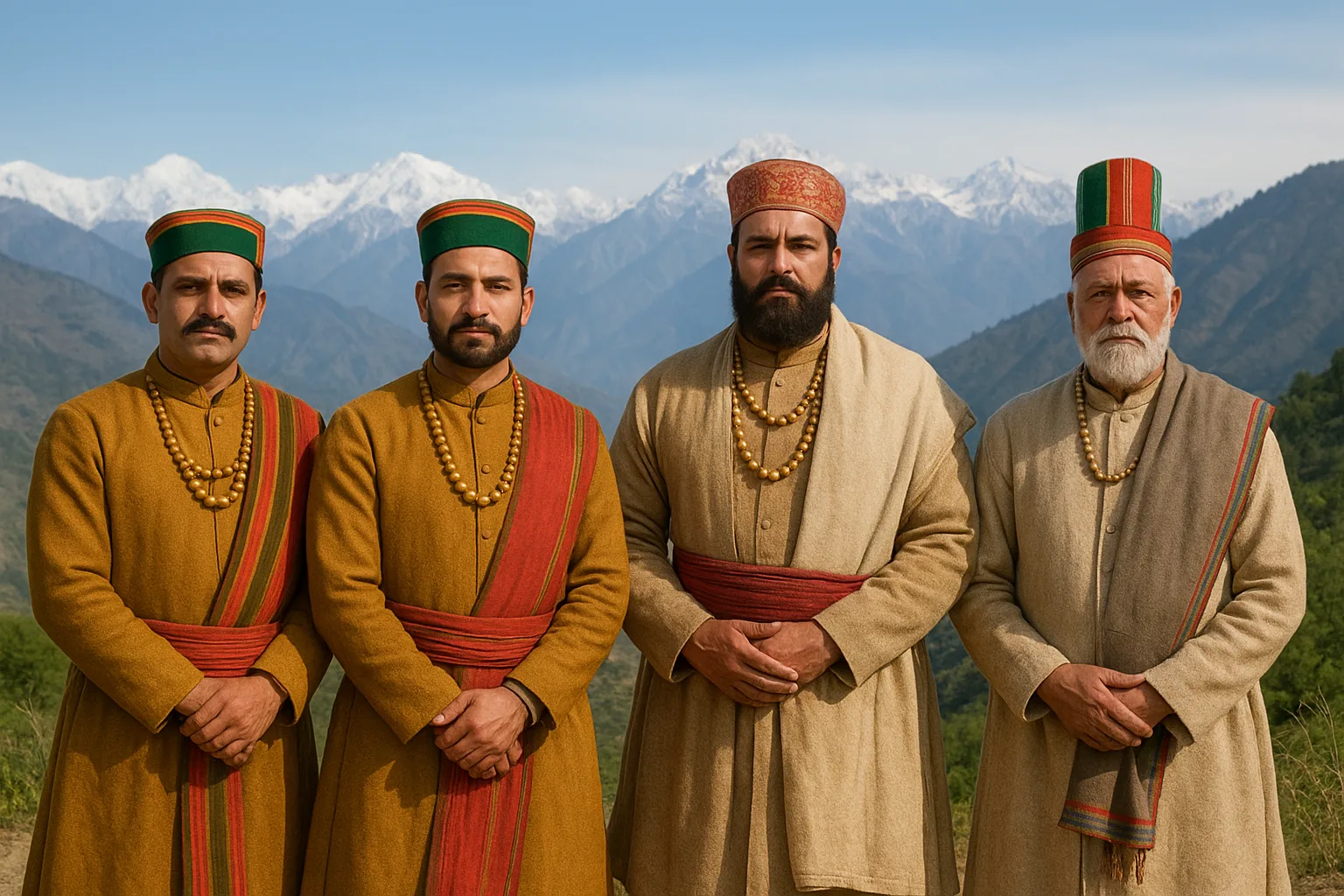
Series: History of Sirmaur, Himachal Pradesh, India
Phase 2: Medieval Kingdom — Part 6 of 30
This article forms part of a continuing series that follows the gradual emergence of organised power in the western Himalayas. As small communities gave way to clans, chieftainships, and hill states, patterns of rule, alliance, and conflict began to take shape. This phase examines how authority was negotiated through land, ritual, and warfare, laying the groundwork for regional kingdoms that would dominate the medieval landscape.
In the Shadow of Peaks: Sirmaur Before the Kingdom
The monsoon mist curls through the lower Shivalik hills, cloaking the ancient valleys of Sirmaur in a hush broken only by the call of distant herders. Here, centuries before the clangor of great armies or the rise of stone-walled towns, small communities eked out a living amidst forests and riverbanks. This is where our story begins: not with a king, but with the land itself—a crossroads between the Himalayas and the vast Indo-Gangetic plain.
By the first millennium CE, the region that would become Sirmaur was a tapestry of scattered settlements, shaped by the Sutlej and Yamuna rivers and the trade routes that threaded north from the plains. The world beyond these hills was already in motion: Gupta and post-Gupta polities had left their imprint on the plains, but in the valleys, social memory was shaped less by chronicles and more by oral tales, sacred groves, and local alliances.
Oral Traditions and the Veil of Myth
For generations, the earliest history of Sirmaur has lived in the cadence of stories whispered around hearths. Local tradition speaks of the Pandavas’ exile in these hills, of sages meditating by the streams, and of miraculous springs said to have emerged at their touch. These legends, preserved in Pahari ballads and temple rituals, weave Sirmaur into the larger mythic geography of the Himalayas—a sacred landscape linked with the Mahabharata and ancient epics.
Yet, for the historian, these stories are both a gift and a challenge. They illuminate how communities saw themselves—as custodians of a land favored by gods and heroes—but they do not yield precise dates or verifiable events. Still, even as myth, these tales shaped the emerging identity of Sirmaur, providing a shared memory that would prove vital when new rulers sought to legitimize their claims.
Early Settlements: Communities and Beliefs
Long before the birth of the Sirmaur kingdom, the region’s hills and valleys hosted a mosaic of communities: pastoralists, small farmers, and artisan groups. Archaeological evidence remains sparse, but patterns of settlement suggest a continuity of habitation dating back to the early centuries CE. The Giri and Bata rivers, with their fertile banks, supported pockets of agriculture, while upland pastures drew the Gaddis and Gujjars, known for their seasonal migrations.
Religious life in early Sirmaur was similarly diverse. Shaivism and folk goddess worship dominated village shrines, while Buddhist influences may have filtered in from the trans-Himalayan trade. Local deotas (village deities) commanded fierce loyalty, their oracles consulted in matters both mundane and momentous. The region’s landscape, dotted with ancient nagas (serpent stones) and stone cairns, attests to a spirituality deeply rooted in the land itself.
Trade, Contact, and the Emerging Hill States
Sirmaur’s early communities were never wholly isolated. The ancient trade routes—some now little more than forest tracks—connected the foothills to the broader world. Salt, wool, and metal goods moved north, while grains and textiles flowed up from the plains. These exchanges brought not just material goods, but ideas, beliefs, and ambitions.
By the 10th century, the political map of the western Himalayas was changing. The decline of the Gurjara-Pratihara and later Rajput polities in the plains spurred a wave of migration and state formation in the hills. According to the Imperial Gazetteer of India and local chronicles, this was the age when the first outlines of Sirmaur as a kingdom began to emerge, alongside neighboring states like Bashahr and Kangra.
From Clan Chieftains to Royal Lineage
The transition from clan-based rule to a centralized kingdom in Sirmaur remains partly veiled in legend. Oral traditions remember Sirmaur’s founder as Raja Sobha Rawal, a scion of the Rajput house of Jaisalmer, who is said to have arrived in these hills around the late 10th or early 11th century. Whether this migration was a flight from wars in the plains, or a strategic move to control hill trade, remains a point of debate among historians.
What is clearer is that Sobha Rawal, or his successors, established a fortified seat of power at Rajban, and later at Nahan—a hilltop overlooking the valleys and rivers below. The Nahan fort became both a symbol and an instrument of authority: from here, the new rulers could command local chiefs, levy tribute, and oversee the blossoming of a state that would bear their name.
As the Sirmaur kingdom took shape, it drew on both imported Rajput traditions and local customs. The rulers styled themselves Rajas, claimed descent from ancient lineages, and patronized Hindu temples. Yet their power depended on a delicate balance with indigenous clans and the deota cults that anchored village life. This blending of highland and lowland traditions would come to define Sirmaur’s distinctive political and cultural identity.
Documented Beginnings: Chronicles and Early Rule
The earliest written records of Sirmaur surface in the 11th and 12th centuries, as regional chroniclers and later Mughal sources began to take note of the hill states. The Gazetteer of the Sirmur State (late 19th century) draws on these older traditions, recounting a succession of Rajas who expanded their domain, established Nahan as the capital, and dealt with incursions from neighboring states and the plains below.
By the late medieval period, Sirmaur had emerged as a recognized polity in the Himalayan world—its rulers granting land to Brahmins, founding fairs and temples, and mediating disputes between their hill subjects. The kingdom’s boundaries ebbed and flowed with the fortunes of its rulers, but its cultural coherence remained strong, anchored in ritual, memory, and the enduring landscape.
Enduring Legacy: Ancient Roots in Today’s Sirmaur
Even as Sirmaur has modernized, its ancient roots are never far below the surface. The tales of founding Rajas and holy ascetics remain alive in local festivals, songs, and processions. The pattern of hill settlements—clustered around temples, overlooking river valleys—echoes the choices of early inhabitants. The relationship between ruler and village deity, once central to politics, lingers in the rituals that still mark the rhythm of rural life.
As the series continues, we will follow the kingdom’s growth through the turbulence of medieval India, tracing how Sirmaur navigated shifting alliances, invasions, and the rise of new powers. The foundation laid in these early centuries—of memory, myth, and negotiation—will cast a long shadow over the region’s unfolding story.
Previous: Sirmaur’s Role in Regional Trade and Migration Routes
Next: Rajput Dynasties That Ruled Sirmaur