
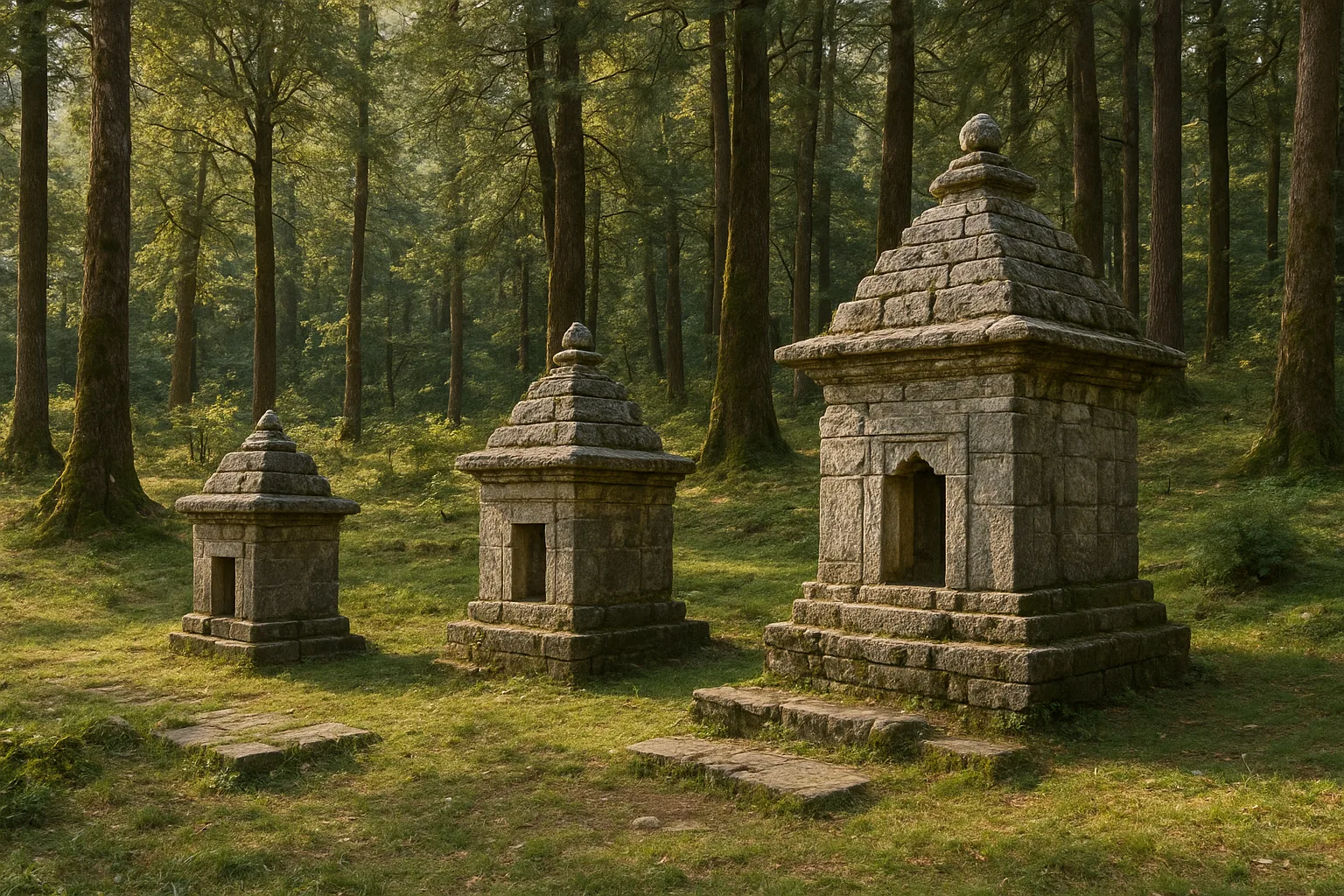
Series: History of Sirmaur, Himachal Pradesh, India
Phase 1: Ancient & Early Roots — Part 4 of 30
This article is part of a broader historical series exploring the earliest layers of human presence in the western Himalayas. Beginning with landscape, belief, and early patterns of movement and settlement, the series traces how communities adapted to mountainous environments long before formal states or written records emerged. These foundational centuries shaped cultural memory, local traditions, and relationships with the land that would endure through later periods of change.
Mist and Memory: An Ancient Sirmaur Morning
Long before stone temples rose above the cedar forests, the dawn broke over Sirmaur with the sound of distant river currents and the gentle hush of wind through deodar branches. Imagine a morning thousands of years ago: villagers gather near a cluster of mossy boulders, their breath visible in the cool air, as they offer grains and wildflowers to unseen powers dwelling in the land. The hills, already old, hold the stories of these earliest inhabitants—stories passed from lips to ear, shaped by the land and its mysteries.
Setting the Stage: Sirmaur’s Earliest Settlers
The region now known as Sirmaur, in southern Himachal Pradesh, sits cradled by the lower Himalayas—a crossroads of ancient trade and migration. Archaeological traces and later chroniclers suggest that by the early first millennium BCE, semi-nomadic communities had begun to settle along the banks of the Giri and Yamuna rivers. These people, likely related to the proto-Indo-Aryan and Tibeto-Burman groups, left few written records, but their presence endures through local legend and material traces.
Early settlements clustered near fertile valleys and perennial springs. These communities worshipped the forces that sustained them: river spirits, mountain deities, and ancestral shades. The objects of reverence were not grand shrines, but sacred groves, curious rock formations, and ancient trees—sites marked more by story than by stone.
Oral Traditions: Gods of Earth and Sky
Unlike the more codified Vedic religions developing in the plains to the south, Sirmaur’s spiritual landscape was shaped by oral traditions—songs, chants, and rituals passed through generations. Gazetteers from the colonial era note that the hill people kept alive a rich tapestry of beliefs, drawing on both indigenous practices and influences from travelers and migrants.
Mythology in Sirmaur often centers on local manifestations of pan-Indian deities: Shiva as Mahasu, Durga as Bala Sundari, or the serpent-god Nag Devta, whose shrines are still nestled in remote hamlets. These stories are not merely echoes of distant Sanskritic texts, but living traditions, tailored by the hills and valleys to the needs and fears of their people.
It is here that the distinction between oral tradition and historical inference becomes crucial. While tales of gods walking the hills abound, our understanding of early Sirmaur relies on piecing together the material fragments—ritual objects, burial mounds, and the persistent memory of sacred places.
Sacred Sites: Stones, Springs, and Groves
Long before the emergence of formal temples, Sirmaur’s sacred geography was defined by natural features. Certain boulders—called shilas—were believed to be seats of divine power. Springs and pools, especially those never known to run dry, were sites for offerings and communal rites. The region’s dense forests became sanctuaries for both animals and spirits; some trees, especially the towering deodars, were never to be cut or profaned.
Some of these ancient sites survived the passage of time to become centers of later Hindu worship. The temple at Trilokpur, for instance, now dedicated to Bala Sundari, is believed by local tradition to have been revered as a sacred spot long before the formal shrine was built. Similarly, the cave-temple of Renuka—noted in the Mahabharata and the Puranas—has roots in pre-Vedic nature worship, where the lake and its spirit-mother were honored by early dwellers of the region.
Encounters and Exchange: Trade, Pilgrimage, and Early States
Sirmaur’s valleys did not exist in isolation. By the mid-first millennium BCE, trade routes threaded through the Shiwalik foothills, connecting the region to the Gangetic plains, the Punjab, and beyond. Traders, wandering ascetics, and pilgrims carried not only goods but ideas—bringing new rituals and beliefs into dialogue with local customs.
As these connections grew, so did the region’s social complexity. Early hill chieftains, known in later chronicles as râjas or thakurs, began to emerge, claiming descent from legendary ancestors and often tying their legitimacy to sacred sites. These leaders sometimes sponsored the building of simple shrines or the hosting of communal festivals, embedding their authority in the sacred landscape.
By late antiquity, Sirmaur had become a tapestry of small principalities and village republics, each with its own guardian deities and ritual specialists. Chronicles and regional gazetteers, such as the Sirmaur State Gazetteer, record how these early polities often vied for control over pilgrimage sites and fairs—recognizing their spiritual and economic significance.
Documented Transitions: The Early Medieval Religious Landscape
With the gradual rise of formalized polities in the early medieval period (circa 6th–10th centuries CE), Sirmaur’s religious life entered a new phase. Royal patronage shifted some worship from sacred groves to stone temples, though the underlying reverence for nature and local spirits persisted. Inscriptions and temple records from neighboring regions reference endowments to local shrines—evidence that the rulers of Sirmaur both respected and leveraged religious authority.
Yet, even as the region’s rulers adopted Sanskritic titles and rituals, the old ways endured. Many sacred sites retained their dual character: formal temple complexes surrounded by untouched groves, ancient stones still receiving secret offerings on moonless nights. The religious world of Sirmaur remained layered, its surface shaped by politics but its roots sunk deep in ancestral memory.
Continuities and Living Legacies
Today, the echoes of these early beliefs remain woven into Sirmaur’s daily life. Village festivals still honor the Nag Devta; holy trees and stones are quietly tended by families whose ancestors first knelt before them. The landscape itself—its rivers, forests, and peaks—retains its aura of sacredness, even as modernity encroaches.
In understanding the early religious beliefs and sacred sites of Sirmaur, we glimpse not just a vanished world, but a living thread connecting past and present. These ancient roots continue to shape the region’s identity, weaving together memory, belief, and belonging.
In the next part of this series, we’ll follow the emergence of Sirmaur’s earliest dynasties, tracing how spiritual authority and political power began to intertwine in the forging of the hill states.
Previous: Tribal Communities of Pre-Kingdom Sirmaur
Next: Sirmaur’s Role in Regional Trade and Migration Routes