
Series: History of Una, Himachal Pradesh, India
Phase 5: Modern Era — Part 29 of 30
This article appears within a continuing historical series that follows the western Himalayas into the modern era. With the end of princely rule and the integration into independent India, long-standing social and political patterns were reconfigured. This phase examines how development, state formation, and memory interact with inherited landscapes, shaping contemporary life while carrying forward echoes of the past.
In the Veranda: An Elder’s Tale Begins
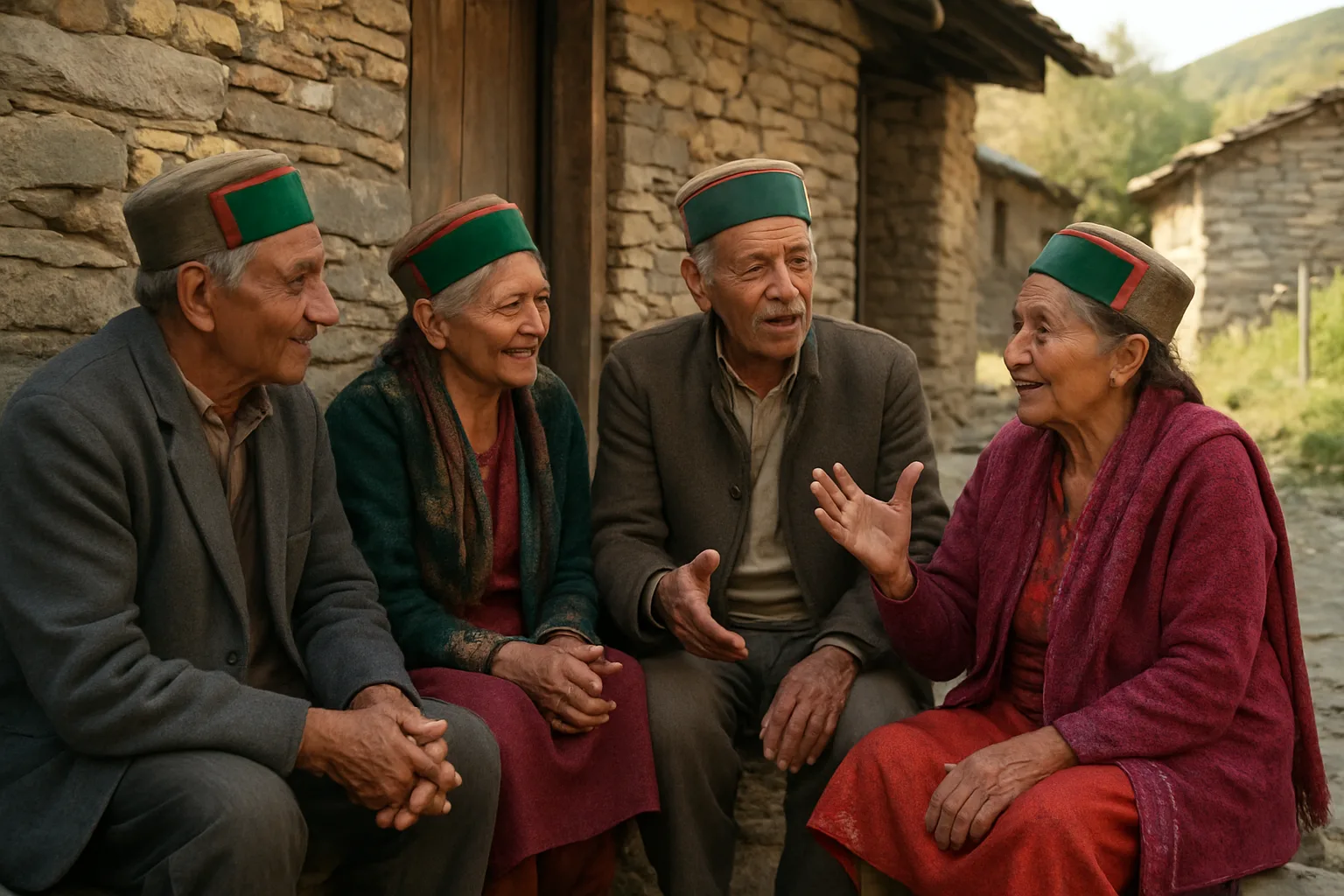
On a late spring afternoon in Una, the air shimmered with heat and the scent of mango blossoms. Under a sloping tiled roof, octogenarian Harnam Singh sat cross-legged on a charpoy, his turban immaculate, the lines on his face mapping nearly a century of memory. Behind him, the Shivalik hills framed the horizon, silent witnesses to decades of change. As neighborhood children gathered at his feet, Harnam’s voice rose above the hum of fans and distant temple bells. “You want to know how Una became what it is? Then listen well,” he began, his words carrying echoes of migration, war, and stubborn hope.
Before the Borders: Life Along the Old Tracks
Una’s oldest residents still recall stories from before the redrawing of India’s borders. In the 1930s and ‘40s, Una occupied an ambiguous place—neither fully Punjab nor yet Himachal. Grandmothers remember bustling markets where traders from Hoshiarpur and Kangra mingled, and narrow dirt lanes where the clop of bullock carts mixed with the call to prayer from distant mosques. Festivals brought together Hindus, Sikhs, and Muslims in a patchwork of shared traditions. The annual fair at Chintpurni was a highlight, its stalls brimming with handmade wares, the air alive with folk songs and laughter.
Oral tradition paints a picture of a close-knit yet cosmopolitan settlement, shaped by the Sutlej’s unpredictable floods and the grain trains that rattled through on their way to the plains. Old-timers recall the arrival of the North-Western Railway line—a marvel that, as one elder described, “shrunk the world.”
Partition’s Shadow: Flight, Loss, and New Beginnings
Then, 1947 cast a long shadow. Stories from Una’s Partition years are still told in hushed tones. Gurdial Kaur, now in her nineties, remembers her mother packing hurried bundles, hiding family heirlooms in the folds of her sari. “We heard horses at night, saw columns of people on the road,” she recounts, eyes brimming with remembered fear. Like much of the region, Una became a waystation—refugees poured in from what was now Pakistan, clutching hope and faded photographs. Temporary camps sprang up in schoolyards and temple courtyards. The town’s demography shifted overnight; familiar faces vanished, replaced by newcomers bearing stories of loss and survival.
Yet, as these elders emphasize, Una found ways to adapt. The communal kitchens of those chaotic months forged new friendships. Locals and migrants rebuilt homes, shared seeds for next season’s planting, and together revived the town’s battered markets. The scars of Partition remain, but so too does a stubborn sense of solidarity.
The Language of Memory: Songs, Proverbs, and Oral Maps
For Una’s elders, history is not just a list of dates but a living language. They remember in folk songs, in proverbs recited at dusk, and in the nicknames given to old banyan trees or forgotten wells. “Our river is not just water,” insists Sohan Lal, a retired schoolmaster, “it is a witness to our joys and sorrows.”
These oral histories preserve details the official records miss: the precise taste of mangoes grown on the banks of the Swan, the laughter of children at the first cinema show, the whispered warnings about the haunted house near Amb. Every season, as crops are sown or harvested, elders mark the passage of time with stories—of droughts survived, weddings celebrated, visiting sadhus who foretold floods.
Such memories also serve as oral maps. In the absence of written deeds, families recall land boundaries by tracing the paths of vanished streams or recalling legendary disputes settled beneath the peepal tree at Basdehra. Memories, in Una, are as much geography as they are history.
Local Heroes: The Unwritten Chronicles
While national figures like Jawaharlal Nehru and Sardar Patel are remembered for shaping post-Independence India, Una’s elders honor their own local heroes—figures less known outside the region, but legendary in the stories retold at dusk.
- Master Tara Chand: A teacher who, during the political uncertainty of the 1950s, led literacy drives and encouraged girls to attend school—often at great personal risk.
- Subedar Lachhman Singh: Decorated in the Second World War, he returned to Una and organized the first cooperative dairy society, providing stability to families battered by Partition.
- Rukmani Devi: Remembered for organizing women’s self-help groups in the 1970s, she championed the cause of widow remarriage and led campaigns against child marriage, decades before such issues gained national attention.
These stories, passed from generation to generation, shape the town’s collective identity. Each tale underscores a recurring theme: resilience in the face of upheaval, and the quiet heroism found in everyday acts.
Modernity Arrives: Roads, Radios, and the Changing Face of Una
The 1960s and 1970s brought visible change. As Himachal Pradesh was formally established and Una found itself a district headquarters, roads were tarred, new schools opened, and the first buses began to ply the route to Nangal. The opening of the Bhakra Dam transformed the region’s economy, even as it submerged ancestral lands. Elders speak of the thrill of electricity lighting up the bazaar, and of the first radio sets crackling with news from Delhi.
Yet, these changes were not without cost. Old customs frayed as migration to Punjab and Delhi accelerated. The annual fairs grew smaller. Still, in the evenings, elders gathered in temple courtyards or under the shade of ancient trees, retelling stories to anchor youth in a rapidly changing world.
Preserving the Past: Memory Keepers in a Digital Age
Today, as Una’s youth scroll through smartphones and local shops sell global brands, the voices of elders grow more precious. Story circles, once a nightly ritual, are now rare. But some in the town are fighting to preserve these memories. Teachers record oral histories for local archives. Schoolchildren interview their grandparents, discovering tales of rice shortages during the 1965 war and the excitement of the first color television in the neighborhood.
Initiatives like the Una Heritage Walk take inspiration from these recollections, mapping old routes and reviving forgotten festivals. Even WhatsApp groups, often dismissed as frivolous, have become spaces where elders share historical photographs and snippets of dialect poetry, knitting together a community that refuses to forget.
Living With the Legacy: Una’s Past in the Present
As the sun sets behind the hills and the day’s heat gives way to cool breezes, Una’s elders remind us that history is not just what is written in books but what is remembered, sung, and shared. Their stories—of displacement and belonging, of hardship and hope—continue to shape the character of the town. They remind younger generations that the markets, the temples, the very language of Una, are layered with memory. Even as new roads and technologies arrive, the past remains close at hand, guiding choices and anchoring identity.
This living legacy, preserved in the voices of Una’s elders, ensures that the town’s history is not merely a record of what once was, but a guide for what it might yet become. As we prepare to conclude our series in the next post, we carry forward these memories—a map for the future, drawn in the words and wisdom of those who have seen Una change and endure.
Previous: Preserving Cultural Identity in Modern Una
Next: Una’s Past, Present, and Future