
Series: History of Una, Himachal Pradesh, India
Phase 5: Modern Era — Part 27 of 30
This article appears within a continuing historical series that follows the western Himalayas into the modern era. With the end of princely rule and the integration into independent India, long-standing social and political patterns were reconfigured. This phase examines how development, state formation, and memory interact with inherited landscapes, shaping contemporary life while carrying forward echoes of the past.
One Morning on the Sutlej’s Banks
The monsoon clouds gathered over the Sutlej, their shadows flickering across the fields near Una. It was 1979, a year still vivid in the memories of older residents. Children waded through knee-deep grass to school, their path lined with wildflowers and the distant call of mynas. Yet, beneath the idyllic veneer, something was shifting—bulldozers had arrived at the edge of town, carving new roads. The air, once scented with pine and loam, now carried a trace of diesel. Una, long a sleepy outpost cradled by hills and rivers, stood on the cusp of transformation.
From Pastoral Calm to Political Calculation
For centuries, Una’s rhythms were dictated by its geography. The forests of Amb and Bangana, the fertile tracts along the Swan River, and the foothills bordering Punjab shaped daily life. Early British records from the 19th century praised Una’s “refreshing air” and “abundance of verdure.” Colonial officers, drawn by its tranquility, established rest houses and documented its rich biodiversity.
The Partition of 1947, however, set new forces in motion. Refugees surged across the border, seeking sanctuary in Una’s valleys. The town’s population blossomed almost overnight. Land was cleared for new settlements—first by hand, then by machines. In the 1960s, Chief Minister Yashwant Singh Parmar’s push for industrialization in Himachal Pradesh echoed into Una. Promises of progress brought new factories, roads, and a railway extension. Yet, each promise extracted a subtle environmental toll.
The Swan River Scheme: Hopes and Hazards
By the late 1970s, the Swan River had become both Una’s lifeline and its lament. Once a perennial stream, its monsoon floods grew fiercer as hills were stripped of their natural cover. Soil erosion, an unintended consequence of expanded farming and unchecked construction, clogged the river’s arteries.
In response, the ambitious Swan River Channelization Project launched in the 1980s. Engineers, led by figures such as S.P. Sharma, envisioned taming the river’s seasonal rage with embankments and dredging. Villagers watched as excavators redefined the river’s contours, hopeful that their crops would no longer drown each July. But the project, while curbing some floods, also disrupted fish habitats and reduced wetland areas essential to migratory birds. The trade-off between security and ecological balance became a recurring theme in Una’s development story.
Factories, Fumes, and Fragile Air
The 1990s marked another turning point. The Himachal Pradesh government, under leaders like Virbhadra Singh, courted investment by establishing the Gagret and Mehatpur industrial belts. Factories for textiles, paper, and chemicals sprouted along the border, bringing jobs—and pollution.
Residents of Mehatpur recall the first time smoke from a paper mill blanketed their village in acrid haze. Cattle refused to graze in fields tainted by industrial runoff. The once-pristine air, cooled by breezes from the Shivalik hills, now carried particles invisible but harmful. Local doctors like Dr. Ramesh Thakur began noting a rise in respiratory ailments, especially among children and the elderly. Efforts to enforce environmental safeguards often lagged behind the pace of investment, leaving Una’s natural assets increasingly vulnerable.
Urbanization and the Disappearing Green
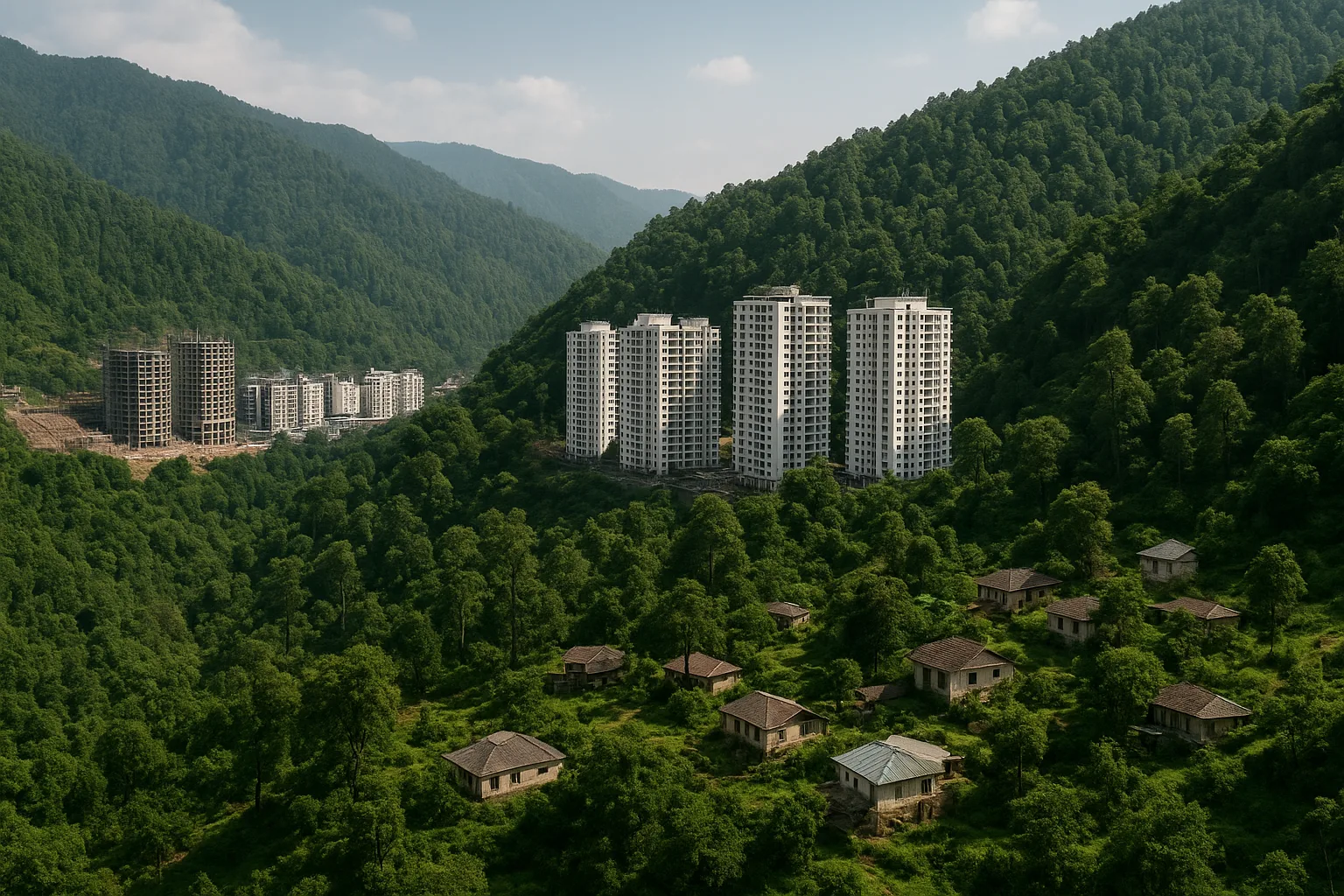
As the 21st century dawned, urban sprawl accelerated. Una’s population surged past 500,000 by 2011. New housing colonies, shopping complexes, and schools replaced orchards and communal grazing lands. The landscape of the district center shifted: the once narrow bazaars widened into traffic-choked avenues, and the old banyan trees on Hospital Road were felled to make way for parking lots.
Despite campaigns by civic leaders such as Smt. Manju Bala to plant saplings and protect parks, the pressure on green spaces remained relentless. Satellite images from the last two decades reveal a steady loss of forest cover, especially in the transitional zones between Una town and the villages of Haroli and Tahliwal.
The Swan’s Rebirth: Grassroots to the Rescue
Yet Una’s story is not only one of loss. By the mid-2010s, a new generation of environmentalists, teachers, and farmers began to mobilize. The “Swan Eco-Revival” campaign, started by school principal Jagat Singh and local youth groups, rallied villagers to reforest riverbanks and monitor water quality. Women’s collectives in Santoshgarh revived traditional water-harvesting systems, reducing strain on the river during dry months.
These grassroots movements gained momentum, supported by government grants and technical advice from environmental scientists at Himachal Pradesh University. A modest but growing network of eco-clubs in Una’s schools now educates children on the district’s unique biodiversity—and the cost of its neglect.
Echoes of the Past, Hopes for the Future
Walking today along the banks of the Swan, one can still glimpse herons wading in the shallows and hear the laughter of children skipping stones. Yet the landscape bears scars—a reminder that progress and preservation have never been easy companions in Una’s journey. The district’s history, from colonial outpost to industrial hub, is written not just in census records and factory walls, but in the shifting course of its rivers and the thinning canopy of its forests.
Una’s environmental challenges are, in many ways, a microcosm of India’s rapid development: the tension between growth and sustainability, between immediate needs and the inheritance owed to future generations. The decisions made over the last century—by leaders, engineers, and ordinary residents—continue to shape the air, water, and land that define Una today. As the district looks ahead, its history offers both cautionary tales and enduring hope: that even in the face of daunting challenges, communities can adapt, recover, and renew their bond with the land they call home.
Previous: Tourism, Temples, and Pilgrimage Sites of Una
Next: Preserving Cultural Identity in Modern Una