
Series: History of Shimla, Himachal Pradesh, India
Phase 4: Freedom & Transition — Part 21 of 30
This article is part of a wider series tracing the transformation of the western Himalayas under colonial influence. As British authority extended into the hills, existing political systems were restructured through treaties, administration, and new forms of governance. This phase considers how colonial rule reshaped society, economy, and space while leaving lasting imprints on local identity.
The Last Monsoon of Empire
High on the ridges of the Himalayas, the rains arrived in June 1947 much as they always had—softening the red-brick spires of the Viceregal Lodge, cloaking the deodar forests in mist, and rushing in torrents down the steep bazaar streets of Shimla. Yet, beneath this familiar seasonal rhythm, something unprecedented was unfolding. The city, for decades the summer nerve center of British India, was witnessing the final days of an empire. The air crackled with anticipation, uncertainty, and a sense of ending that was at once public and intensely personal.
Shimla’s Colonial Zenith: Setting the Stage
By the mid-20th century, Shimla had become much more than a hill station. Since the 1860s, it had served as the summer capital of the British Raj, drawing administrators, military officers, and their families to its cool heights each year. The city’s streets—Mall Road, the Ridge, Jakhu—bore the marks of colonial grandeur and bureaucratic routine. Here, policies that shaped millions were debated in oak-paneled halls, while sporting clubs and grand hotels echoed with the accents of distant England.
Through the summer of 1947, the city’s usual rhythms were disrupted. Telegrams arrived with increasing urgency. Special trains brought high officials from Delhi and Lahore. The Viceregal Lodge, perched at Observatory Hill, was the scene of crucial meetings: Lord Mountbatten, the last Viceroy, conferred with Indian leaders and British advisors as the partition plan took final shape. Across Shimla, both British and Indian residents sensed that the world they had known was dissolving.
Communities and Tensions: The Human Face of Transition
Shimla’s population in 1947 was far from homogeneous. Alongside the colonial elite, the city was home to a sizeable Indian community: Pahari traders, service workers, clerks, and domestic staff whose families had served in British households for generations. There were longstanding Sikh, Hindu, and Muslim enclaves, each with their own temples, gurdwaras, and mosques. Many local Himachali families traced their roots to villages and estates in the surrounding hills, their histories intertwined with the region’s ancient feudal states.
As independence approached, anxiety simmered. Rumors drifted up from the plains—communal violence, trains attacked, refugees on the move. In Shimla, the mood was watchful but tense. Oral accounts from local families recall how some British residents quietly packed their belongings, selling off household goods or gifting possessions to Indian friends and servants. For others, there was hope: of self-rule, of new opportunities under the Indian flag. Yet, the sense of rupture was inescapable.
Negotiating the Future: The Simla Conferences and Aftermath
Shimla had, in earlier years, served as the stage for several historic negotiations. Most notably, the 1945 Simla Conference—held at the Viceregal Lodge—had attempted, unsuccessfully, to agree upon a framework for Indian self-government. By 1947, the urgency was greater and the stakes higher. Lord Mountbatten’s consultations with Jawaharlal Nehru, Sardar Patel, and Muhammad Ali Jinnah were shrouded in secrecy but widely discussed in the city’s clubs and bazaars.
Historical records indicate that local Indian leaders, teachers, and civil servants in Shimla followed these events closely. Some were invited to receptions and briefings, glimpsing the machinery of transition at work. For most, however, the changing of the guard was witnessed from a distance—a pageant of departing uniforms, lowered flags, and uncertain futures.
Departures, Arrivals, and the Shape of a New Order
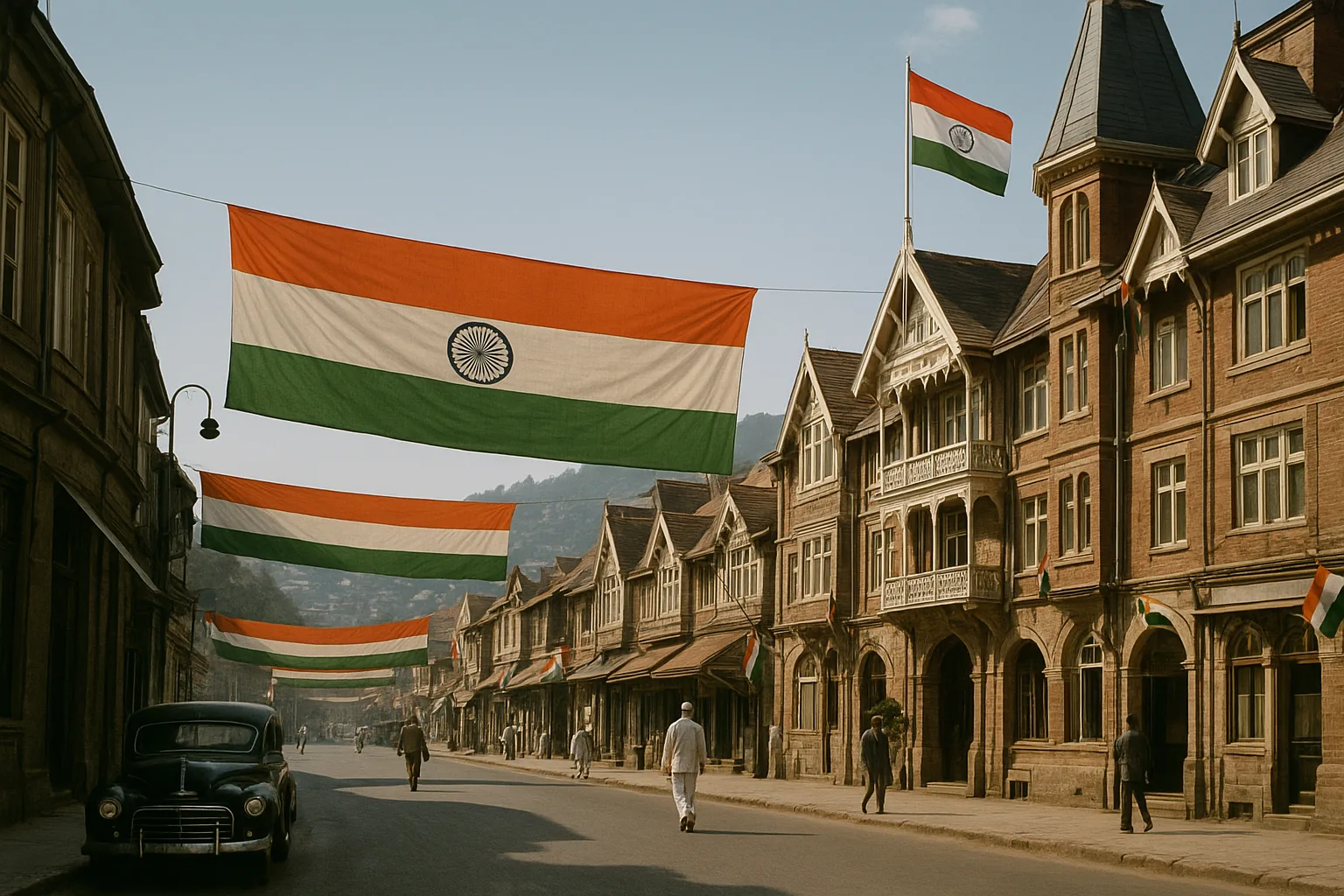
By August 1947, the departure of British officials was underway in earnest. The Ridge, so long the scene of imperial parades and Sunday promenades, now hosted farewell gatherings. The Union Jack was lowered from the Town Hall. Some British families left hurriedly, others lingered into autumn, reluctant to abandon the city they had made a home. The Indian tricolor was raised in official ceremonies, its saffron, white, and green a visible marker of new sovereignty.
For Shimla’s Indian residents, independence brought a profound sense of possibility but also practical challenges. The administrative apparatus shifted rapidly from colonial to national control. Many Pahari and Punjabi families who had worked in subordinate roles found new opportunities in government, education, and business. Yet, the city also absorbed refugees from Punjab and what became Pakistan, as partition’s violence sent tens of thousands fleeing to the safety of the hills. The social fabric of Shimla was transformed, its neighborhoods mixing old residents with new arrivals, each bearing their own memories and traumas.
Belief and Continuity: Local Traditions Amid Change
Even in this time of upheaval, Shimla’s older rhythms endured. Oral traditions among Himachali families recall prayers for peace at the Jakhu temple and in village shrines. The worship of local deities, the observance of festivals like Dussehra and Diwali, and the telling of ancient legends continued alongside the new political order. While British rule had left its mark on the cityscape and public life, the underlying currents of belief and community carried forward, adapting but not disappearing.
Regional gazetteers and early chronicles from the princely hill states—such as Keonthal, Jubbal, and Bushahr—remained sources of local pride and identity. For many, the end of the Raj was less a total rupture than another chapter in a long history of adaptation: from Gorkha invasions to Sikh expansion, from colonial arrival to independence. The hills, as ever, observed and endured.
Legacy and Looking Forward
Today, traces of 1947 linger quietly in Shimla’s lanes and institutions. The Viceregal Lodge—now the Indian Institute of Advanced Study—still stands, its grandeur repurposed for new generations. The Ridge hosts celebrations of independence, echoing with both memory and renewal. Families who witnessed those momentous days pass down their recollections, blending personal stories with the broader arc of India’s freedom.
Yet, the impact of that summer extends beyond nostalgia. The administrative, social, and cultural realignments of 1947 set Shimla on a new path, one that continues to shape its identity as a Himachali city and an Indian state capital. As we turn to the next part in this series, we will trace how Shimla navigated the first years of independence—balancing the legacies of empire with the demands and dreams of a new nation.
Previous: Shimla During India’s Freedom Struggle
Next: Shimla as the Capital of Himachal Pradesh