
Series: History of Shimla, Himachal Pradesh, India
Phase 4: Freedom & Transition — Part 22 of 30
This article is part of a wider series tracing the transformation of the western Himalayas under colonial influence. As British authority extended into the hills, existing political systems were restructured through treaties, administration, and new forms of governance. This phase considers how colonial rule reshaped society, economy, and space while leaving lasting imprints on local identity.
Cold Dawn: Shimla in the Year of Transition
The winter of 1947 in Shimla arrived with more than its usual bite. Frost glazed the rooftops of the town’s spread of mock-Tudor bungalows, while the chill in the air was matched by uncertainty and anticipation. Along the Mall, the heart of colonial administration for nearly a century, few could ignore the sense of a world on the cusp of transformation. India’s independence had just been declared, and the fate of Shimla—its role, its identity—hung in the balance.
Shimla’s Colonial Inheritance
Shimla’s emergence as a strategic center was born not of ancient royal decree, but of the British colonial project. The town’s selection as the summer capital of British India in 1864, documented in the Punjab Administration Reports and colonial gazetteers, shaped its architecture, culture, and political rhythms. For decades, policies affecting millions across the subcontinent were drafted within the panelled halls of Viceregal Lodge. Yet, even as the British began their withdrawal in 1947, Shimla’s significance was far from spent.
Unlike the ancient seats of power in the plains, Shimla was a newcomer to the role of capital. Oral traditions among local families recall the earlier days when the region, known as Shyamala after the goddess revered at Jakhu hill, was a modest cluster of temples and hamlets. The British left an indelible imprint—railways, schools, and civic institutions—but the town’s layered past remained visible in its shrines and the rhythms of its bazaar.
Partition, Refuge, and Political Flux (1947–1950)
The months following independence saw Shimla transform into a haven for administrators and refugees alike. Historical records indicate a rapid influx of displaced families from the Punjab and the North-West Frontier, seeking shelter from the violence that accompanied Partition. The town’s hotels, boarding houses, and even private homes filled with the voices of those searching for security and a new beginning.
Administratively, the town now found itself at the center of a new constellation of princely states and territories. The region then known as the Chief Commissioner’s Province of Himachal Pradesh was carved out in April 1948, bringing together 30 hill states that had been under various forms of indirect British rule. Shimla, with its existing infrastructure and bureaucratic legacy, was the natural choice for the new province’s capital—though this status was provisional, contested in the debates of state reorganization that would echo for years to come.
Negotiating Identity: From Hill States to Province
The early years of Himachal Pradesh were marked by negotiation—between tradition and modernity, between local identities and the imperatives of a new nation-state. The region’s communities, from the Gaddis of Chamba to the Kanets and Brahmins of Shimla district, brought diverse customs and languages into the political fold. Oral traditions and local chronicles, such as those preserved in the family histories of Rajput chieftains, recall both pride and unease at the consolidation of these ancient polities under a single administrative roof.
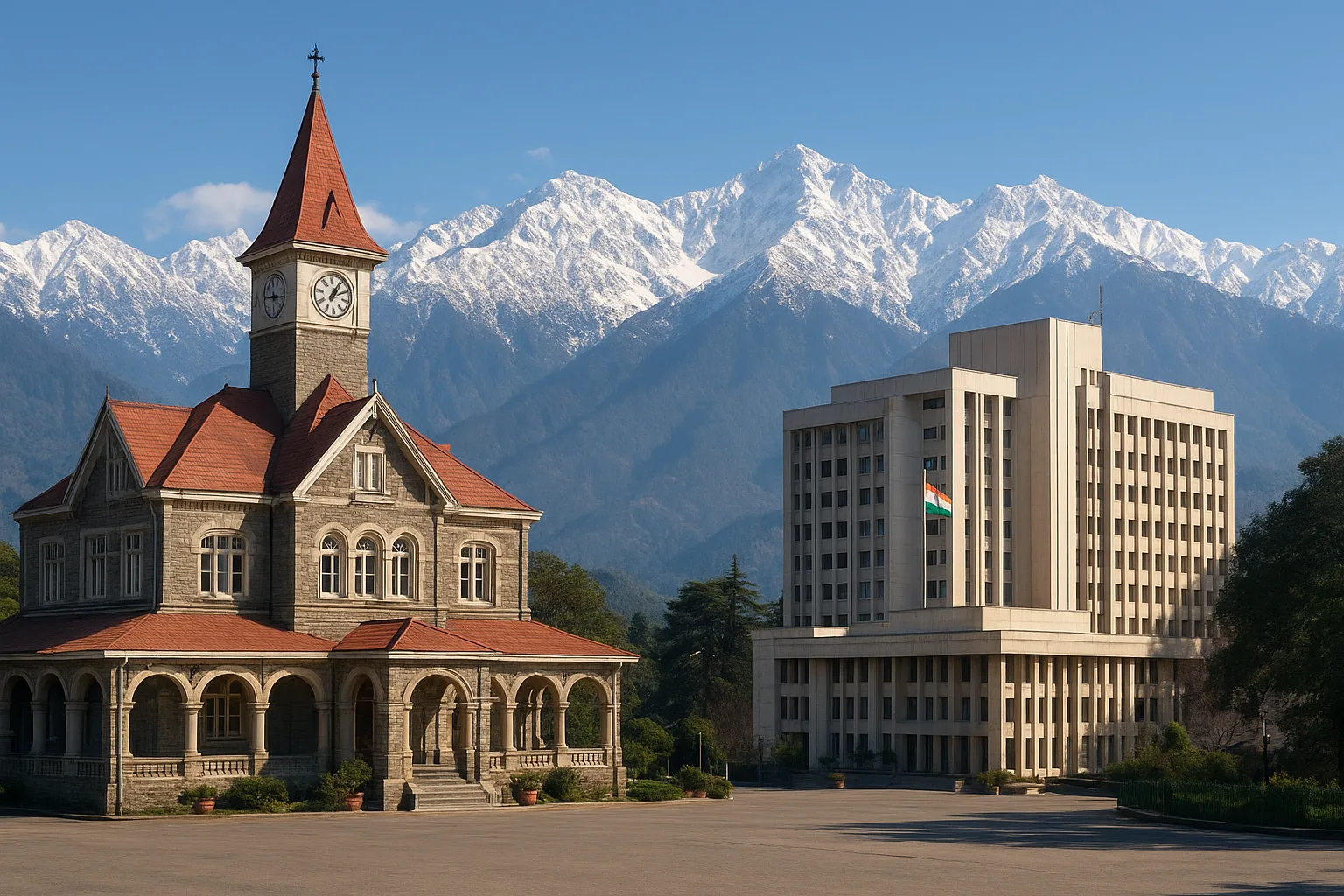
Shimla’s role as capital was not simply a matter of geography or legacy, but also one of symbolism. The city’s British-built structures—the Secretariat, the Gaiety Theatre, the railway station—became spaces where new forms of governance and cultural expression were shaped. State ceremonies blended Indian and colonial forms, while local festivals, such as the Sair and the Shimla Summer Festival, continued to assert indigenous rhythms even as the town’s population swelled with migrants, government workers, and entrepreneurs.
The Road to Statehood (1950–1971)
The promulgation of the Indian Constitution in 1950 transformed Himachal Pradesh into a Part C state, with Shimla confirmed as its administrative heart. Political life in the town acquired a new urgency. The Legislative Assembly met in the old Council Chamber, while the Secretariat buzzed with debates over land reform, education, and infrastructure. Shimla’s press, notably the century-old Himachal Times and other local weeklies, chronicled the challenges of uniting disparate regions and peoples into a coherent polity.
National policies on state reorganization loomed large. Historical records from the States Reorganisation Commission (1956) indicate that proposals to merge Himachal Pradesh with Punjab were met with fierce resistance from local leaders, who argued for the preservation of the region’s distinct identity. Shimla, with its high-altitude isolation and cosmopolitan character, became both a sanctuary for regional aspirations and a laboratory for new political alliances.
It was not until 25 January 1971, after decades of advocacy and negotiation, that Himachal Pradesh was granted full statehood. Shimla’s status as the official capital was reaffirmed, its central role in governance cemented for generations to come.
Administrative and Cultural Hub
The decades following statehood saw Shimla’s transformation from a colonial retreat into a dynamic administrative and cultural center. The town’s demographic composition continued to shift, with growing numbers of students, professionals, and civil servants contributing to its vibrant public life. State institutions—the High Court, the University, the State Museum—rose alongside the old colonial facades, reflecting both continuity and adaptation.
Shimla’s position as capital shaped not only political life but also the region’s cultural imagination. The city became a stage for debates on language policy, tribal rights, and ecological stewardship. Annual festivals, literary gatherings, and student demonstrations filled the Ridge and the Mall, echoing the diverse voices of the state’s valleys and mountains. The town’s theaters and cinema halls premiered films in Pahari, Hindi, and English, while local cuisine and crafts gained new prominence in the state’s emerging identity.
Enduring Legacies and Contemporary Resonance
Today, Shimla’s role as the capital of Himachal Pradesh is visible in its daily rhythms—government files move through corridors built during the Raj, while street vendors and students crowd the same thoroughfares once paced by colonial officers. The city’s administrative character is balanced by its continuing appeal as a cultural and tourist center, where the past is never far from the present.
Yet, beneath the surface, the tensions and aspirations that shaped Shimla’s journey to capital status continue to inform its sense of self. The debates over development and heritage, language and representation, recall the challenges faced in the years after independence. In the next part of this series, we will trace how Shimla’s political and social life evolved through the late twentieth century, reflecting the broader transformations of Himachal Pradesh in the decades after statehood.
Previous: 1947: End of British Rule in Shimla
Next: Urban Growth and Population Pressure in Modern Shimla