
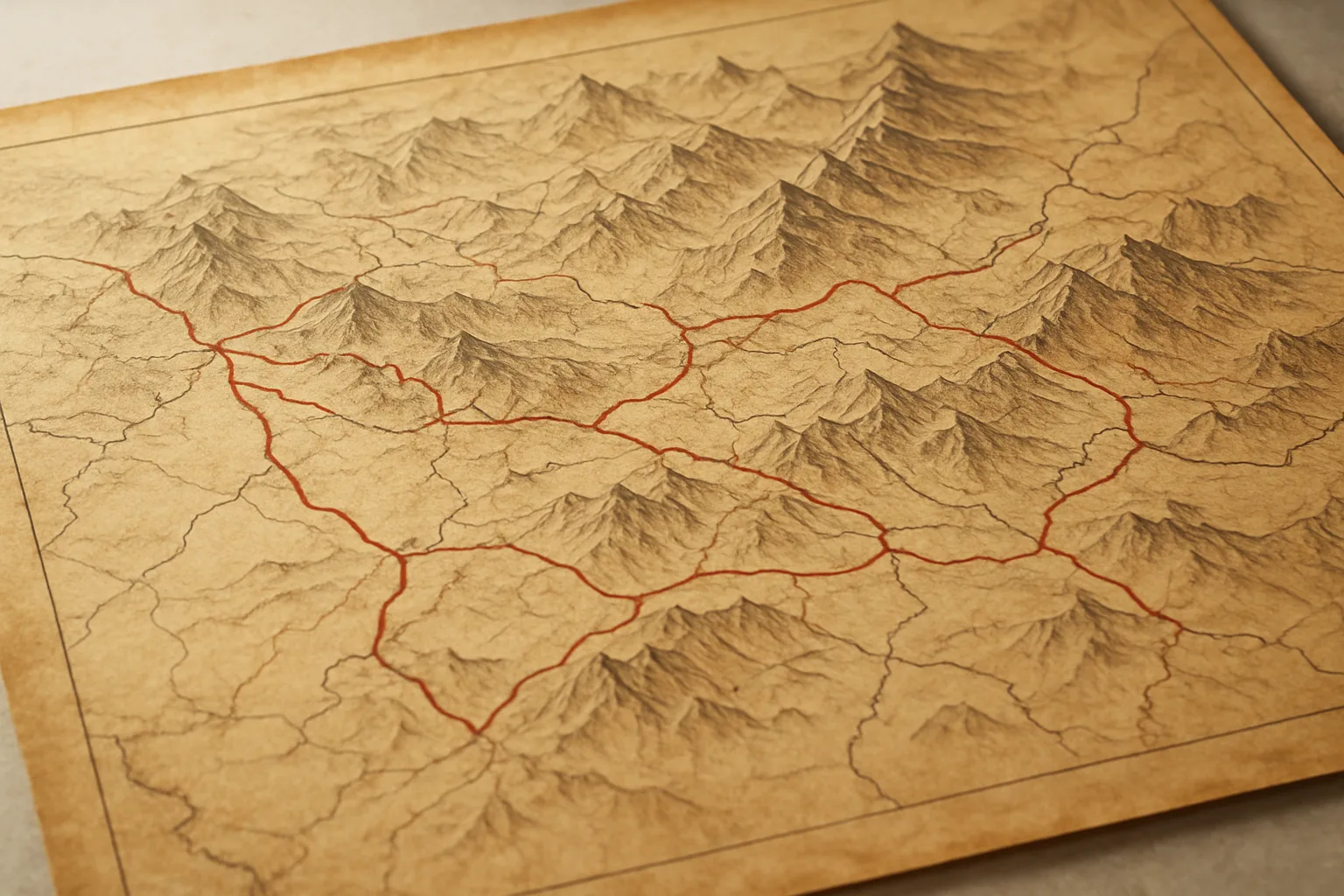
Series: History of Lahaul & Spiti, Himachal Pradesh, India
Phase 1: Ancient & Prehistoric Roots — Part 3 of 30
This article is part of a broader historical series exploring the earliest layers of human presence in the western Himalayas. Beginning with landscape, belief, and early patterns of movement and settlement, the series traces how communities adapted to mountainous environments long before formal states or written records emerged. These foundational centuries shaped cultural memory, local traditions, and relationships with the land that would endure through later periods of change.
Crossing the Roof of the World
The rising sun strikes the jagged white teeth of the Bara Shigri glacier. Wind whips across the Chandra River valley, carrying the muffled clang of hoofbeats. A caravan of laden yaks, their wool thick against the cold, creeps along a narrow track carved into the mountainside. Cloaked traders, faces burnt by sun and wind, press on. This is not a scene from legend—it echoes a thousand years of reality in Lahaul-Spiti, where the high Himalayas opened corridors between worlds.
Long before the unification of India or the rise of Himalayan kingdoms, these valleys were lifelines. They linked the plains of the Indian subcontinent to the silk-laden cities of Central Asia, and beyond. In the shifting snows and thin air, the people of Lahaul and Spiti carved a space for themselves—shaped by geography, sustained by movement, and marked by a legacy of exchange that still lingers in stone ruins and whispered stories.
Land Between Worlds: Early Settlements and Mythic Echoes
Lahaul and Spiti stand as twin valleys divided by the Kunzum La, yet united by their isolation. Archaeological traces—stone tools unearthed near Tandi and ancient burial sites atop windswept ridges—suggest human presence here from the dawn of the Holocene. While hard evidence is sparse, oral traditions recorded in regional gazetteers recall primordial tribes: the Doms, the Bhotas, the Khampas of distant Tibet. These stories, preserved in the languages and festivals of the region, blur the line between memory and myth.
Some tales speak of a land once submerged, risen from the waters at the command of divine beings. Others recall the migrations of clan ancestors, crossing impossible passes with their herds and sacred objects. While these narratives cannot be taken as literal history, they hint at a profound truth: the earliest societies in Lahaul-Spiti were shaped by movement, adaptation, and an enduring reverence for the land’s harsh beauty.
The First Traders: Trails of Salt, Wool, and Gold
By the late Bronze Age and early Iron Age, the snowbound valleys had become arteries of exchange. The Spiti valley, in particular, formed a crucial segment of the vast trans-Himalayan trade network. Salt harvested from the Tibetan plateau flowed south, while barley, rice, and textiles made their way north. Lahaul, with its bridges over the Chandra and Bhaga rivers, became a resting place for caravans navigating the treacherous Taglang La and Baralacha La passes.
Historical inference, drawn from the distribution of ancient coins, ceramics, and petroglyphs, reveals the contours of these routes. Traders from Ladakh, Kullu, and even distant Bactria left their mark. Alongside goods, they carried stories, technologies, and belief systems that would gradually transform the cultural fabric of the high Himalayas.
Spiritual Crossroads: Belief Systems on the Move
The trade routes were not only highways for commerce—they were conduits of faith. The earliest religious imprints in Lahaul-Spiti reflect the mingling of Bon, an indigenous Himalayan tradition, with evolving forms of Buddhism, Hinduism, and animist practice. Cave shrines near Tabo and Lhalung, some dating to the first millennium CE, bear paintings and relics that hint at these shifting currents.
Documented political history is sparse before the 10th century, but early chronicles from Tibetan and Indian sources suggest that Lahaul-Spiti was a zone of spiritual experimentation. Monks, shamans, and wandering sages moved with the caravans, exchanging not just goods but cosmologies. The syncretic rituals that persist in village festivals today—mixtures of Buddhist prayers, ancient animist rites, and local legends—testify to this age of spiritual convergence.
Emergence of Hill States: The Politics of Passage
As the centuries turned, the valleys’ strategic importance did not go unnoticed by ambitious rulers. By the early medieval period, the Kullu kingdom to the south and the Guge kingdom in western Tibet sought to control these vital arteries. Regional gazetteers and Tibetan chronicles record periodic clashes for control of Spiti and Lahaul’s passes, punctuated by alliances forged through marriage or tribute.
Local chieftains—often styled as Wazirs or Nono—emerged as political intermediaries. Their power rested on their ability to guarantee safe passage, levy tolls, and command the loyalty of scattered settlements. These proto-states seldom built great fortresses, but their authority was written in the stones of waystations, the survival of mountain villages, and the intricate web of obligations that bound trade, faith, and community together.
Communities Forged by Passage
Over generations, the inhabitants of Lahaul and Spiti became both gatekeepers and guides. The harsh climate—marked by short summers and brutal winters—demanded cooperation. Villages like Keylong and Kaza grew at the confluence of trails, their economies shaped by the ebb and flow of travelers. Oral traditions recall the hospitality extended to strangers, but also the perils: avalanches, brigands, and the ever-present threat of famine.
Distinct communities emerged: the Bodhs of Lahaul, the Spiti Bhotias, and itinerant traders who bridged the linguistic and cultural divides. Their lives revolved around seasonal rhythms—sowing, harvest, and the coming of the first caravans after the passes thawed. Alongside trade, festivals and rituals reinforced shared identity, blending the sacred and the practical in ways unique to the high Himalayas.
Legacy in Stone and Memory
Today, the remnants of these ancient trade routes are visible in weathered chortens, crumbling mani walls, and the faint traces of paths etched into scree slopes. The languages of Lahaul-Spiti, peppered with words from Tibetan, Ladakhi, and Hindi, bear witness to centuries of exchange. Even as roads and tunnels bring new forms of connection, the memory of the old ways endures—in the songs sung at harvest, the rituals at mountain shrines, and the collective pride of a people shaped by passage and resilience.
The story of Lahaul-Spiti’s ancient trade routes is not merely one of commerce; it is a testament to the power of movement, adaptation, and encounter in forging identity. In the next part of this series, we will journey deeper into the rise of Buddhist monasticism and its profound influence on the valleys—a spiritual legacy inseparable from the trails first trodden by traders and pilgrims alike.
Previous: Early Settlements Along the Chandrabhaga and Spiti Rivers
Next: Geography and Isolation in Early Lahaul–Spiti History