
Series: History of Lahaul & Spiti, Himachal Pradesh, India
Phase 1: Ancient & Prehistoric Roots — Part 2 of 30
This article is part of a broader historical series exploring the earliest layers of human presence in the western Himalayas. Beginning with landscape, belief, and early patterns of movement and settlement, the series traces how communities adapted to mountainous environments long before formal states or written records emerged. These foundational centuries shaped cultural memory, local traditions, and relationships with the land that would endure through later periods of change.
Moonrise Over the Valley: A Scene from Deep Time
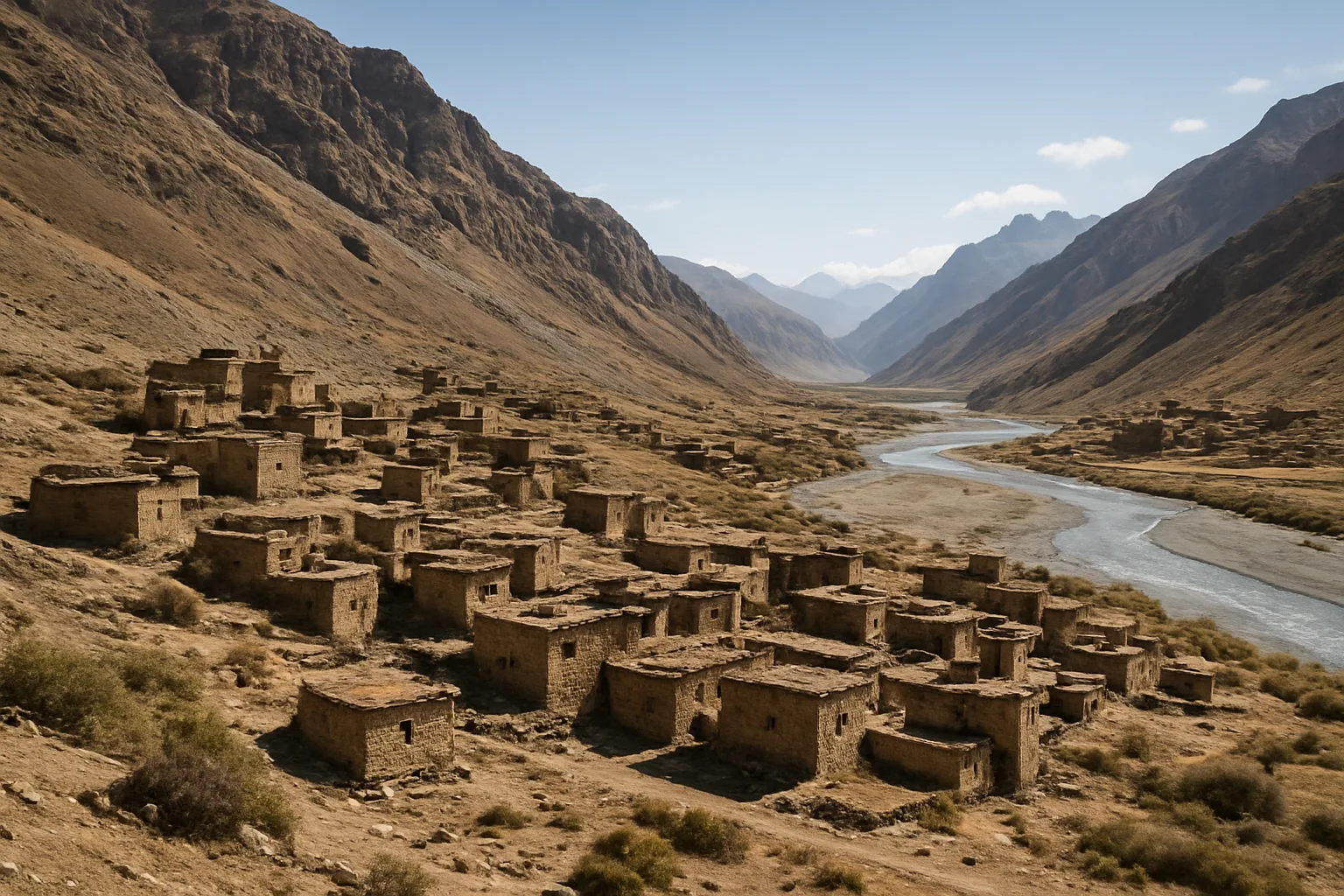
The faint sound of water echoes through the narrow gorges as dusk falls along the Chandrabhaga River. A thin mist gathers, clinging to terraced slopes and ancient footpaths winding through the high-altitude silence. The Spiti River, a distant sibling, carves its own lonely course through a stony desert to the east. Long before the arrival of written records, before the boundaries of Lahaul and Spiti were drawn, these rivers witnessed the earliest human footsteps in the upper Himalayas—a world shaped by harsh seasons, towering peaks, and the restless flow of water.
Between Myth and Memory: The Land Before History
Oral traditions passed down by Lahauli and Spitian elders speak of ancestors who emerged from the earth itself, guided by spirits dwelling in rocks, rivers, and the open sky. Ancient ballads recall migrations, mysterious strangers, and the taming of wild riverbanks. In these tales, myth and memory entwine, offering glimpses into how the first settlers understood their world: as a place alive with unseen power, where survival depended on respecting both land and spirit.
Yet beyond these evocative tales, archaeological evidence and regional chronicles—such as those later compiled in the Imperial Gazetteer and the Tibetan chronicles of Ladakh—suggest early habitation stretching back to the late Stone Age. Stone tools found in cave shelters near Udaipur and Tabo hint at a hardy presence, sustained by hunting, herding, and the slow domestication of highland crops. The region’s stark beauty was, for these earliest people, both sanctuary and test.
Rivers as Lifelines: First Settlements Emerge
The Chandrabhaga (known downstream as the Chenab) and the Spiti Rivers have always been more than mere waterways. In a land where arable ground is scarce, their alluvial fans offered narrow ribbons of fertility. It is here, on sunlit terraces above the floodplain, that the first semi-permanent hamlets took root. Early dwellings, likely constructed from stone, mud, and timber, clustered around springs and seasonal streams.
By the late Bronze Age and early Iron Age, the valleys supported small but enduring communities. Their survival depended on a delicate balance: cultivating barley and buckwheat in short summers, tending yaks and sheep, and storing away food for the long, snowbound winters. The settlements—never large, but remarkably tenacious—became the nuclei around which later societies would form.
Belief and Worldview: Sacred Landscapes
The high valleys of Lahaul and Spiti, remote even by Himalayan standards, fostered unique belief systems. Long before Buddhism or Hinduism took root, local animistic traditions flourished. Every glacier, prominent rock, and mountain pass was believed to house a deity or spirit. The practice of erecting cairns and offering stones along pilgrim routes, still visible today, began in these early days as acts of propitiation and gratitude.
Oral histories recount the exploits of local deities—such as the fierce goddess of the Kunzum Pass or the river spirits of the Chandrabhaga—whose favor was sought for safe passage and bountiful harvests. These beliefs, woven into daily life, shaped communal rituals and seasonal festivals that persist in adapted forms to this day.
Paths Through the Mountains: Trade and Encounter
Despite their isolation, the valleys of Lahaul and Spiti were never wholly cut off from the wider world. Ancient trails—some lost, some still used—linked these settlements to the Indus Valley to the west, Tibet to the east, and the plains of India far below. The passes of Baralacha, Kunzum, and Rohtang, though perilous, became arteries of exchange.
- Salt and Wool: Caravans from Tibet brought salt, wool, and turquoise, which were traded for barley, medicinal herbs, and handicrafts from the southern valleys.
- Ideas and Rituals: Along with goods came new ideas—early forms of shamanism, evolving cosmologies, and eventually, the first hints of Buddhism and Hinduism, carried in the memories of travelers and monks.
These early trade routes laid the groundwork for later political and religious transformations, making Lahaul and Spiti a crossroads, not only of goods, but of cultures and belief systems.
From Clan to Community: The Rise of Local Polities
As centuries passed, scattered settlements began to coalesce into loosely organized clans and chiefdoms. Oral genealogies preserved among Lahauli and Spitian families trace descent from legendary founders—warriors, priests, or migrants from distant lands. By the early medieval period, these groups had begun to assert control over specific valleys, passes, and trade rights.
While early political structures were fluid and kin-based, the seeds of future hill states—such as the Thakurs of Gondhla and the Nono rulers of Spiti—were already being sown. These proto-states would later feature in Tibetan and Indian chronicles as the region’s first recognized rulers, negotiating autonomy at the margins of greater empires.
Legacies in Stone and Song
Much of what we know of these early settlements comes not from grand monuments, but from the landscape itself: the remains of ancient irrigation channels, the weathered outlines of stone pens, and the persistent echoes of folk songs recounting winter hardships and summer migrations. Regional gazetteers compiled during colonial times, and the painstaking oral histories recorded by modern ethnographers, together help us reconstruct the mosaic of early Lahaul and Spiti.
These ancient roots—mythic, material, and communal—continue to shape the region’s identity. The rhythms of river and mountain, the fierce independence of small communities, and the reverence for sacred landscapes remain as vital today as they were millennia ago. In the next part of this series, we will journey further into the early medieval era, tracing the consolidation of local states and the arrival of new faiths that would forever alter the cultural tapestry of Lahaul and Spiti.
Previous: Prehistoric Human Presence in Lahaul and Spiti
Next: Ancient Trade Routes Across the High Himalayas