
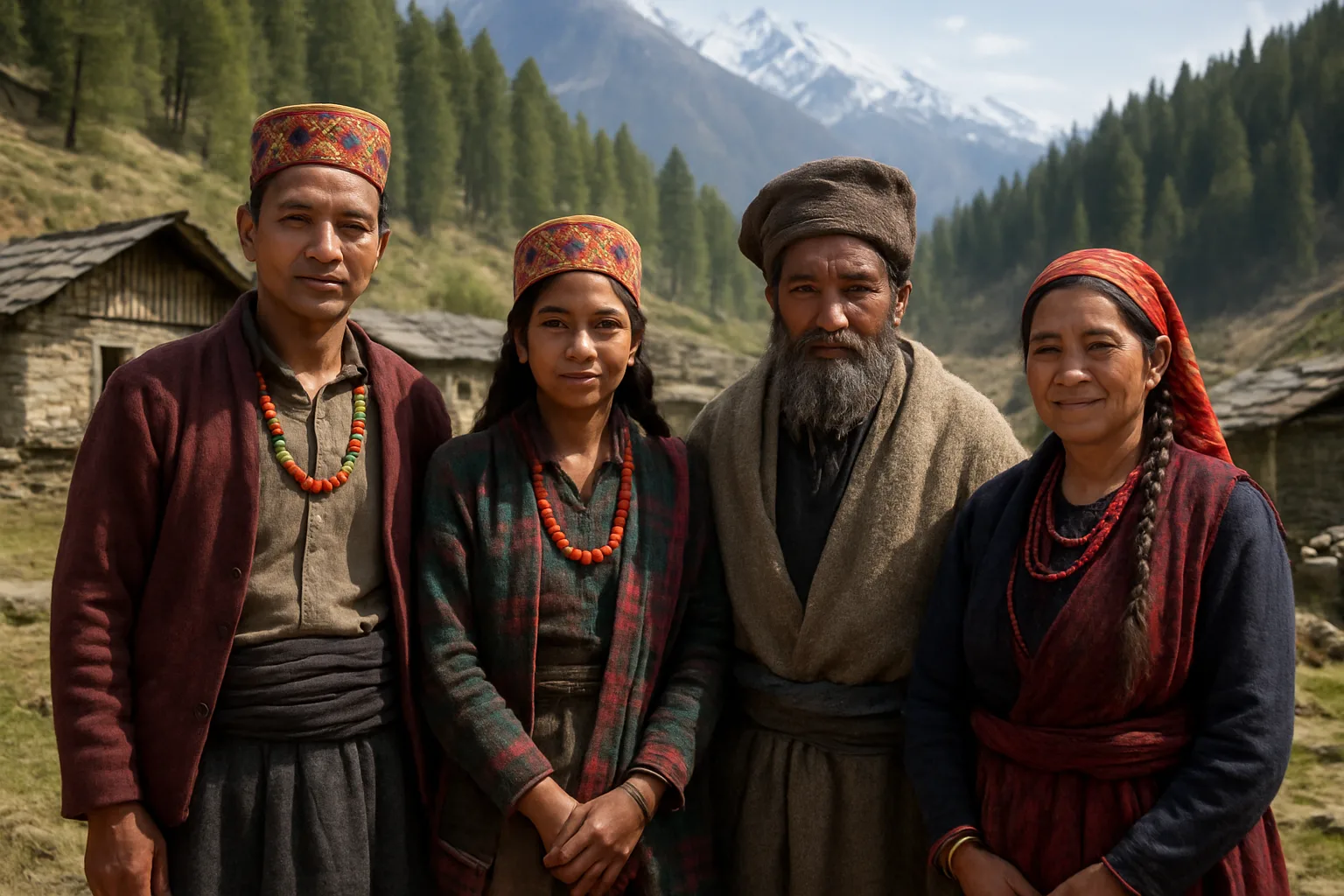
Series: History of Kullu, Himachal Pradesh, India
Phase 1: Ancient & Mythological Roots — Part 4 of 30
This article is part of a broader historical series exploring the earliest layers of human presence in the western Himalayas. Beginning with landscape, belief, and early patterns of movement and settlement, the series traces how communities adapted to mountainous environments long before formal states or written records emerged. These foundational centuries shaped cultural memory, local traditions, and relationships with the land that would endure through later periods of change.
In the Shadow of the Himalayas: Dawn in the Valley
The first rays of sunlight spilling over the jagged ridges of the Greater Himalayas reveal a landscape at once timeless and alive. Millennia before the world would know the word “Kullu,” these high valleys echoed with the rhythms of hunter-gatherers, shifting settlements, and the pulse of tribal life. The Beas River—then as now—was more than mere geography; it was the lifeblood threading together disparate communities, shaping the earliest human stories in this corner of Himachal Pradesh.
Today, scholars and villagers alike walk the same riverbanks, passing stones and shrines whose origins are often lost in the mists of oral tradition. Yet beneath the layers of myth, archaeological hints and old chronicles allow us to glimpse the real communities that first called Kullu home—long before the rise of kingdoms or the ink of chroniclers.
Ancient Footprints: A Historical Anchor
Evidence of human settlement in the upper Beas valley stretches back to the Neolithic period, c. 2000 BCE and earlier, as suggested by scattered implements and ancient habitation sites. In the Kullu valley, the earliest communities were likely drawn by the region’s sheltered valleys, abundant forests, and the perennial waters of the Beas. Early records—such as those referenced in the Imperial Gazetteer of India and regional folk histories—note that long before the arrival of Vedic or later Indo-Aryan groups, the land was home to indigenous tribes with distinctive customs and beliefs.
Here, myth and memory intertwine. Local oral traditions recall a time when the land was called “Kulantapitha”—the end of the habitable world—hinting at the awe the mountains inspired in their earliest inhabitants. But beyond myth, traces of ancient settlements and burial practices reveal a complex tapestry of tribal life, distinct yet interconnected with the wider Himalayan world.
The Earliest Inhabitants: Kol and Kirata Traditions
Among the many groups who have left their mark on Kullu’s ancient story, the Kol and Kirata peoples are most often remembered. The Kols—a term found across northern India—were a broad grouping of proto-Austroasiatic or pre-Dravidian tribes, living by hunting, gathering, and modest agriculture. In Kullu, their presence is reflected in folk memory and the survival of certain animistic rituals, often centered on sacred groves and stones.
Close on their heels came the Kiratas, a people frequently mentioned in Sanskrit epics such as the Mahabharata and in Puranic lore. The Kiratas were famed as mountain dwellers, skilled hunters, and archers—occupying the forests and uplands from the eastern Himalayas to the valleys of Himachal. In early Kullu, the Kirata presence is memorialized in both local legend and the persistence of certain names and festivals, suggesting a deep-rooted influence on the valley’s social fabric.
Belief Systems and Sacred Geography
Kullu’s ancient tribal communities lived within a landscape alive with spirits and deities. The earliest belief systems were deeply animistic, revering local mountains, rivers, trees, and stones as abodes of power. Rituals involved communal feasting, offerings to natural forces, and seasonal festivals marking the rhythms of agriculture and the hunt.
Some of these traditions survive in the valley’s living customs: the veneration of local deities (devtas), the importance of sacred groves, and the role of village councils in religious life. The later arrival of Vedic and Brahmanical influences did not erase these beliefs but blended with them, producing an intricate religious mosaic that remains visible in Kullu today.
Trade Routes and Contact with the Wider World
Even in prehistoric times, Kullu was never truly isolated. The Beas valley formed a natural corridor between the plains of Punjab and the high passes leading towards Tibet and Ladakh. Early trade routes traversed these mountains, facilitating the exchange of salt, wool, grains, and—inevitably—ideas. Oral tradition holds that traders and pastoralists from distant lands would pass through, sometimes settling, sometimes moving on, but always leaving traces of their language and craft.
By the early centuries BCE, these routes had grown into arteries of commerce, drawing in influences from the west and the trans-Himalayan east. The region’s strategic position would, in time, attract the attention of emerging hill states and ambitious rulers, but for centuries it remained a crossroads animated by tribal autonomy and seasonal migration.
Emergence of Early Hill States
The transformation from tribal autonomy to organized hill polities occurred gradually. The earliest references to proto-states in Kullu appear in oral and written traditions around the start of the first millennium CE. According to the Kullu Gazetteer and local chronicles, it was during this period that the valley’s tribes began to coalesce under chieftains—often linked to legendary founders or semi-divine ancestors.
The process was not one of abrupt conquest but of negotiation—alliances forged through marriage, ritual, and shared defense against rivals. Over time, clusters of villages formed loose confederations, laying the groundwork for the emergence of the Kullu rajas who would later dominate the region’s politics. Yet even as centralized authority grew, the memory of tribal origins persisted in customary law, religious practice, and the enduring autonomy of village institutions.
Legacy of the First Settlers
Much of what defines Kullu today—its festivals, its fierce attachment to local identity, its reverence for the land—has roots in these ancient tribal communities. The Kol and Kirata peoples may be gone in name, but their imprint lingers in language, custom, and the valley’s distinctive sense of place. Even the rhythms of daily life, from the annual fairs to the structure of village councils, echo patterns set down thousands of years ago.
As we trace Kullu’s journey from tribal autonomy to the rise of its first kingdoms, the region’s history reveals not a break with the past, but a deep, living continuity. In the next part of our series, we will follow the story as the valley’s early polities consolidate power, myth and history intertwining ever more closely—shaping the cultural and political landscape that defines Kullu to this day.
Previous: Early Human Settlements in the Beas Valley
Next: Geography and Isolation in Ancient Kullu History