
Series: History of Kullu, Himachal Pradesh, India
Phase 3: Religion & Culture — Part 11 of 30
This article belongs to a historical series examining how expanding empires and regional powers reshaped life in the western Himalayan hills. As external influences pressed into the mountains, local rulers navigated diplomacy, resistance, and accommodation. This phase explores how wider political currents intersected with entrenched hill traditions, altering governance without entirely displacing older structures.
A Valley Awaits: Kullu Before Raghunath
On a crisp autumn morning centuries ago, the mist curling above Kullu’s riverbanks seemed to pause—as if the land itself sensed a momentous arrival. The Beas River, keeper of countless stories, wound through the valley as it had since time immemorial, its banks lined with cedar and pine. This was a crossroads, not just of ancient trade but of old beliefs, rural settlements, and emerging states. Before the Raghunath Temple cast its long shadow over local consciousness, Kullu’s spiritual landscape was fragmented, alive with oral traditions, animistic rites, and the worship of local deities known as devtas.
Kullu’s earliest communities lived in small, scattered hamlets, their lives intimately tied to the rhythms of the mountains. The valley, referenced in the Rajatarangini and later regional gazetteers, was a place of both seclusion and passage. Traders, pilgrims, and exiles passed through this corridor connecting the Punjab plains to the Himalayan heartlands, carrying not only goods but stories—some destined to reshape the land forever.
Belief Systems Before the Temple
The people of early Kullu held their world together through faith in an invisible order, reflected in their devotion to the ever-present devtas. These local gods—each with their own shrines, legends, and festivals—acted as both protectors and arbiters of justice. Oral tradition holds that entire villages would gather for night-long rituals, drums echoing across the valley, as priests entered trance to convey the will of the divine.
Unlike the major urban centers of the plains, Kullu’s religious life was decentralized. Instead of grand temples, sacred groves and stones marked the locations where the spiritual and material worlds touched. The hill polity, ruled by chieftains and early rajas, often sought the approval of these gods before waging war or negotiating marriages. These beliefs were not static; as trade routes brought new influences, there was a gradual blending of Shaiva, Vaishnava, and even Buddhist practices, especially along the old salt routes crossing the Rohtang and Jalori passes.
The Political Landscape and the Arrival of Raghunath
By the early 17th century, Kullu’s chieftaincies had coalesced into a more defined kingdom, ruled by the Sen dynasty. Regional chronicles recall Raja Jagat Singh as a ruler tormented by guilt, whose search for redemption would transform not only his own fate but the valley’s religious axis. The legend—rooted in both oral tradition and written records—speaks of the Raja’s encounter with a Brahmin named Damodar Das, who claimed to possess a sacred image of Lord Raghunath (a form of Lord Rama) from Ayodhya.
This moment, as narrated by generations of priests and chroniclers, marks a pivotal turning point. Whether one accepts the miraculous elements of the tale or views it as a shrewd act of statecraft, the arrival of the Raghunath idol in Kullu is firmly documented in both local records and later colonial gazetteers. The Raja’s decision to install Raghunath as the valley’s chief deity established a new spiritual and political order—one that would ripple through every level of Kullu society.
Building the Temple: Ritual, Power, and Community
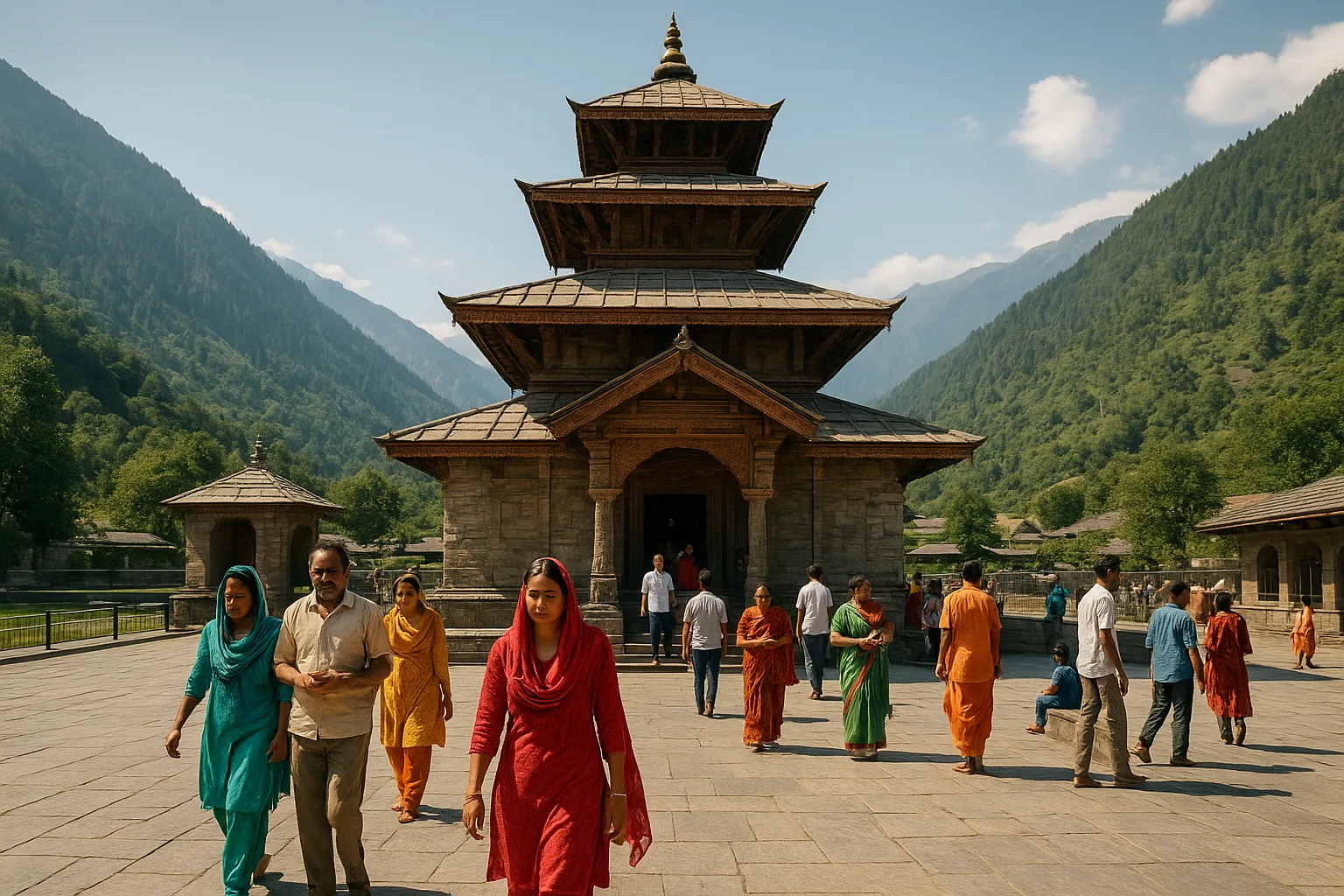
The construction of the Raghunath Temple, set atop a gentle slope in Sultanpur, was more than an act of devotion. It was a statement of sovereignty. With its modest stone walls and tiered wooden pagoda roof, the temple fused local architectural idioms with the grandeur expected of a royal shrine. Here, faith and politics became inseparable. The Raja, now a penitent devotee, declared Raghunath the reigning king of Kullu, demoting himself to the deity’s humble servant.
Historical inference suggests that this act was as much about consolidating royal authority as it was about personal redemption. By linking his dynasty to the pan-Indian cult of Rama, the Raja could appeal to a wider spiritual community, while simultaneously anchoring his legitimacy in the valley’s unique traditions. The temple became a focal point for the famous Kullu Dussehra, a festival that drew hill gods and pilgrims from across the region—transforming a local event into an annual convergence of faith and festivity.
Myth, Memory, and the Making of a Sacred Center
Over generations, the story of Raghunath’s arrival grew in the telling. Oral tradition embroidered the facts: some spoke of the idol journeying across rivers on its own, others of miracles that proved its divine favor. Yet beneath these mythic layers, the documentary record is clear—the temple catalyzed a shift in Kullu’s religious geography. Local devtas were now woven into the annual Dussehra procession, acknowledging Raghunath’s primacy while preserving their own roles.
Chronicles such as the Kullu gazetteer and records left by early British administrators in the 19th century provide a more detached, if still fascinated, perspective. They note how the temple’s influence extended beyond ritual, fostering a sense of valley-wide identity. Here, faith and memory took root together, making the Raghunath Temple not just a place of worship, but a living archive of Kullu’s evolving culture.
Trade, Pilgrimage, and the Expanding World of Kullu
With the rise of the temple, Kullu’s profile changed along the ancient Himalayan trade arteries. Pilgrims began to arrive from distant valleys, drawn by tales of Raghunath’s grace. The temple’s festivals offered opportunities for barter and exchange, attracting merchants from Ladakh, Tibet, and the Punjab. It was here, in the bustling squares during Dussehra, that diverse communities mingled—shepherds, traders, artisans, and ascetics—each finding a place in the new religious order.
Yet for all this outward openness, the core of Kullu’s spiritual life remained deeply local. The annual gathering of the devtas at Dussehra was a negotiation, both ceremonial and political, between the old and new powers. The temple, while a unifying force, never erased the valley’s older traditions; instead, it adapted, incorporating them into a uniquely Kullu identity.
Echoes Through the Centuries: Raghunath’s Enduring Legacy
Today, as the temple bells echo over Sultanpur and the Beas flows on, the legacy of that turning point is felt in every corner of Kullu life. The Raghunath Temple remains both a place of worship and a symbol of unity, its annual festivals drawing together a patchwork of beliefs and histories. The rituals, processions, and stories that began centuries ago continue to shape how Kullu imagines itself—rooted in ancient faith, yet open to the world’s currents.
As we follow this series deeper into Kullu’s religious and cultural evolution, the next chapter will explore how local art, architecture, and oral traditions flourished under the temple’s influence, weaving new patterns into the valley’s enduring tapestry.
Previous: Agriculture and Economy of Medieval Kullu
Next: Kullu Dussehra: Origins of a Royal Festival