
Series: History of Kinnaur, Himachal Pradesh, India
Phase 5: Modern Era — Part 29 of 30
This article appears within a continuing historical series that follows the western Himalayas into the modern era. With the end of princely rule and the integration into independent India, long-standing social and political patterns were reconfigured. This phase examines how development, state formation, and memory interact with inherited landscapes, shaping contemporary life while carrying forward echoes of the past.
Moonlit Valleys: Where Stories Breathe
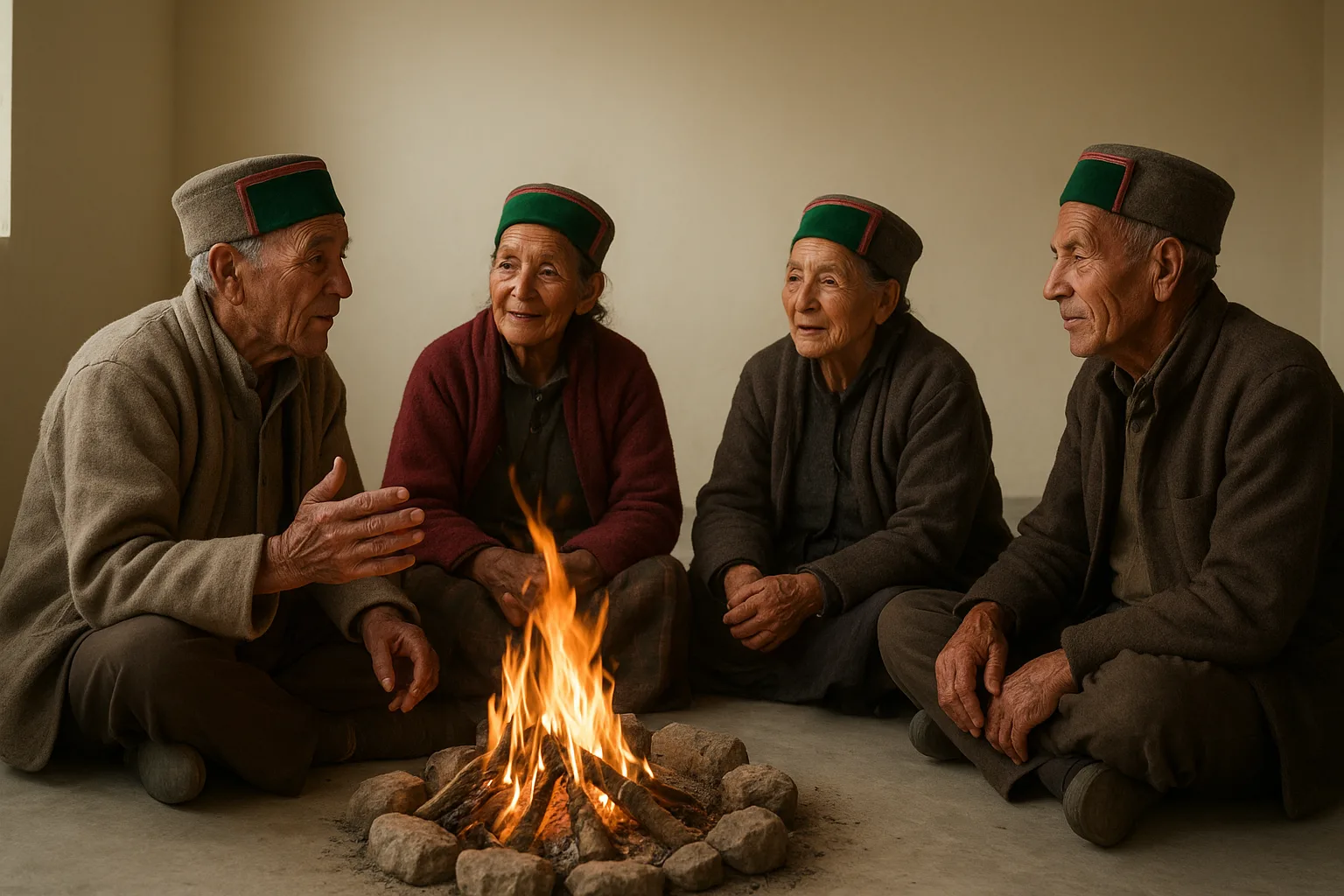
Night settles quickly in the high valleys of Kinnaur. The wind, scented with pine and snow, sweeps down slopes where scattered hearths glow faintly. Inside a wooden house in Sangla, a circle forms around the fire. An elder’s voice rises, weaving a tale of giants, spirits, and the great river Sutlej. For centuries, Kinnaur’s people have gathered like this—passing on their histories, beliefs, and warnings not through ink and parchment, but in the living breath of story.
The Land and Its Early Settlers
Cradled between the towering Zanskar and Greater Himalayas, Kinnaur has long been a crossroads—remote, yet open to influences from the plains, Central Asia, and Tibet. By the early centuries CE, this region, then known in ancient Sanskrit texts as Kinnaradesha, was home to semi-nomadic tribes—most prominently, the Kinners. Early accounts, echoed in Rajatarangini and regional gazetteers, describe these people as skilled in song and dance, living in harmony with their formidable environment. The rhythms of their daily lives—herding, cultivating barley and buckwheat, trading salt and wool—were punctuated by festivals and rituals that would become the core of Kinnauri oral tradition.
Myth, Memory, and the Divine
Oral traditions in Kinnaur do not merely recall the past; they infuse it with the supernatural. The Kinners, mentioned in the Mahabharata and Buddhist Jataka tales, were imagined as celestial musicians, their origins straddling the human and divine. In local folklore, these stories are localized: ancestors are said to have descended from the gods or to have bargained with spirits for their lands. The tales of Chitkul’s Badrinarayan, the fierce Chango Devi, or the shape-shifting Banasur are more than entertainment—they encode warnings, values, and a sense of belonging.
Yet, there is a marked distinction between myth and memory. While local bards—called Harijans and Dashans—recite epics that blend cosmic battles with the exploits of local heroes, the same narratives often carry echoes of historical migrations, climatic disasters, or ancient conflicts. For example, the recurring motif of bridges built with the help of spirits may allude to the region’s early engineering feats—and to the perilous task of taming the Sutlej’s wild waters.
Oral Traditions and Historical Inference
Scholars have long debated how to separate legend from fact in Kinnaur’s oral heritage. Early British administrators, such as A.H. Francke and C.T. Atkinson, recorded local stories in their gazetteers, noting how tales of clan feuds or miraculous escapes often aligned with the physical remnants of ruined forts or ancient trade paths. These stories, passed from grandparent to child, preserve kernels of historical memory—migrations from the Tibetan plateau, alliances forged through marriage, or the rise and fall of minor hill chieftains.
For instance, the legend of the Bering Nag temple at Sangla, said to be built atop a serpent’s lair, likely echoes the assimilation of ancient animist cults into later Hindu and Buddhist practices. Similarly, stories recounting the arrival of Buddhist saints, such as Padmasambhava, often mark the gradual adoption of new religious ideas amid older beliefs. Through such tales, the oral tradition becomes a palimpsest: myth layered over memory, memory layered over landscape.
Belief Systems Across the Valleys
Kinnaur’s oral traditions are not uniform. Distinct communities—Chitkulis, Kanets, Rajputs, Scheduled Tribes—have preserved their own versions of the past, shaped by geography and contact. In the lower valleys, tales often center on Hindu deities and their local incarnations. Higher up, close to the Indo-Tibetan border, stories reflect the imprint of Tibetan Buddhism: tales of the Lama who tamed wild rivers, or the Chosgyal kings who ruled by divine mandate.
Yet, across Kinnaur, there are shared motifs: the sanctity of the land, the cyclical struggle between order and chaos, and the uneasy peace with the supernatural. Oral traditions reinforce social norms too—taboos around sacred groves, festivals like Phulaich or Sazo that mark the seasons, and the invocation of ancestors before major undertakings. Storytelling is thus both a social glue and a means of navigating the uncertainties of mountain life.
Trade Routes, Hill States, and Storytelling
The great Himalayan passes—Shipki La, Nako, and Hangrang—have for centuries linked Kinnaur to Tibet and beyond. Along these routes, traders carried not just salt, wool, and turquoise, but also tales. Stories of distant lands, miraculous escapes from avalanches, and encounters with foreign merchants were woven into the local fabric. Early settlements like Kalpa, Pooh, and Morang became centers for both commerce and culture, where new ideas mingled with ancient lore.
By the late medieval period, small hill states emerged, each with its own oral chronicles—praises for local rulers, laments for lost battles, and genealogies tracing noble descent to both earthly and divine ancestors. These narratives, though often recast to bolster political legitimacy, remain a vital source for reconstructing Kinnaur’s fragmented history. As the region’s political map shifted under the Mughals, Gurkhas, and eventually the British Raj, oral traditions adapted, preserving the memory of resistance and accommodation alike.
Echoes in the Present
Today, Kinnaur’s oral traditions are not relics—they are a living heritage. Children still gather to hear stories of gods and ghosts, elders recall ancestral migrations, and festivals continue to blend ancient myth with contemporary identity. The valleys echo with the same rhythms that guided the Kinners centuries ago, even as new influences reshape the land. In the next part of our series, we journey into Kinnaur’s modern era, tracing how these deep roots continue to shape its people’s sense of belonging—and how the past is retold in the face of change.
Previous: Preserving Tribal Identity in a Changing World
Next: Kinnaur’s Past, Present, and Future