
Series: History of Kinnaur, Himachal Pradesh, India
Phase 5: Modern Era — Part 25 of 30
This article appears within a continuing historical series that follows the western Himalayas into the modern era. With the end of princely rule and the integration into independent India, long-standing social and political patterns were reconfigured. This phase examines how development, state formation, and memory interact with inherited landscapes, shaping contemporary life while carrying forward echoes of the past.
Early Mornings in Sangla: A New Rhythm in the Valley
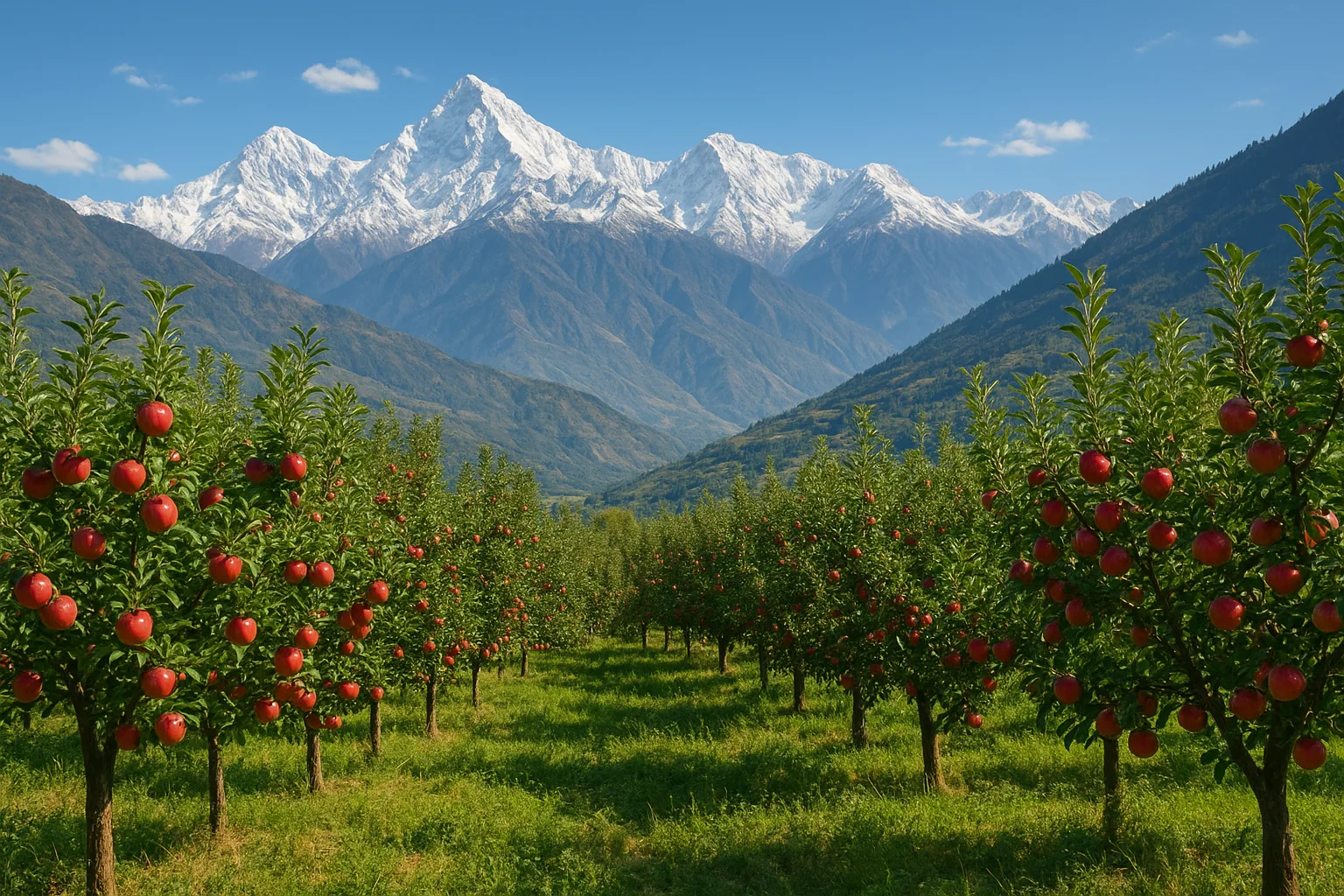
The first rays of sun slip quietly over the snow-draped peaks of Kinnaur. In villages like Sangla or Kalpa, the mountain air buzzes with anticipation as men and women file into terraced orchards, baskets slung across their backs. The crispness of the morning is punctuated by the sweet scent of ripening apples—a sight that, for most of Kinnaur’s long history, would have seemed improbable.
Yet this landscape, where the apple tree now reigns, is a relatively recent transformation. For centuries, these valleys were shaped by the rhythms of barley, buckwheat, and polycultural subsistence. The journey from those ancient grains to the apple’s red promise is one of both adaptation and upheaval—a tale etched into the very slopes of the Himalayas.
Ancient Roots: Kinnaur Before Apples
Kinnaur’s recorded history stretches back into the mists of myth and memory. Oral traditions among the Kinnauras speak of the region as the mythical land of Kinner Kailash, home to both gods and mortals. Early chronicles, such as those referenced in the Gazetteer of the Kangra District (1883), describe a people adept at navigating harsh terrain, trading with Tibet, and living in close kinship with the land. Here, belief systems intertwined Hindu and Buddhist cosmologies, with local deities—devtas—presiding over every brook and forest.
Archaeological evidence and early British surveys suggest that by the medieval period, small hamlets clustered along the Sutlej and Baspa rivers. These communities relied on hardy grains, animal husbandry, and the rich barter networks that linked Ladakh, Tibet, and the Indo-Gangetic plains. The idea of large-scale horticulture, let alone monoculture orcharding, was not yet even a distant dream. Instead, survival depended upon diversity—of crops, skills, and social ties.
Colonial Encounters and the Seeds of Change
When British administrators first ventured into Kinnaur in the 19th century, they encountered a region at the crossroads of tradition and modernity. The political history of the area—once loosely tied to the Bashahr state, and before that, influenced by the rise and fall of hill kingdoms—had left Kinnaur relatively autonomous and inward-facing. The British, fascinated by its strategic location along the Hindustan-Tibet road, began to document its customs and economies with a meticulous, sometimes intrusive, gaze.
Horticultural experiments in British-run hill stations, especially in Shimla and the adjoining valleys, had already introduced the idea of temperate fruit cultivation. Yet, in Kinnaur, such ideas took time to take root. The region’s remoteness, combined with its extreme winters and the conservatism of local tradition, meant that apples remained a curiosity—a novelty imported by a handful of enthusiastic administrators and missionaries.
The Arrival of Apples: Visionaries and Early Pioneers
The turning point came in the turbulent decades following India’s independence. In the 1950s, Samuel Evans Stokes—later known as Satyanand Stokes—had already revolutionized apple cultivation in Himachal Pradesh’s Kotgarh region. His efforts inspired local elites and progressive farmers to experiment with apple saplings in Kinnaur’s high-altitude climate. Oral accounts recall the skepticism of elders, who doubted whether the delicate trees could survive the punishing winters. But a handful of visionaries persisted, grafting foreign varieties onto local rootstock and carefully tending the first orchards on the sunniest slopes.
By the 1960s and 1970s, aided by government extension programs and improved road access, apple cultivation began to spread from village to village. The crop’s success was dramatic. Apples thrived in Kinnaur’s cold nights and brilliant days, yielding fruit of exceptional color and flavor. The region’s isolation, once a barrier, now became a blessing, protecting orchards from pests and diseases plaguing other parts of the state.
Transformation of the Landscape and Society
The story of Kinnaur’s apple boom is not merely agricultural—it is the story of an economic and social revolution. Fields that once bore barley and buckwheat gave way to neat rows of apple trees. As apple harvests grew, so did the rhythms of life: the calendar now marked not just religious festivals, but cycles of pruning, flowering, and picking. The arrival of laborers from lower Himachal and Nepal during picking season brought new faces and customs, subtly reshaping the social fabric of once-insular communities.
Economic change followed swiftly. Apple incomes allowed families to build sturdier homes, send children to schools in Rampur and Shimla, and invest in vehicles and farm equipment. The traditional barter economy faded, replaced by cash transactions and bank accounts. Yet, these changes came with challenges: the dependence on a single cash crop left families vulnerable to market fluctuations, unpredictable weather, and the whims of distant traders. Stories abound of years when hail or bureaucratic mismanagement wiped out livelihoods overnight.
Identity, Environment, and Modern Tensions
By the late 20th century, Kinnaur had become almost synonymous with apples. The fruit became a symbol of the region’s success, appearing in local festivals and even political campaigns. Yet, beneath the glossy surface, new tensions simmered. The spread of orchards led to deforestation and water shortages in some areas, igniting debates over sustainability. The traditional polyculture, with its ecological resilience, was now a memory for many elders. Younger generations, raised on stories of apple prosperity, faced the pressures of fluctuating prices and the need to innovate—experimenting with new varieties, organic practices, or even diversifying back into traditional crops.
At the same time, questions of identity grew sharper. As outside influences arrived—tourists, traders, and new technologies—some in Kinnaur worried about the erosion of language, ritual, and the intricate social codes that once held villages together. Yet, the apple also became a point of pride, a way to assert Kinnaur’s distinctiveness within Himachal and across India.
Echoes of the Past in Today’s Orchards
Standing on a ridge above Kalpa today, one can see the layers of history etched into the landscape. Apple trees, heavy with fruit, share space with ancient temples and stone houses built in the old kath-kuni style. The rituals of the devtas continue, even as mobile phones and market news reach the farthest hamlet. The apple’s journey—from an outsider’s experiment to the lifeblood of Kinnaur’s economy—mirrors the region’s ability to adapt, absorb, and transform while retaining its core identity.
The story is not finished. As climate change, market volatility, and new aspirations shape the future, Kinnaur’s orchards stand as both promise and warning—a legacy of resilience, but also of the risks that come with change. In the next part of this series, we will follow the contemporary debates over sustainability, local governance, and the search for balance between tradition and innovation in Kinnaur’s evolving economy.
Previous: Roads, Connectivity, and Modern Infrastructure in Kinnaur
Next: Tourism and Cultural Exposure in Modern Kinnaur