
Series: History of Kinnaur, Himachal Pradesh, India
Phase 3: Religion & Culture — Part 15 of 30
This article belongs to a historical series examining how expanding empires and regional powers reshaped life in the western Himalayan hills. As external influences pressed into the mountains, local rulers navigated diplomacy, resistance, and accommodation. This phase explores how wider political currents intersected with entrenched hill traditions, altering governance without entirely displacing older structures.
Stone and Silence in the Sangla Valley
An early morning mist clings to the slopes above the Baspa River, its banks punctuated by gnarled deodar and apple orchards. Here in the Sangla Valley, a faint bell rings out, echoing across centuries. In the heart of Kinnaur, the architecture of temples and monasteries has always been more than stone and timber: it is an enduring conversation with wind, faith, and the mountain gods themselves.
Kinnaur’s location—nestled between the Greater Himalaya and the Trans-Himalayan ranges—has shaped every facet of its heritage. By the time the first oral epics were sung in these valleys, the region had already become a crucible of cultures, straddling the ancient trade arteries of the Hindustan-Tibet route. The earliest communities here, ancestors of today’s Kinnauras, settled along rivers, carrying with them animist beliefs intertwined with the rhythms of the land.
Legend and Memory: Roots of Sacred Spaces
Oral traditions in Kinnaur speak of a time when the gods themselves walked these hills. Stories of the Pandavas’ exile, of deities like Maheshwara and the enigmatic local goddess Chitkul Devi, are woven into the very foundations of village temples. Yet, these tales—while powerful—are best understood as the region’s poetic memory, rather than precise historical record.
Historical inference, drawn from regional chronicles and gazetteers compiled during the British period, points to the gradual coalescence of local hill states from the 10th century onward. With the emergence of small polities such as Bushahr and Kamru, patronage of temple construction became a visible statement of both political legitimacy and continuity with the sacred landscape.
Wood, Stone, and the Himalayan Imagination
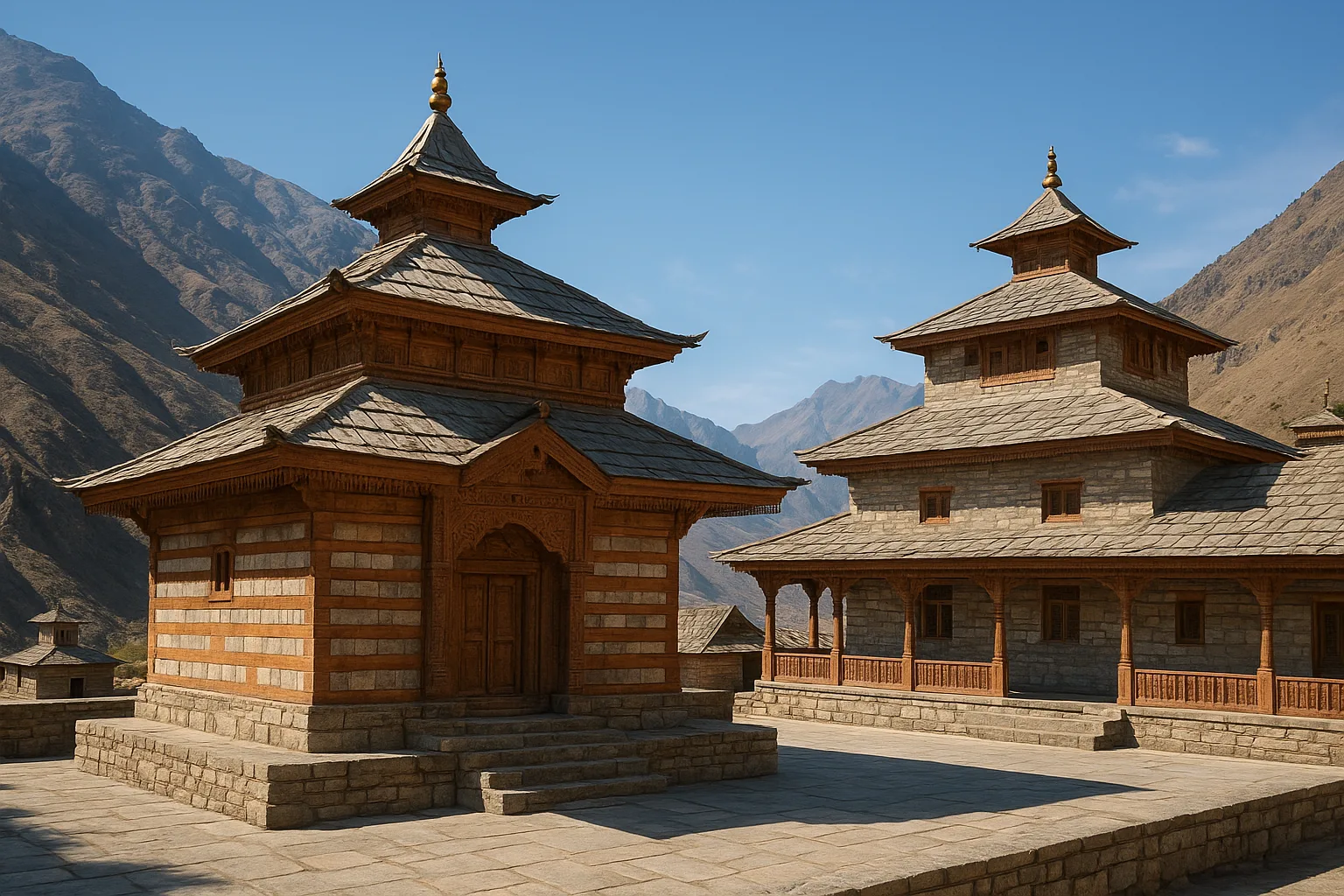
The architecture that evolved in Kinnaur bears witness to this unique confluence. Unlike the grand stone temples of the Indian plains, Kinnauri shrines are shaped by the dictates of climate and topography. At their core is the Kath-Kuni style: alternating layers of dressed stone and timber, ingeniously earthquake-resistant and suited to the region’s harsh winters.
Walk through the precincts of the Badrinath Temple at Kamru or the centuries-old Mathi Temple in Chitkul, and the interplay of wood and slate is unmistakable. Carved deodar beams boast intricate motifs—dragons, lotus flowers, and stylized masks—each echoing a blend of Himalayan iconography and local myth. Roofs slope steeply, clad in shimmering slate, to shed the weight of winter snow.
The walls of these temples are not mute. They bear silent witness to the passage of artisans from Kashmir, Tibet, and the western Himalaya, whose techniques and tools have left indelible marks on lintels and doorways. Each sanctuary, however humble, signals the community’s desire to anchor the divine within the landscape.
Buddhist Monasteries and Himalayan Exchange
Kinnaur’s spiritual geography is not solely Hindu. From the 11th century, waves of Buddhist influence began to ripple through the region, carried by itinerant monks and merchants along the ancient trade routes to Tibet. The monasteries—gompas—that arose in places like Riba, Lippa, and Kanum reflect both the artistic vocabulary of Tibetan Buddhism and the pragmatic genius of local builders.
The Tashi Choling Monastery in Riba stands as a testament to this synthesis. Its whitewashed walls and gently tapering towers, adorned with prayer wheels and thangkas, are unmistakably Tibetan in spirit yet adapted to Kinnaur’s vernacular idiom. Even the orientation of these monasteries, often perched on hilltops or river bends, speaks to a careful reading of geomancy and the Himalayan belief in sacred geography.
Unlike the stone fortresses of Ladakh or Spiti, Kinnauri monasteries are more often intimate, woven into the fabric of village life. This blending of the sacred and the familiar is a hallmark of the region’s religious architecture, bridging the divide between house and shrine, ritual and daily life.
Temple Complexes and Emerging Hill States
As the medieval period gave rise to more structured political entities, temple architecture in Kinnaur began to reflect new ambitions. The Kamru Fort—once the seat of the Bushahr rulers—encloses a remarkable temple complex dedicated to the goddess Kamakhya Devi. Here, the temple’s intricate woodwork serves not only as devotional art but also as a statement of dynastic power and legitimacy.
Regional gazetteers from the late 19th century, such as those compiled by British administrators, note the proliferation of temples in every settlement, large or small. These shrines, often guarded by wooden gates and stone lions, became centers not only of worship but of local governance and seasonal festivals. Pilgrims and travelers, braving the treacherous high passes, would rest in the shade of temple courtyards, exchanging goods and stories under the watchful gaze of carved guardians.
In this way, Kinnaur’s temples became more than religious sites—they were repositories of collective memory and instruments of social cohesion. The architecture itself, with its blend of defensive features and sacred ornamentation, mirrors the region’s perennial balancing act between openness and self-preservation.
Cycles of Renewal: Artistry and Preservation
Time, weather, and periodic earthquake have taken their toll on Kinnaur’s sacred buildings. Yet, the tradition of renewal is as old as the structures themselves. Every generation, master craftsmen and community members gather to repair, repaint, and sometimes rebuild the temples and monasteries that define their villages.
This cyclical process is more than maintenance; it is a reaffirmation of identity. In Kalpa, the Narayan-Nagini temple’s elaborate shikhara—partly destroyed in past fires—has been painstakingly restored using ancient joinery techniques. The collective memory of loss and renewal is etched into every timber, every stone replaced by careful hands.
Today, festivals and rituals continue to animate these spaces. The sound of conch shells, the slow turning of prayer wheels, and the rhythmic chanting of mantras weave the past and present together, making the architecture of Kinnaur a living tradition rather than a relic.
Continuity and Change: Kinnaur’s Sacred Landscape Today
In the shifting light of dusk, the silhouette of a temple roof stands out against the snow-capped peaks—an enduring sign of Kinnaur’s layered history. The architecture of its sacred sites, shaped by centuries of migration, belief, and adaptation, remains at the heart of community life. Despite modern pressures and the challenges of preservation, these temples and monasteries continue to anchor Kinnauri identity, drawing both pilgrims and historians into their orbit.
As we move forward in this series, we will delve deeper into the intangible heritage of Kinnaur: the festivals, rituals, and oral traditions that breathe life into these ancient stones and timbers, ensuring the sacred landscape is as vibrant as ever.
Previous: Festivals and Rituals Unique to Kinnaur
Next: British Entry into the Trans-Himalayan Border Regions