
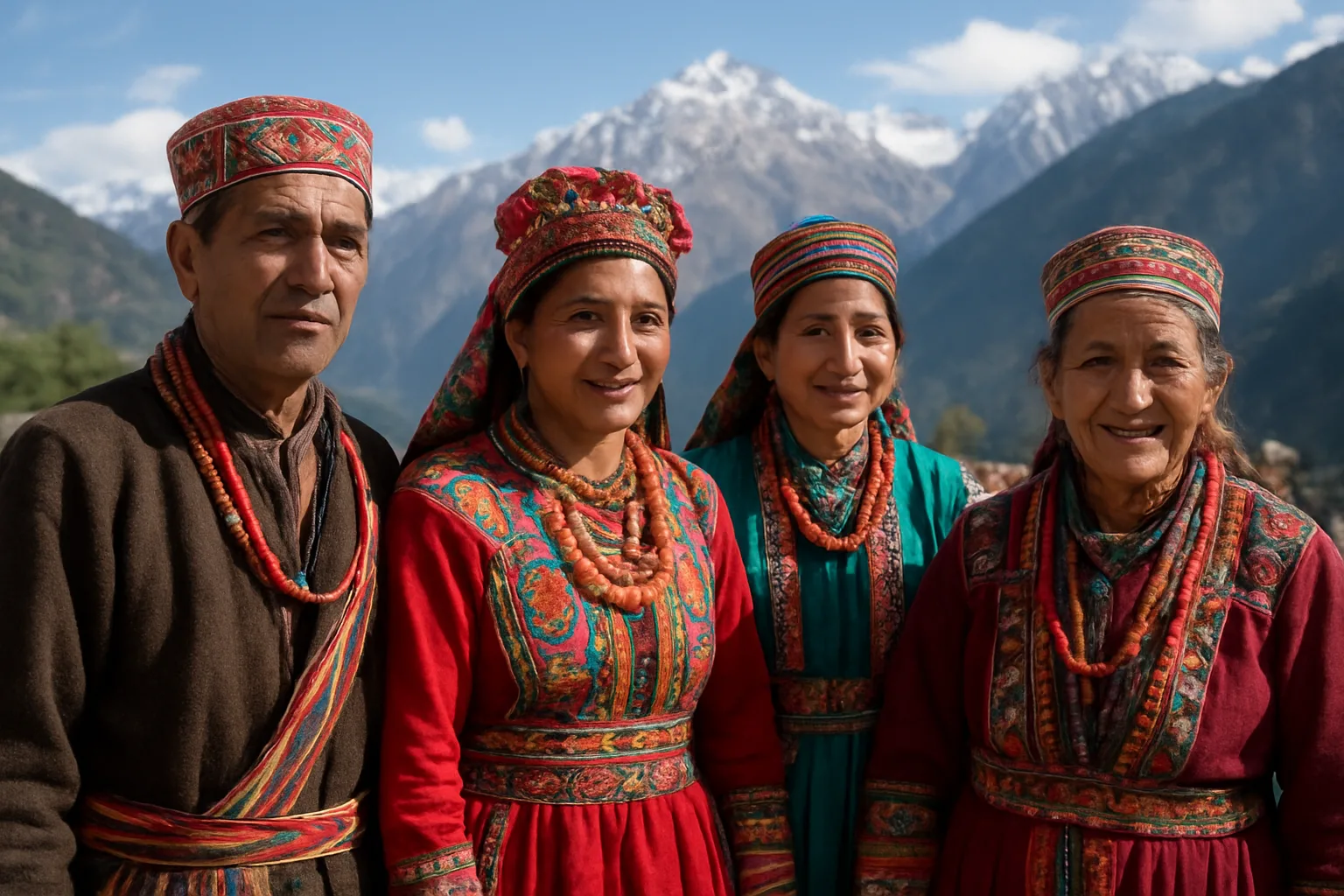
Series: History of Kinnaur, Himachal Pradesh, India
Phase 3: Religion & Culture — Part 14 of 30
This article belongs to a historical series examining how expanding empires and regional powers reshaped life in the western Himalayan hills. As external influences pressed into the mountains, local rulers navigated diplomacy, resistance, and accommodation. This phase explores how wider political currents intersected with entrenched hill traditions, altering governance without entirely displacing older structures.
In the Shadow of Kinner Kailash
It is midwinter in the Sangla Valley, and the snow lies heavy on the cedar roofs of villages scattered along the Baspa River. Smoke curls upward, carrying the scent of burning juniper. Inside the communal temple, elders in woolen coats murmur prayers while young men rehearse masked dances by flickering lamp-light. Outside, the silence of the Himalayas is broken only by the rhythm of a drum. To witness a festival in Kinnaur is to step into a living cycle, where time folds and the ancient world breathes through ritual.
Kinnaur, perched along the Indo-Tibetan frontier of Himachal Pradesh, has always stood at the crossroads of myth and history. As we continue this series examining the region’s cultural fabric, we turn now to the festivals and rituals that have defined Kinnauri identity for centuries—practices where oral tradition, historical memory, and local politics are woven together in ceremony.
Early Settlements and the Roots of Ritual
Long before written chronicles, Kinnaur’s valleys were shaped by a patchwork of tribal communities—Kinners, Kanets, and the descendants of early Indo-Aryan settlers. The region’s severe climate and isolation fostered a close-knit social structure, where communal celebrations offered both spiritual sustenance and pragmatic cohesion. According to oral histories recounted by village bards, the first festivals were offerings to appease mountain deities and guard the fragile harvest from the whims of weather and spirit alike.
Archaeological clues—such as the ancient stone temples at Morang and Kamru—suggest a continuity of sacred practice stretching back at least a millennium. Early travelers’ accounts, including those in the colonial-era Punjab Gazetteer, remark on the distinctiveness of Kinnauri customs, which blend animistic rites with Buddhist and Hindu influences. The annual cycles of sowing and reaping, birth and death, are marked not by solitary prayer but by collective celebration, binding village life to the rhythms of the land.
The Mythic Landscape: Oral Tradition and Living Legend
Festivals in Kinnaur are inseparable from the region’s mythic geography. The towering peak of Kinner Kailash, believed by Hindus to be the winter abode of Shiva, dominates both landscape and imagination. Many rituals, especially the great Phulaich (flower festival), are rooted in stories passed down through generations—stories where gods and ancestors walk the same paths as living villagers.
Phulaich, celebrated in early autumn, is a striking example. Oral tradition holds that the festival was established to honor the spirits of the dead, offering wildflowers plucked from high alpine meadows as tokens of remembrance. Dancers in elaborate costume reenact the journeys of the ancestors, while elders recount tales of the Kinners—mythical beings said to inhabit the mountains and serve as intermediaries between humans and the divine. These legends, while not strictly historical, form the bedrock of communal identity, shaping the rituals that endure today.
Historical Inference: Festivals and the Formation of Hill States
As Kinnaur’s villages grew into loosely organized hill polities, festivals took on new roles as expressions of political authority and social order. The emergence of local chieftaincies, such as the Bushahr state, is mirrored in the formalization of communal rites. Chroniclers record how the rulers of Kamru, the region’s ancient capital, would preside over major festivals, distributing food and gifts as symbols of their legitimacy.
Trade routes linking Kinnaur to Tibet and the plains of India brought new influences—Buddhist lamas, Hindu priests, and itinerant merchants all left their mark. Yet, even as Buddhist festivals like Losar (New Year) and Hindu celebrations such as Dussehra found their place in the calendar, Kinnaur’s unique rituals persisted. The blending of traditions did not erase local identity but enriched it, giving rise to ceremonies that exist nowhere else in the Himalayas.
The Ritual Year: Cycles of Celebration
Kinnauri festivals follow the ancient lunar and agricultural calendar, with each season marked by its own cycle of rituals. Some of the most significant include:
- Phulaich: Also known as the “Flower Festival,” Phulaich is a time of communal gathering and remembrance, where villagers ascend to alpine meadows to collect wildflowers for offerings to ancestors and deities. The festival’s masked dances and processions invoke both joy and solemnity.
- Ladarcha: Once a major trade fair, Ladarcha historically marked the end of the trading season with Tibet. Merchants and villagers would gather in the high passes for barter, song, and feasting—a celebration of both economic and social ties.
- Fagli: Celebrated in late winter, Fagli welcomes the coming of spring. Homes are decorated with intricate patterns of colored flour, and ritual dances drive away the lingering spirits of cold and darkness. The festival’s origins are grounded in both agrarian necessity and mythic symbolism.
- Losar: The Tibetan New Year, celebrated with particular fervor in the upper valleys, blends Buddhist liturgy with local custom—prayers for prosperity and the ritual turning of prayer wheels are accompanied by Kinnauri music and dance.
Each festival is a tapestry of belief: offerings of barley, butter, and local wine; the clangor of cymbals; the masked processions of dancers evoking gods, demons, and animals. Above all, these celebrations reaffirm the bonds of kinship and memory, anchoring the present to a storied past.
Changing Traditions: Modernity and Continuity
In the twentieth century, Kinnaur’s festivals faced new pressures—roads and electricity brought the outside world closer, while migration and education exposed younger generations to different ways of life. Yet the core rituals persist, often adapted but rarely abandoned. Village committees work to ensure that ancient dances and songs are taught to children; temple councils debate the proper order of ceremonies, balancing innovation with reverence for the old ways.
Documented accounts from the post-independence period, including local gazetteers and oral interviews, show that festivals remain vital, not as relics but as evolving expressions of identity. Even as modern governance and tourism reshape the valley, the community calendar revolves around the same ancient cycles—each festival a living link between Kinnaur’s mythic past and its unfolding present.
Ritual in Community Life: Sacred and Social Ties
For Kinnauris, ritual is never merely spectacle. The work of festival preparation—gathering wildflowers, weaving costumes, preparing communal feasts—binds families and neighborhoods across generations. Participation is both a duty and a joy, reinforcing social networks and reaffirming a shared sense of belonging.
In times of hardship—be it famine, political upheaval, or natural disaster—these communal rituals have offered solace and solidarity, channeling collective grief and hope into meaningful action. The line between sacred and secular is blurred; a festival is as much about honoring ancestors as it is about celebrating survival and forging unity.
The Living Heritage of Kinnaur
As the prayer flags flutter on the ridgelines and the echoes of drums carry across the snowfields, Kinnaur’s festivals remind us that history is not only written in chronicles but lived in ritual. The ancient rhythms of celebration—shaped by myth, memory, and necessity—continue to define the valley’s identity, even as the world beyond grows ever more complex. In the next part of this series, we will journey deeper into the sacred architecture and temple traditions that have anchored these rituals for centuries, tracing the stones and stories that keep Kinnaur’s living heritage alive.
Previous: Local Deities and Animistic Beliefs of Kinnaur
Next: Architecture of Temples and Monasteries in Kinnaur