
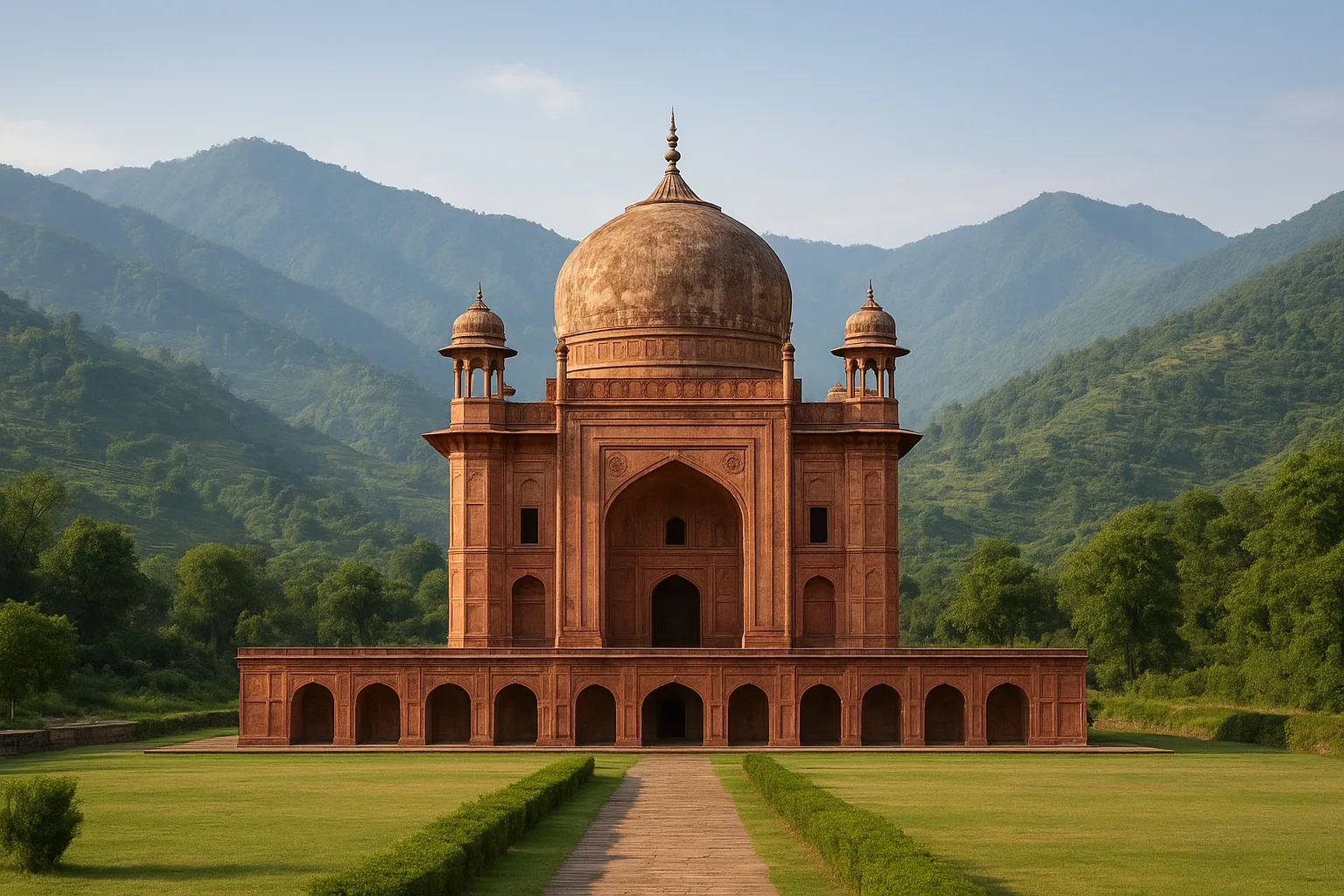
Series: History of Kangra, Himachal Pradesh, India
Phase 3: Mughal & Sikh Era — Part 12 of 30
This article belongs to a historical series examining how expanding empires and regional powers reshaped life in the western Himalayan hills. As external influences pressed into the mountains, local rulers navigated diplomacy, resistance, and accommodation. This phase explores how wider political currents intersected with entrenched hill traditions, altering governance without entirely displacing older structures.
Under the Watchful Eye of the Empire
The first rays of sun slip through cedar groves, gilding the terraced slopes of Kangra Valley, as the sound of conch shells rises from distant temples. It is the early 17th century, and the air carries an unfamiliar tension—a subtle reminder that the valley, with its ancient shrines and bustling bazaars, now lives beneath the shadow of Mughal authority. In the hilltop fort, the banner of Akbar’s empire flutters alongside the royal insignia of Kangra’s Rajput rulers, a potent symbol of the changing order.
The Valley’s Deep Roots: Before the Mughals
Long before imperial messengers wound their way up from the Punjab plains, Kangra’s history ran deep. Oral traditions—still recounted by local bards—trace the region’s lineages to the fabled Trigarta kingdom, mentioned in the Mahabharata. While these stories blur the line between legend and history, there is little doubt that by the 10th century, Kangra had emerged as a significant Rajput principality, its granite fort dominating the valley and its rulers drawing prestige from both warfare and patronage of faith.
Historical chronicles, such as the famed Tarikh-i-Firishta and later British gazetteers, describe a patchwork of hill states—Kangra, Nurpur, Chamba, and others—each governed by dynasties who claimed descent from the solar or lunar lines, their authority tied to both martial prowess and religious legitimacy. Local belief systems, deeply entwined with the land, persisted: Devi temples, Buddhist stupas from earlier centuries, and Sufi shrines all found space on the sacred landscape.
Faiths Intertwined: Temples, Shrines, and the People
Daily life in Kangra’s villages and market towns revolved around ritual and festival. The temples of Brajeshwari and Jawalamukhi drew pilgrims from across the sub-Himalayan region, while the fort itself housed shrines that blended royal patronage with local custom. Oral traditions tell of goddess legends—Sati’s tongue falling at Jwalamukhi, or Durga bestowing victory upon Kangra’s kings. These tales, embroidered over generations, shaped the valley’s self-image as a land blessed by the divine and protected by its rulers.
Yet Mughal rule brought new influences. Sufi mystics, Persian scribes, and traders from Lahore and Kabul arrived, their presence noted in contemporary chronicles and local accounts. Some settled, marrying into local communities, introducing new crafts, textiles, and even architectural motifs. The valley’s faith traditions, while resilient, absorbed these influences, giving rise to a subtle synthesis visible in both ritual and art.
Hill States Amidst Imperial Ambition
The arrival of the Mughals in the hills was no sudden storm. Akbar’s policy in the north was as much diplomatic as martial; he sought tribute and submission, not outright destruction. The rulers of Kangra, led by Raja Bidhi Chand, alternately resisted and negotiated, seeking to preserve autonomy even as Mughal envoys demanded fealty. The siege of Kangra Fort in 1620—a landmark event—culminated in the Mughal annexation of the fort, after centuries of Rajput defiance. Jahangir, Akbar’s son, is said to have visited the fort himself, marveling at its strength and commissioning Persian inscriptions that still survive.
But Mughal influence, though profound, was never absolute. In the high villages and remote valleys, local chieftains and councils—panchayats—continued to resolve disputes, collect taxes, and oversee festivals. The imperial court in Delhi, while imposing, remained distant, and the rhythms of rural life persisted much as before, punctuated by the arrival of imperial tax collectors or the passage of Mughal troops on their way to Kashmir. The hill states, fragmented yet resilient, learned to navigate this new order: negotiating, resisting, and sometimes accommodating the imperial hand.
Trade Routes and Everyday Life
Kangra’s position on historic trade routes—linking the plains of Punjab to the mountain passes of Lahaul and Tibet—ensured a degree of prosperity even in uncertain times. Mule caravans carried salt, wool, dried fruits, and the famed Kangra tea (in later centuries) along narrow paths flanked by rhododendron forests. Bazaars at Nagrota and Palampur bustled with activity, the languages mingling: Dogri, Pahari, Persian, and the polyglot chatter of traders and pilgrims.
Everyday life for most residents was shaped by the seasons: sowing and reaping, tending livestock, and attending fairs that doubled as spaces for both commerce and courtship. Local crafts—wood carving, metalwork, and the beginnings of the Kangra painting tradition—flourished under both Rajput and Mughal patronage. Chronicles such as the Ain-i-Akbari mention the skill of Kangra’s artisans, whose work soon found its way to distant courts.
Myth, Memory, and the Historical Record
The story of Kangra under the Mughal shadow is preserved in fragments—inscriptions, court chronicles, and the rich oral traditions of the valley. The line between history and myth is sometimes thin: ballads sung during harvest festivals recall heroic defenses of the fort, while temple priests recite genealogies that stretch back to the dawn of time. Yet careful examination of administrative records, tax registers, and early European accounts reveals a society adept at adaptation—one that absorbed external pressures while fiercely maintaining its identity.
Regional gazetteers compiled in the colonial era, drawing on both Mughal records and local testimony, confirm the survival of traditional institutions even as new forms of authority took root. The Kangra Rajputs, though humbled by imperial conquest, retained a measure of prestige, their alliances and rivalries shaping the political landscape of the hills for generations to come.
Echoes of Empire: Kangra’s Legacy
Today, the legacy of Mughal rule lingers in Kangra’s palimpsest landscape. The fort’s battered ramparts, Persian inscriptions, and the enduring popularity of Sufi shrines speak to centuries of encounter and exchange. The festivals, crafts, and oral narratives of the valley remain deeply rooted in an era when local and imperial worlds collided, negotiated, and ultimately shaped each other.
As we move deeper into the Mughal and Sikh era in the next part of this series, we will follow the shifting fortunes of Kangra’s rulers and their people—through rebellion, alliance, and the eventual rise of new powers that would again redraw the map of the hills.
Previous: Akbar’s Siege of Kangra Fort
Next: Decline of Mughal Influence in Kangra