
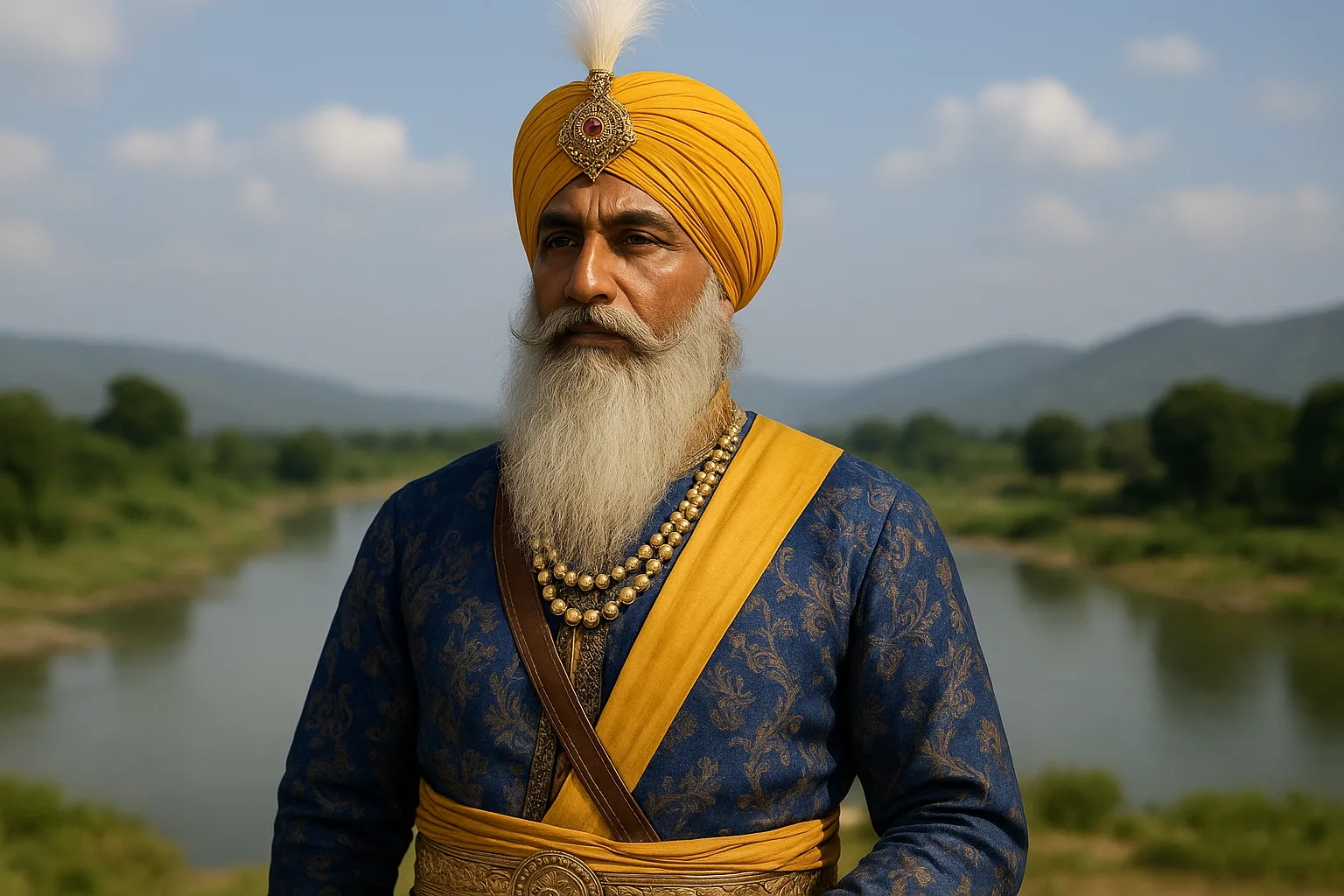
Series: History of Una, Himachal Pradesh, India
Phase 3: Sikh Period — Part 12 of 30
This article belongs to a historical series examining how expanding empires and regional powers reshaped life in the western Himalayan hills. As external influences pressed into the mountains, local rulers navigated diplomacy, resistance, and accommodation. This phase explores how wider political currents intersected with entrenched hill traditions, altering governance without entirely displacing older structures.
Dawn at the Border: Change Arrives in Una
The mist hung low over the Sutlej River, swirling above the fords and fields of Una in the spring of 1815. Villagers gathered on rooftops and riverbanks, eyes fixed eastward as a cavalcade of horsemen—resplendent in saffron and green—approached. Rumors had swept ahead of them: the Lion of Punjab, Maharaja Ranjit Singh, was extending his rule. For Una, perched on the shifting frontiers between hill states and the plains, this was not the first time outsiders had arrived with banners flying. But the scale, ambition, and discipline of the Sikh Empire were unlike anything living memory could recall.
Between Empires: Una Before the Sikhs
To understand how Ranjit Singh’s flag came to flutter over Una, we must look to the region’s fractious past. For centuries, Una had been a crossroads—ruled at times by the Katoch dynasty of Kangra, at others by the Mughal Empire, and later by Afghan chieftains. Its valleys were dotted with forts and shrines, its people accustomed to shifting allegiances and border skirmishes. The late 18th century brought new instability as the Mughal grip weakened and hill rajas fought to defend their lands. This vacuum of power set the stage for the rise of the Sikh misls and, ultimately, Maharaja Ranjit Singh.
The Lion’s Approach: Ranjit Singh Eyes the Hills
Maharaja Ranjit Singh, born in 1780 in Gujranwala, rose to unify the Sikh misls into a formidable kingdom. His ambitions soon looked beyond the plains of Punjab. The hill territories—Kangra, Jaswan, and the lands around Una—held both strategic and symbolic allure. In 1809, after successfully defending against Afghan incursions and solidifying his rule in Lahore, Ranjit Singh began to turn his gaze to the hills.
The pivotal moment came in 1809 when Sansar Chand, the Katoch ruler of Kangra, sought Ranjit Singh’s help against the Gorkhas, who had swept in from the east. Ranjit Singh agreed, but at a price: control of the Kangra Fort and its dependencies. After a dramatic siege and subsequent victory, the Sikh armies established a foothold in the hills. Una, lying along the key routes between Punjab and Kangra, became an immediate point of interest.
Conquest and Compromise: The Sikh Advance into Una
The Sikh annexation of Una was both swift and calculated. Ranjit Singh’s generals—most notably Hari Singh Nalwa and Diwan Mohkam Chand—were dispatched to oversee the transition. They encountered scattered resistance from local chieftains, but the overwhelming might and organization of the Sikh forces made prolonged opposition futile.
Unlike previous conquerors, Ranjit Singh favored a blend of force and diplomacy. Many zamindars and minor rajas were allowed to retain their lands in exchange for tribute and loyalty. The Sikh administration was careful to respect local customs, recognizing the importance of the region’s temples and shrines. Yet, the presence of Sikh garrisons and tax officials marked a clear shift in authority.
Life Under Sikh Rule: Administration and Daily Realities
What did it mean for Una’s people to live under the Sikh Empire? The answer lay in the rhythms of governance. Sikh officials introduced new systems of revenue collection, demanding land taxes in cash or kind. While this brought greater predictability compared to the arbitrary extortion of previous decades, it also imposed a heavier burden on some cultivators, especially during years of poor harvest.
Yet, the Sikh administration was not solely extractive. Roads and river crossings were improved to facilitate troop movements and trade. Markets in Una began to flourish, benefiting from the region’s new status as a frontier post for goods moving between Punjab and the hills. Sikh soldiers, merchants, and artisans brought new customs, languages, and religious practices, subtly weaving their influence into Una’s cultural tapestry.
Religious policies under Ranjit Singh, a Sikh ruler in a multi-faith empire, were pragmatic. While Sikh symbols became more visible, the Maharaja famously patronized Hindu temples and Sufi shrines alongside gurdwaras. In Una, the annual fairs at Chintpurni and Dera Baba Barbhag Singh continued without interruption, drawing pilgrims from across the region. This relative tolerance helped stabilize relations in a land accustomed to religious diversity.
Strategic Importance: Una as Gateway and Garrison
The geography of Una made it crucial to the Sikh Empire’s security and commerce. It served as a gateway between the Punjab plains and the hill states. Control of Una meant control of the approaches to Kangra, the trade in salt and grain, and the vital river crossings over the Sutlej and Swan.
To safeguard these interests, Ranjit Singh established a network of outposts and fortified dharamsalas along the main routes. Sikh garrisons watched over the region, ready to respond to threats from rival hill rajas or British movements from the east. The presence of these troops was both reassuring and intimidating for local villagers, who supplied provisions but also lived uneasily with the realities of occupation.
At the same time, Una became a melting pot. Merchants from Amritsar, soldiers from Lahore, and artisans from distant towns mingled in the bazaars. Tales of the Maharaja’s exploits—his one-eyed gaze, his golden throne, his penchant for witty repartee—circulated alongside rumors of British designs and new technologies sweeping in from Calcutta and Bombay.
Echoes of Resistance and Accommodation
No rule is uncontested, and the story of Una under the Sikhs was no exception. Some local elites quietly resented the loss of autonomy, recalling the days when they owed fealty only to distant hill rajas. There were sporadic protests over taxation and conscription, and minor uprisings that were swiftly suppressed. Yet, many others adapted, forging ties with Sikh officials and finding new opportunities in the changing order.
Women, too, found their roles shifting. Sikh governance brought changes to property laws and dispute resolution, sometimes favoring female claimants in inheritance cases—an unusual departure from older customs. Stories survive of Una’s women intervening in family feuds or negotiating with officials, their voices carried in the folk songs that still echo across the fields.
The Shadow of Empire: British Intrigue and the End of Sikh Rule
Even as Ranjit Singh’s authority seemed unassailable, new dangers loomed. The British East India Company, already entrenched in Delhi and the Doab, eyed the Sikh Empire with growing unease. Their agents traveled through Una in disguise, gathering intelligence and probing for allies.
After Ranjit Singh’s death in 1839, the Sikh Empire began to fragment under court intrigues and succession crises. Sensing weakness, the British moved quickly. By the time of the First Anglo-Sikh War (1845–1846), Una found itself at the edge of a new imperial contest. The Treaty of Lahore and subsequent treaties redrew borders and transferred much of the region, including Una, into the British sphere—ending three decades of Sikh rule.
Legacy in Stone and Memory
Today, traces of the Sikh period linger in Una’s architecture and folklore. Ruins of old garrison posts and caravanserais still dot the countryside. Place names bear echoes of that era, and every spring, processions recalling Ranjit Singh’s court wind through the streets. The Sikh influence is felt in the rhythms of local festivals, the food, and even the dialects spoken in market stalls.
But more than monuments, it is the legacy of adaptation—of living at the crossroads of empires—that shapes Una’s identity. The memory of negotiating with distant powers, of blending new customs with old, continues to guide the town’s pragmatic spirit. As Una faces modern challenges, from migration to development, the lessons of resilience and openness learned under Ranjit Singh’s rule remain as relevant as ever.
Previous: Sikh Expansion into the Una Region
Next: Administrative and Military Changes During Sikh Rule