
Series: History of Hamirpur, Himachal Pradesh, India
Phase 2: Medieval Period — Part 9 of 30
This article forms part of a continuing series that follows the gradual emergence of organised power in the western Himalayas. As small communities gave way to clans, chieftainships, and hill states, patterns of rule, alliance, and conflict began to take shape. This phase examines how authority was negotiated through land, ritual, and warfare, laying the groundwork for regional kingdoms that would dominate the medieval landscape.
Before the Plow: Early Mornings in Medieval Hamirpur
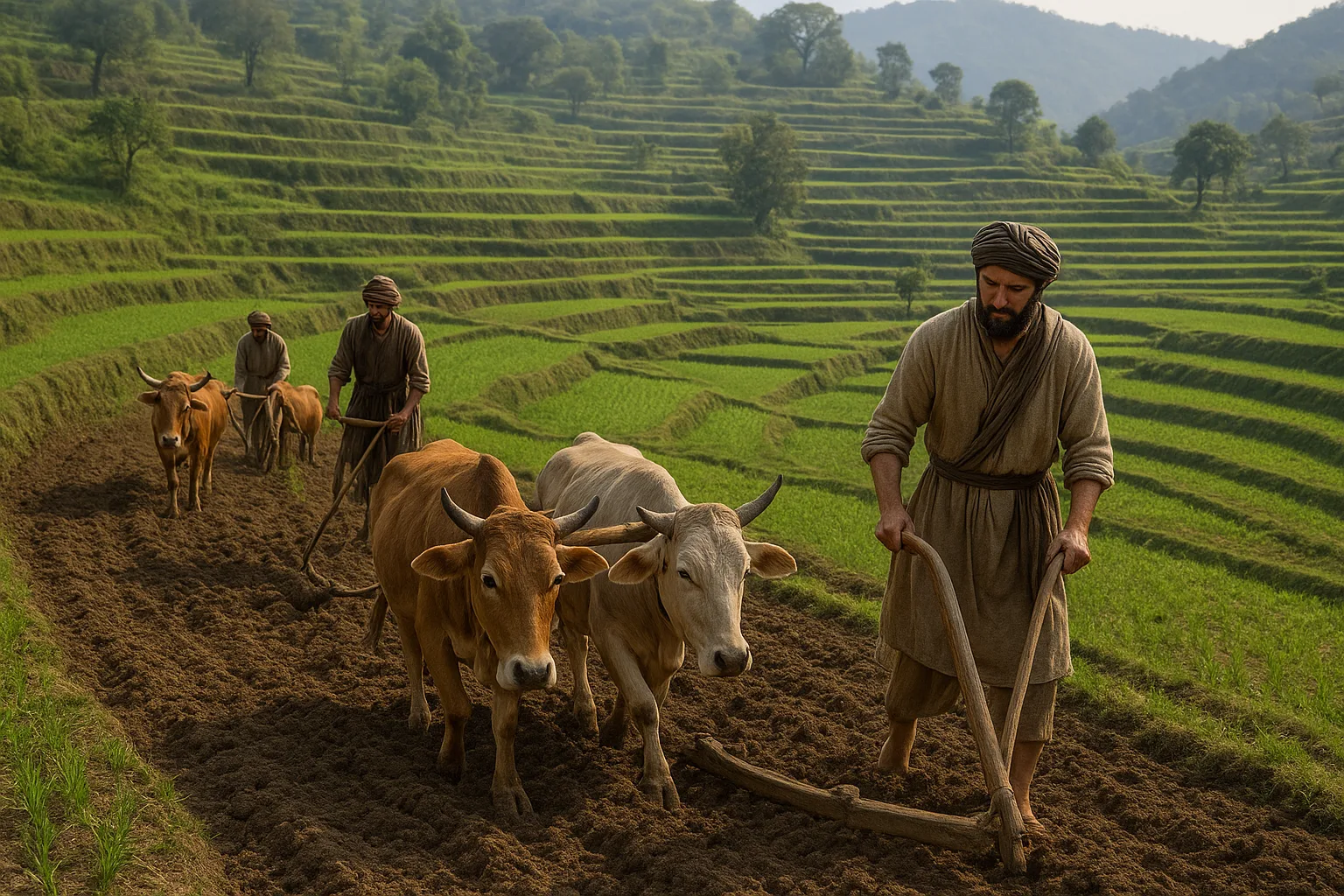
Imagine the first light slipping through mists over the Beas River, dew clinging to terraced fields carved into the gentle hills of what we now call Hamirpur. In these valleys, centuries before modern boundaries, the rhythm of daily life was set by the rising sun and the demands of the earth. The air was alive with the calls of herders and the low, soothing chant of women as they scattered seed—a world woven from land, tradition, and the slow pulse of the seasons.
This was no isolated backwater. By the early medieval period (roughly 6th–13th centuries), the region that would become Hamirpur was a patchwork of hamlets and forests, watched over by emerging clans and chieftains. Early chronicles and regional gazetteers, such as the Kangra District Gazetteer, hint at a world in flux, poised between mythic memory and written record, local custom and the faint reach of distant powers.
From Oral Traditions to Political Realities
Oral traditions tell of ancient rajas and local deities, of the hills as an abode of divine spirits and heroic ancestors. Folk tales—still told in the shaded courtyards of Hamirpur—recall migrations from the plains, stories of survival and settlement, and the sacred compact between people and land. These stories, though wrapped in the language of myth, often encode memories of real struggles: clearing forests, defending fields, and adapting to the unpredictable moods of the Himalayan climate.
Historical inference, supported by early land records and regional chronicles, suggests that by the 10th century, Hamirpur’s rural economy was starting to crystallize. The influence of larger hill states—such as Kangra and Nadaun—began to reach into the valleys, shaping patterns of taxation, land use, and local authority. Yet, the essential character of Hamirpur’s rural life remained rooted in the small village, the family field, and the sacred grove.
Communities and the Making of Rural Society
The medieval villages of Hamirpur were shaped by the interplay of geography, kinship, and faith. Rajput clans, shepherding Gaddis, and long-settled agricultural castes each found their place in the mosaic. Over time, villages formed around water sources or defensible hillocks, often marked by a shrine or an ancient tree revered as the guardian of the settlement. The village was both a social and economic unit, its boundaries defined less by written law than by custom, memory, and mutual obligation.
Belief systems revolved around the cycles of sowing and harvest, with local deities invoked for rain, fertility, and protection. Oral histories recall the persistence of ancestor worship alongside the growing influence of Shaivism and later Vaishnavism, as seen in the simple stone temples and ritual practices that have endured through the centuries. These religious currents shaped both daily life and broader social organization, binding communities together and offering a measure of continuity amid change.
Fields, Forests, and the Fragile Economy
Agriculture in medieval Hamirpur was both a necessity and an act of resilience. The land, though fertile in places, was never easy: rocky slopes, erratic rains, and the constant threat of wild animals shaped the rhythms of work. Terracing—an ancient skill still visible in the landscape—allowed farmers to coax grain from the hills. Wheat, barley, and millets were staple crops, supplemented by pulses and the bounty of forest groves: wild fruits, medicinal herbs, and fodder for livestock.
The rural economy was not wholly autarkic. Villagers exchanged surplus grain, ghee, and woven cloth at periodic markets, sometimes venturing to larger trade centers along the Beas or Sujanpur Tira. The shadow of taxation loomed—tribute demanded by local rajas, often paid in kind but occasionally in coins that hinted at wider connections. Yet, for most, wealth was measured in land, cattle, and the strength of family ties.
Trade Routes and the Wider World
Though seemingly remote, Hamirpur’s villages were touched by the faint pulse of regional trade. Ancient footpaths snaked through forests, linking hamlets to neighboring valleys and, by stages, to the greater currents flowing from Punjab to the western Himalayas. Traveling traders—banjaras, salt merchants, and wandering mendicants—brought news and goods, exchanging salt, iron tools, or beads for local produce and wool.
At times, these routes carried more than trade. They bore the influence of ideas: new religious practices, innovations in farming, and the shifting claims of rival hill chiefs. The emergence of hill states such as Kangra and Jaswan was mirrored in Hamirpur by the rise of local petty chieftains, each seeking control over fertile tracts and key crossings. The region’s position—at the crossroads of the hills and the plains—ensured that its economy, though modest, was never static.
The Ties That Bound: Social Hierarchies and Custom
The social structure of medieval Hamirpur was layered but adaptive. Landholding Rajput families often held sway as village headmen, mediating disputes and organizing defense, but their authority depended on the cooperation of cultivators, artisans, and herders. Customary law, rooted in oral tradition as much as in royal edict, governed matters of inheritance, marriage, and land use. The deep sense of mutual obligation—whether expressed through communal labor during harvest or collective worship—strengthened the bonds of rural society.
Festivals marked the calendar: the coming of spring, the first cutting of wheat, the worship of local deities. These were moments of respite and renewal, reinforcing both social ties and the enduring relationship with the land. Even as external rulers changed, the core patterns of rural life endured, shaped by necessity, faith, and the slow accumulation of tradition.
Legacy in Modern Hamirpur
The fields of medieval Hamirpur have long since seen the arrival of new crops, roads, and technologies, but the echoes of that rural past are still present. The terraced hills, the persistence of local festivals, and the enduring importance of kinship and community reflect roots set deep in the medieval soil. The region’s resilience—its ability to adapt to change while preserving its essential character—is a legacy of those early centuries.
As our series continues, we will follow the rising fortunes of Hamirpur through the era of expanding hill states, exploring how political change and dynastic ambition would reshape both the land and its people.
Previous: Village Administration and Governance in Medieval Hamirpur
Next: Temples and Faith in Medieval Hamirpur