
Series: History of Hamirpur, Himachal Pradesh, India
Phase 2: Medieval Period — Part 10 of 30
This article forms part of a continuing series that follows the gradual emergence of organised power in the western Himalayas. As small communities gave way to clans, chieftainships, and hill states, patterns of rule, alliance, and conflict began to take shape. This phase examines how authority was negotiated through land, ritual, and warfare, laying the groundwork for regional kingdoms that would dominate the medieval landscape.
The Dawn Mist Over Hill Shrines
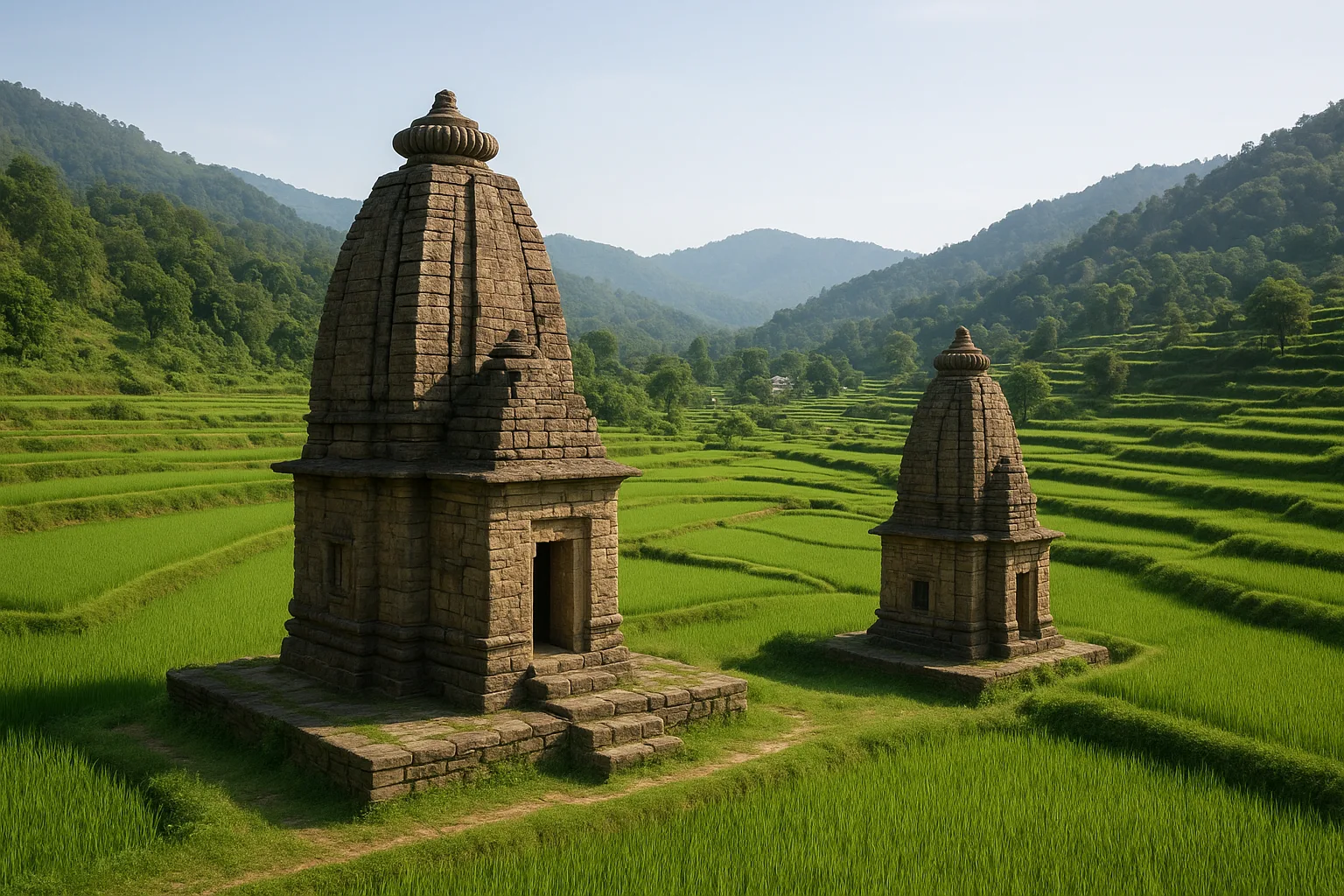
As the sun rises over the undulating ridges of Hamirpur, Himachal Pradesh, centuries-old rooftops—some tiled, some thatched—catch the pale light. In the cool hush, villagers gather at the edge of a stone-paved courtyard, incense curling upward as bells echo from a modest shrine to Baglamukhi Devi. This ritual—familiar yet ancient—binds together the faith of a people whose spiritual roots extend deep into the medieval past.
Hamirpur’s Place in the Medieval Hills
By the beginning of the second millennium CE, the region we now call Hamirpur was a patchwork of fertile valleys, dense forests, and scattered hamlets. It lay on the southern slopes of the Western Himalayas, nestled between the powerful hill states of Kangra and Bilaspur. While Hamirpur itself did not emerge as a formal political entity until much later, its villages were already part of a complex web of trade routes, tributary relationships, and cultural exchanges that defined the wider western Himalayan world.
The land here was shaped as much by its geography as by its people: streams carved out valleys, while narrow paths snaked over the ridgelines, connecting isolated communities to bustling markets and distant courts. Early chronicles and regional gazetteers, such as the Punjab Hill States Gazetteer, note that these hills were home to vibrant local traditions long before any central administration.
Oral Traditions and Hill Pantheons
Many of Hamirpur’s earliest stories survive not in stone inscriptions or written records, but as oral tales. Legends recount the journeys of wandering sadhus, the miracles of folk deities, and the origins of shrines whose foundations are lost to memory. The people of these hills, predominantly of the Rajput, Brahmin, and various indigenous castes, wove their beliefs into the landscape: every grove or spring might be the seat of a tutelary spirit.
Among the most revered is the Baglamukhi temple at Bankhandi, whose antiquity is affirmed as much by the reverence of local communities as by the weathered stones themselves. Oral tradition links the temple to the Mahabharata, a claim echoed across northern India but deeply cherished in Hamirpur. While historians caution against taking such legends at face value, they reflect an enduring faith that has shaped the region’s identity.
Documented Faiths and Early Shrines
From the 9th to 14th centuries, Hamirpur’s religious landscape began to crystallize in more tangible forms. Archaeological remains in neighboring Kangra and Bilaspur hint at the architectural styles that would influence Hamirpur: low stone walls, pyramidal roofs, and wooden pillars carved with motifs from Shaivism, Vaishnavism, and Shaktism. Some shrines in Hamirpur, such as the Narbadeshwar and Tauni Devi temples, are believed—based on architectural and stylistic analysis—to have medieval origins or to stand atop far older sanctuaries.
Historical inference suggests that many temples evolved from even earlier sacred sites: simple stones or trees venerated by local clans. As trade routes flourished, merchants and pilgrims left votive offerings, gradually enriching these humble shrines. The emergence of formalized priestly lineages—often Brahmins invited from the plains—brought Sanskritic rituals and linked Hamirpur’s temples to wider religious movements sweeping through the western Himalayas.
Communities, Castes, and Patronage
Medieval Hamirpur was a tapestry of small settlements, each with its own cluster of houses, granaries, and shrines. Rajput families—some tracing their lineage to the Katoch and Jaswan dynasties—held sway in many villages, acting as patrons for local temples. Brahmins, as custodians of ritual, became anchors of continuity, often serving several villages as priests, astrologers, and chroniclers.
Artisan castes, such as the lohars (blacksmiths) and carpenters, left their mark through temple bells, carved doors, and wooden idols. Many of their descendants still recount the stories of how their ancestors crafted the sanctums and chariots for local deities. These interwoven roles fostered a sense of communal belonging centered on the temple—not just as a site of worship, but as the heart of village life, dispute resolution, and seasonal celebration.
Faith Along Trade and Pilgrimage Routes
The medieval period saw Hamirpur’s villages become waypoints for travelers moving between the plains and the higher reaches of the Himalayas. Pilgrims en route to Jwalamukhi or Chintpurni would stop at roadside shrines, making offerings and exchanging news. Merchants from Kangra, Bilaspur, and beyond brought goods—and with them, new ideas and rituals—enriching Hamirpur’s already diverse pantheon.
It is from this era that many folk festivals and melas trace their origins. Oral tradition holds that the annual fairs at Deotsidh and Sujanpur’s temples began as gatherings of traders and shepherds, gradually absorbing religious significance. Such events became opportunities for communities to reaffirm their bonds of faith and kinship in the face of external change.
Hill States, Conflict, and the Enduring Sacred
As the medieval centuries wore on, the political map of the western Himalayas shifted with the rise and fall of hill states. Hamirpur’s territory was often contested between neighboring rulers, especially the formidable Katoch dynasty of Kangra. Yet even amid conflict, the temples remained sanctuaries—sometimes plundered, but more often protected and restored by emerging elites seeking legitimacy through religious patronage.
By the 16th century, as new powers rose and old ones faded, the faith traditions of Hamirpur had woven themselves so tightly into daily life that even the most turbulent times could not loosen their grip. The shrines, both grand and humble, continued to draw the faithful, offering a sense of continuity amid uncertainty.
Legacy of Faith in Modern Hamirpur
Today, the ancient roots of Hamirpur’s medieval faith still pulse beneath the surface of modern life. Temple bells ring out not only as echoes of history, but as living symbols of a community’s resilience and identity. The stories passed down—sometimes embroidered, sometimes starkly factual—remain a bridge between past and present, shaping how the people of Hamirpur understand themselves and their land.
As our journey through Hamirpur’s medieval era continues, the next part of this series will turn from shrines and faith to the rise of local rulers and the forging of early hill polities. The echoes of devotion, however, will remain ever-present along the winding paths of history.
Previous: Agriculture and Rural Economy in Medieval Hamirpur
Next: Mughal Presence in the Hill Regions Around Hamirpur