
Series: History of Kinnaur, Himachal Pradesh, India
Phase 5: Modern Era — Part 30 of 30
This article appears within a continuing historical series that follows the western Himalayas into the modern era. With the end of princely rule and the integration into independent India, long-standing social and political patterns were reconfigured. This phase examines how development, state formation, and memory interact with inherited landscapes, shaping contemporary life while carrying forward echoes of the past.
The Valley at Dawn: Kinnaur’s Living Landscape
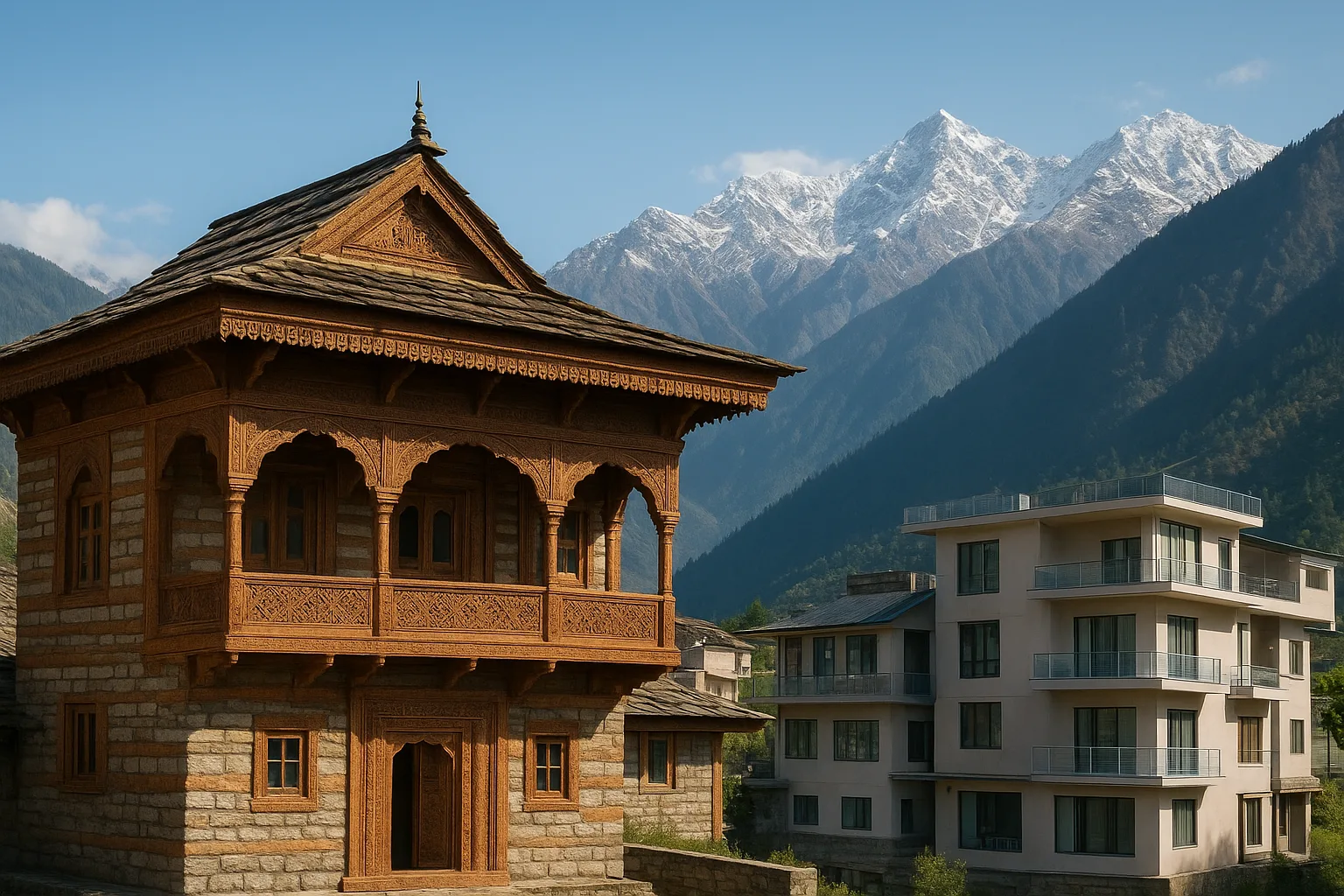
The first light of day creeps over jagged ridgelines, catching the snowfields of Kinnaur in a pale blush. Apple orchards and terraced barley fields shimmer beneath the peaks, and the Sutlej River carves its ancient course, as it has for millennia. Life here moves to rhythms older than memory. In the crisp mountain air, history still lingers — in the carved wooden temples, in the cadence of Kinnauri language, even in the stone footpaths that wind toward Tibet. To understand Kinnaur’s present, we must begin with the layers of its past, where myth and evidence intertwine.
Myth, Memory, and the Oral Traditions of Kinnaur
For generations, the people of Kinnaur have passed down a rich tapestry of stories. Local legend holds that the Kinners, a semi-divine race mentioned in ancient Sanskrit texts, once inhabited these mountains, living in harmony with gods and nature. Such mythology, preserved in song and festival, animates Kinnaur’s spiritual landscape even today. The annual Phulaich and Fulaich festivals, for example, echo the region’s reverence for nature’s cycles, blending animist traditions with ritual practices rooted in the Vedas.
Yet, as evocative as these tales are, historians treat them cautiously. Oral traditions offer indispensable insight into the worldview and values of Kinnaur’s people, but they do not always align with the archaeological or textual record. Still, the continuity of these traditions hints at a community deeply attuned to its environment — and resilient in the face of change.
Early Settlements: Between Rivers and Trade Routes
Archaeological finds in the Sutlej and Baspa valleys point to small, scattered settlements as early as the first millennium BCE. These communities, though isolated by geography, were far from insular. The presence of ancient trade trails — some still visible as stone-paved mule tracks — underscores Kinnaur’s role as a passage between India and Tibet.
Over the centuries, merchants and pilgrims traversed these high routes, exchanging salt, wool, barley, and turquoise. The region’s proximity to the ancient Hindustan-Tibet road made it a conduit for not just goods, but also ideas: Buddhism, Shaivism, and later, indigenous forms of Hinduism mingled in Kinnaur’s valleys. Early copper plate inscriptions and the accounts of Chinese pilgrims such as Xuanzang suggest a landscape dotted with monasteries and shrines, where spiritual traditions coexisted with the pragmatic demands of trade and survival.
Belief Systems: The Syncretic Heart of Kinnaur
Kinnaur’s spiritual fabric defies easy categorization. The district’s belief systems reflect a syncretism born of centuries of exchange and adaptation. Animism, ancestor worship, and reverence for local deities — the devtas — have long shaped village life. Temples dedicated to gods like Maheshwar and Chango’s Devi stand beside Buddhist gompas, their prayer flags rippling in the same wind that carries the scent of cedar smoke.
Historical chronicles and regional gazetteers from the colonial era describe Kinnauris as followers of both Hinduism and Buddhism, often within the same household. The community’s unique Dabla script and polyandrous marriage customs, noted by early British administrators, further distinguish Kinnaur from its neighbors in Himachal Pradesh. These customs, though less common today, speak to a society shaped by its environment — where survival often demanded cooperation and adaptation.
Emergence of Hill States and Political Boundaries
By the late medieval period, Kinnaur found itself on the edge of shifting political frontiers. The rise of the Bushahr state, centered at Rampur, gradually brought the region under a loose feudal authority. Bushahr’s rajas claimed suzerainty over Kinnaur, but in practice, local chieftains retained significant autonomy, governing through customary law and council. The 19th-century accounts of Captain Alexander Gerard and other colonial surveyors document a land of fiercely independent villages, each negotiating its relationship with distant rulers and neighboring valleys.
The British annexation of the Punjab Hill States in the mid-1800s brought new administrative structures, but change came slowly to these highlands. The people of Kinnaur, described in the 1883 Gazetteer of the Simla District, maintained their traditions even as roads and revenue systems crept up the valleys. Old boundaries, both cultural and political, remained porous, defined more by watershed and kinship than by lines on a map.
Kinnaur in the Modern Era: Identity and Continuity
India’s independence in 1947 marked a turning point. Kinnaur, once a remote frontier of Bushahr, became a district within Himachal Pradesh in 1960. The construction of the strategic Hindustan-Tibet road and hydroelectric projects brought new opportunities, but also new challenges: migration, changing land use, and the delicate balance between tradition and development.
Even so, Kinnaur’s communities have held fast to their sense of identity. The Kinnauri language, still spoken in homes and markets, carries echoes of ancient dialects. Traditional dress, music, and festivals remain vibrant, even as youth embrace education and technology. The region’s environmental stewardship — rooted in centuries-old relationships with land and water — is being reimagined for a changing climate.
Legacies and Futures: The Echo of Ancient Roots
Stand on a ridge above Kalpa at sunset, and the sweep of history feels immediate. The snowy mass of Kinner Kailash glows in the fading light, a sacred presence revered for generations. Below, villages cluster around temple courtyards where elders recount the old stories, and children learn the dances of their ancestors.
Kinnaur’s past is not a distant relic. It is woven into daily life, a source of resilience and meaning. As the district navigates the pressures of modernity — tourism, resource extraction, and the climate crisis — its ancient roots offer both grounding and guidance. The next chapter of this series will explore how Kinnaur’s people are shaping their future, drawing on the strength of their history to meet the challenges ahead.
Previous: Oral Traditions and Folklore of Kinnaur