
Series: History of Kangra, Himachal Pradesh, India
Phase 5: Modern Era — Part 29 of 30
This article appears within a continuing historical series that follows the western Himalayas into the modern era. With the end of princely rule and the integration into independent India, long-standing social and political patterns were reconfigured. This phase examines how development, state formation, and memory interact with inherited landscapes, shaping contemporary life while carrying forward echoes of the past.
Under the Shadow of the Dhauladhars
Smoke curls from a slate-roofed kitchen, drifting into the crisp dawn air of a Kangra village. Chickens stir beneath a deodar tree, and an old woman, wrapped in a patterned shawl, sits by her threshold. As she sips her morning tea, she murmurs a story—a tale her grandmother told her, of gods walking these hills and warriors defending their land. In Kangra, memory is woven into the landscape. The oral histories of its villages pulse with echoes older than any kingdom, older even than the temples that dot the valleys.
Roots in the Early Himalayan World
The Kangra valley, nestled between the Dhauladhar range and the lower Shivalik foothills, has always been more than a backdrop for legend. Its earliest communities—descendants of tribes whose names are half-remembered in local song—tended terraced fields and grazed flocks along ancient forest paths. Long before the Rajputs or the Gorkha incursions, these villagers marked their presence with stone shrines and whispered prayers to the river goddess Ganga and local deities like Devi Kangra.
Regional gazetteers record the valley’s continuous habitation since at least the Iron Age. Archaeological finds—terracotta figurines, pottery shards, and megalithic remains—anchor the region’s timeline, hinting at a vibrant life where the oral and material worlds met. Though historical chronicles are often silent on the daily lives of these early Kangra inhabitants, their stories persist, carried in the voices of those who still live by the same rivers and beneath the same peaks.
Myth, Memory, and the Telling of Time
Walk through any Kangra hamlet and you will hear stories that straddle the border between myth and memory. Local bards, or gaddis, recite tales of Pandavas wandering in exile, of Bhumi Devi blessing the valley’s first settlers, and of miraculous wells springing forth at a saint’s touch. These oral traditions do not aim for strict chronology; rather, they serve as moral compasses and communal anchors.
Yet, woven through these tales are kernels of historical inference. The Pandava legend, for instance, may reflect real patterns of migration and settlement during the late Vedic period, when Indo-Aryan groups moved into the Himalayan foothills. The story of Kangra’s founding goddess hints at ancient matriarchal cults that predate mainstream Shaivism in the region. These oral histories—shaped by ritual, recitation, and repetition—are part of an ongoing negotiation between the remembered and the recorded past.
Emergence of Hill States and Political Memory
By the early medieval period, Kangra’s valleys had become crossroads. Trade routes threaded through the hills, linking the plains of Punjab to Tibet and Central Asia. The region’s oral traditions often reference legendary kings—Susarma Chandra, for example—whose exploits are celebrated in lok geet (folk songs) and echoed, with embellishment, in the Rajatarangini and other chronicles. While the precise details of these rulers’ reigns are often blurred by time, their names endure in the collective memory of the region.
Documented history records the rise of the Katoch dynasty, whose stronghold at Kangra Fort became both a symbol of power and a magnet for invaders. Yet, even as Persian and Mughal chroniclers described sieges and conquests, village storytellers continued to emphasize the resilience of the land and its people. Their narratives, shaped by loss and renewal, preserved a sense of continuity throughout centuries of upheaval.
Communities and Belief Systems: A Living Mosaic
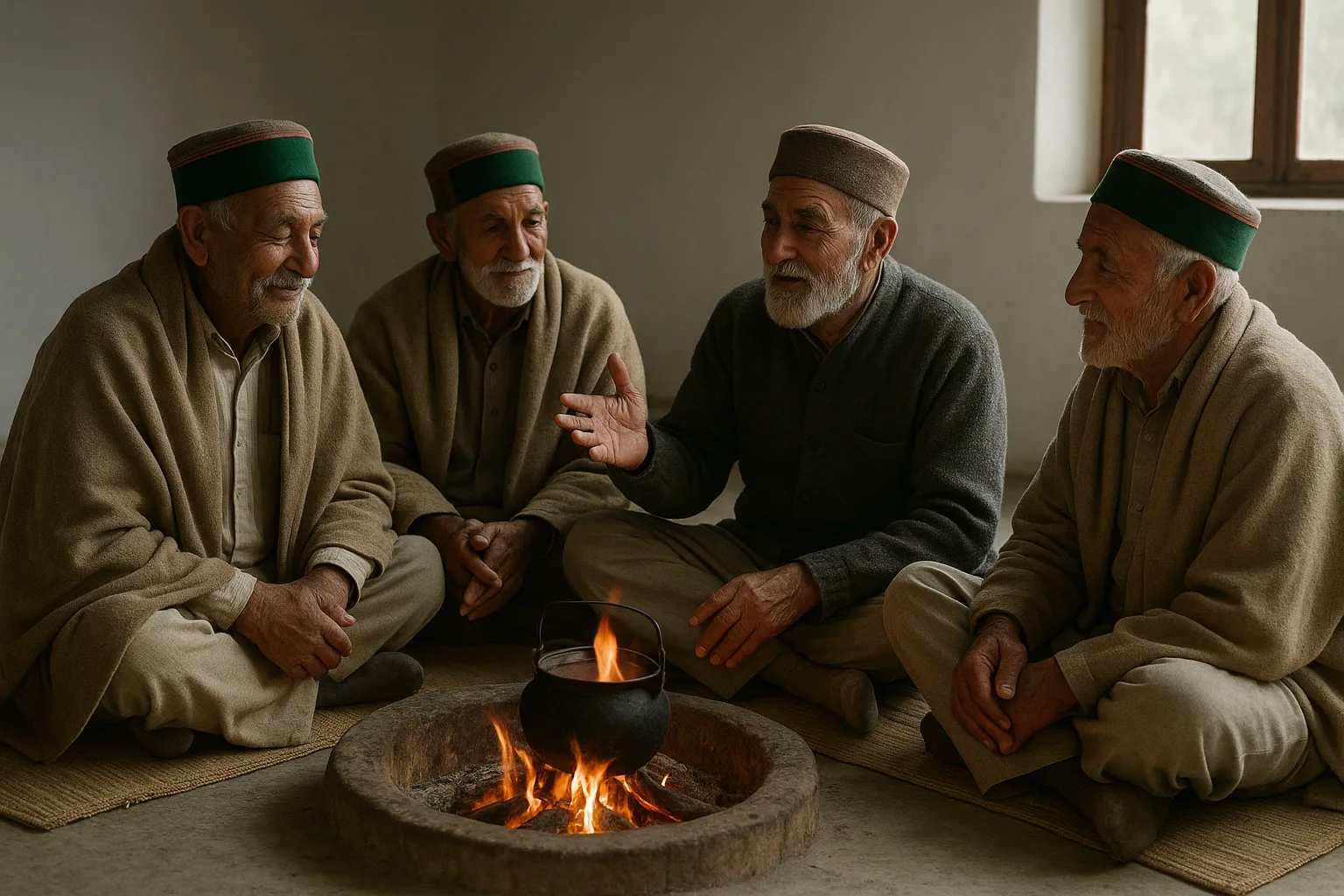
Within Kangra’s villages, faith is not confined to temples or the pages of religious texts. Oral traditions sustain belief systems that blend Hindu, Buddhist, and animist elements—a reflection of centuries of exchange across the Himalayas. Villagers recall stories of Nag Devtas (serpent gods) who demand offerings before the monsoon, and of wandering sadhus whose blessings protect the harvest.
These traditions are not static. Over generations, they absorb motifs from traveling traders, soldiers, and pilgrims. During the annual jagran (night vigil), communities gather to sing hymns that recount not only divine deeds but also historical memories: the devastation of the 1905 earthquake, the struggle against colonial authorities, and the exodus during partition. Each retelling adapts the past for present needs, reinforcing identity and communal bonds.
Oral Traditions and Historical Inference
Historians approach Kangra’s oral histories with both reverence and caution. Myths of creation and heroism illuminate values and self-perceptions, but distinguishing fact from embellishment is a careful art. The Pahari ballads—sometimes performed by hereditary minstrels, sometimes by elders at firesides—often encode real events: a drought, a memorable migration, a village’s founding. Cross-referencing these tales with early British gazetteers or the Tibetan chronicles allows for cautious reconstruction of social and political dynamics.
For example, the motif of the fort’s “unconquerable walls” recurs in both oral and written sources, yet the stories diverge in their treatment of betrayal, divine intervention, and the everyday resilience of villagers who rebuilt after each siege. Through such narratives, Kangra’s people claim agency and continuity, even when formal records are silent or incomplete.
Tradition as Identity: Kangra’s Living Past
Today, as modernization and migration reshape Kangra’s villages, oral history remains a vital thread connecting past and present. Schoolchildren learn of Ashoka and the Katoch kings, but they also hear, at home, the stories of ancestors who survived famine, defended their cattle from leopards, or walked to distant fairs along forgotten trade paths. In these everyday acts of remembrance, the valley’s ancient roots continue to nourish its sense of self.
The next post in this series will move from oral memory to the written record, following the arrival of colonial administrators and their attempts to catalog, classify, and sometimes challenge the region’s traditions. As we proceed, the interplay between spoken history and the archive will reveal how Kangra’s past remains both fiercely local and unexpectedly cosmopolitan.
Previous: Preserving Kangra Fort and Temples
Next: Kangra’s Place in Himachal’s Future