
Series: History of Hamirpur, Himachal Pradesh, India
Phase 5: Modern Era — Part 29 of 30
This article appears within a continuing historical series that follows the western Himalayas into the modern era. With the end of princely rule and the integration into independent India, long-standing social and political patterns were reconfigured. This phase examines how development, state formation, and memory interact with inherited landscapes, shaping contemporary life while carrying forward echoes of the past.
In the Shadow of the Dhauladhars
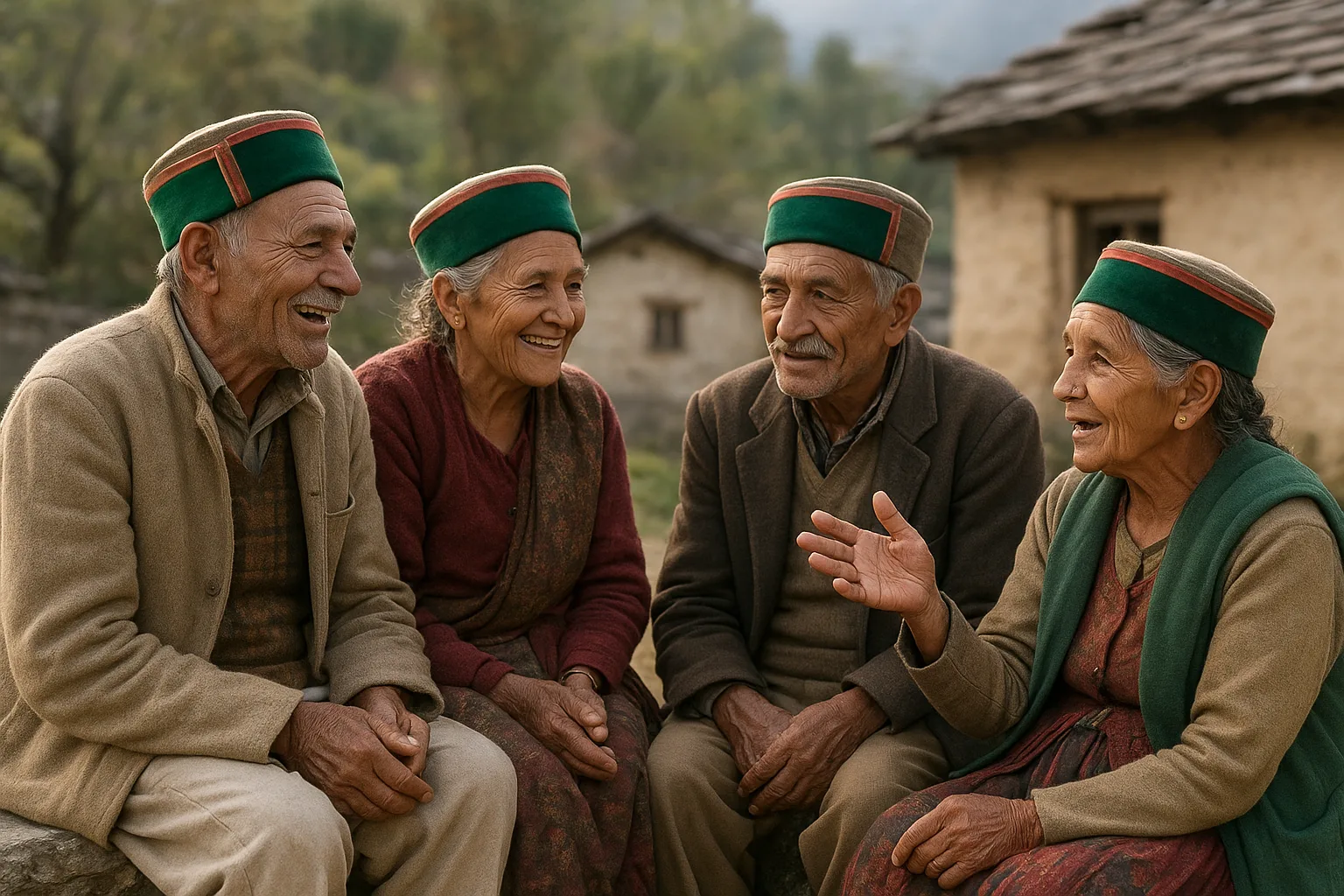
On a mist-laden evening, when the winds sigh through pine groves above the Kunah Khad, elders gather on the courtyards of Hamirpur’s villages. Their voices, rising and falling in rhythm with the flames of a small fire, carry stories older than the written word. Here, in the heart of Himachal’s lower hills, history lingers not just in stone and inscription but in the living memory of its people.
Hamirpur’s story begins not with grand monuments but with the spoken word. Before boundaries and census, before the district’s modern birth in 1972, this land was shaped by the ebb and flow of families, clans, and communities, each leaving traces in the tales they passed down. These oral traditions—part memory, part myth—have long been the backbone of identity here, connecting past to present in a region where the hills themselves seem to listen.
Ancient Footprints and Fading Myths
Oral histories in Hamirpur are a tapestry woven with both legend and lived reality. In the earliest tales, the very creation of the hills is attributed to the mythic feats of local deities—devis and devtas whose actions shaped rivers, forests, and fields. Names like Baba Balak Nath and Narbadeshwar echo through the valleys, their stories blending the supernatural with the earthly.
Yet, beneath the grandeur of myth, these traditions preserve kernels of historic truth. The Pahari dialect, customs around seasonal migration, and rituals linked to agricultural cycles hint at ancient patterns of settlement. Folk songs recount the arrival of Rajput and Brahmin lineages, while tales of wandering shepherds and traders reveal the region’s early connections to wider Himalayan trade networks.
Local gazetteers, such as the Kangra District Gazetteer of the late nineteenth century, record these oral traditions with a scholar’s caution—acknowledging their place in the collective memory while seeking to separate the plausible from the fantastic. Where documentary evidence falls silent, the voices of the people fill the gaps, offering a different, but no less vital, record of the past.
Communities and Early Settlements
Hamirpur’s hills are home to a mosaic of communities, each with its own origin story. The Gaddis, semi-nomadic shepherds, recall ancestral migrations from Chamba and beyond, their routes etched into memory and landscape. Settled agriculturalists, primarily Rajputs and Brahmins, describe arrival from the plains during times of turmoil, seeking sanctuary in the relative isolation of these hills.
These oral accounts find support in early chronicles and administrative records, which document waves of migration following invasions, famine, or dynastic conflict in the neighboring Punjab plains. Small hamlets eventually grew into clustered villages, often centered around a temple or sacred grove—places where the boundaries between the divine and the mortal were believed to blur.
Belief systems, too, were shaped by these movements. Indigenous deities absorbed features of Vedic and later Hindu traditions, resulting in a uniquely syncretic religious landscape. Rituals marking birth, harvest, and death remain strongly rooted in these early customs, their details preserved not in books but in the careful retelling by elders.
Trade Routes and the Pulse of the Hills
Though geographically modest, Hamirpur has never been isolated. Ancient footpaths threaded the hills, connecting the region to the larger Kangra valley, the Satluj corridor, and routes leading into present-day Punjab. Oral lore abounds with tales of traders—salt carriers, cloth merchants, and spice sellers—whose periodic arrivals brought new ideas, customs, and even words to the local dialect.
These trade routes were also conduits for news and rumor, shaping the political consciousness of local communities. Stories of distant kings and conquerors—some exaggerated, some eerily prescient—filtered up the hills, blending with local events in the retelling. Over time, these narratives helped forge a sense of distinct identity, as villages compared their legends and histories with those of their neighbors.
Emergence of Hill States and Political Memory
By the medieval era, oral memory and historical record begin to converge. Chronicles and bardic poetry describe the rise of small hill states, including the foundation of the Hamirpur region’s namesake dynasty. The Katoch rulers of Kangra, whose origins are recounted in both legend and inscription, extended their influence over these lower hills, delegating authority to local chieftains and zamindars.
Oral traditions recall episodes of alliance and rebellion—tales of valor, betrayal, and negotiation, often with a kernel of fact beneath the embellishment. The annexation of territory, imposition of tribute, and shifting loyalties reflect not only the realities of medieval politics but also the enduring importance of personal honor and kinship ties in the hills.
In the absence of written treaties, these stories became the de facto record of political change, remembered and recited at gatherings, festivals, and family councils. The arrival of British colonial administration in the nineteenth century brought new forms of documentation, but oral history persisted as a parallel, sometimes dissenting, voice.
Memory, Identity, and the Modern Era
In the twentieth century, as Hamirpur gained administrative distinction within Himachal Pradesh, oral histories continued to serve as a bridge between past and present. Regional gazetteers, census records, and local journals began to record these traditions more systematically, recognizing their value not only as folklore but as a living archive of community experience.
Today, the voices of Hamirpur’s people—captured in interviews, folk performances, and everyday conversation—remain central to the district’s sense of self. Even as roads, schools, and migration reshape the landscape, the old stories persist, evolving with each retelling but never entirely fading. They provide continuity in a time of change, anchoring identity in the memory of place.
Echoes into the Present
Hamirpur’s oral histories are more than echoes of a distant past; they are threads that tie generations together, shaping how the people of these hills understand themselves and their place in the world. In every household, in every festival, these voices continue to guide choices and forge connections—reminders that history is never just a matter of dates and rulers, but of lived experience handed down through time.
As we move forward in this series, the next post will turn to the modern developments that have further transformed Hamirpur, exploring how education, migration, and changing livelihoods have built on these ancient roots while charting new directions for the district’s future.
Previous: Preserving Hamirpur’s Local History and Heritage
Next: Hamirpur’s Past, Present, and Future