
Series: History of Solan, Himachal Pradesh, India
Phase 5: Modern Era — Part 27 of 30
This article appears within a continuing historical series that follows the western Himalayas into the modern era. With the end of princely rule and the integration into independent India, long-standing social and political patterns were reconfigured. This phase examines how development, state formation, and memory interact with inherited landscapes, shaping contemporary life while carrying forward echoes of the past.
In the Shade of the Pines: Solan’s Green Beginning
Imagine Solan in the late 19th century—a fresh, pine-scented breeze stirring through vast forests, the song of Himalayan birds echoing across quiet valleys. British officers, seeking respite from the lowland heat, remarked on the district’s “invigorating air” and dense cheel (chir pine) canopies surrounding the nascent town. The landscape was a living mosaic: terraced fields, clusters of oak, and wild streams carving through the earth. This was the foundation of Solan’s ecological identity—a place defined by natural abundance and delicate balance.
Yet, even in these early years, the seeds of environmental transformation were being sown. The colonial administration, eager to harness the region’s timber and water, began introducing new management schemes—laying the groundwork for the environmental dilemmas that would shape Solan’s future.
Colonial Timber and the Changing Forests
The British Raj viewed Himachal’s forests as a strategic resource, critical for railway sleepers and military construction. In the 1860s, the establishment of the Forest Department marked a turning point for Solan district. Timber “working plans” regulated the felling of pines and deodar, but these policies often prioritized commercial extraction over ecological health. Local villagers, once stewards of the land, found their access to forest produce sharply curtailed.
Historical records from the late 19th and early 20th centuries speak of mounting tensions. Communities in Kandaghat and Nalagarh protested restrictions on grazing and firewood collection, while British foresters enforced new boundaries. The landscape of Solan began to change: cheel forests expanded at the expense of native broadleaf trees, altering water cycles and soil fertility. It was a transformation both subtle and profound—a shift from a living commons to a managed resource.
Urban Growth and the Arrival of Industry
The 20th century brought rapid change to Solan. The construction of the Kalka-Shimla railway in 1903, snaking through Solan’s hills, connected the district to the wider world. The town of Solan blossomed as a commercial hub, and new industries—brewery, distilleries, and later pharmaceuticals—took root along the valleys. With progress came new pressures.
By the 1960s, the population was swelling as migrants arrived from surrounding villages, drawn by jobs and opportunity. The new Baddi-Barotiwala-Nalagarh (BBN) industrial corridor, established in the late 20th century, marked an economic boom—but also an environmental reckoning. Factories mushroomed along the Sirsa river, discharging effluents into its once-pristine waters. Urban sprawl replaced fields and forests with concrete, while traffic and dust began to choke the narrow streets of Solan town.
Water Woes: Scarcity in Abundance
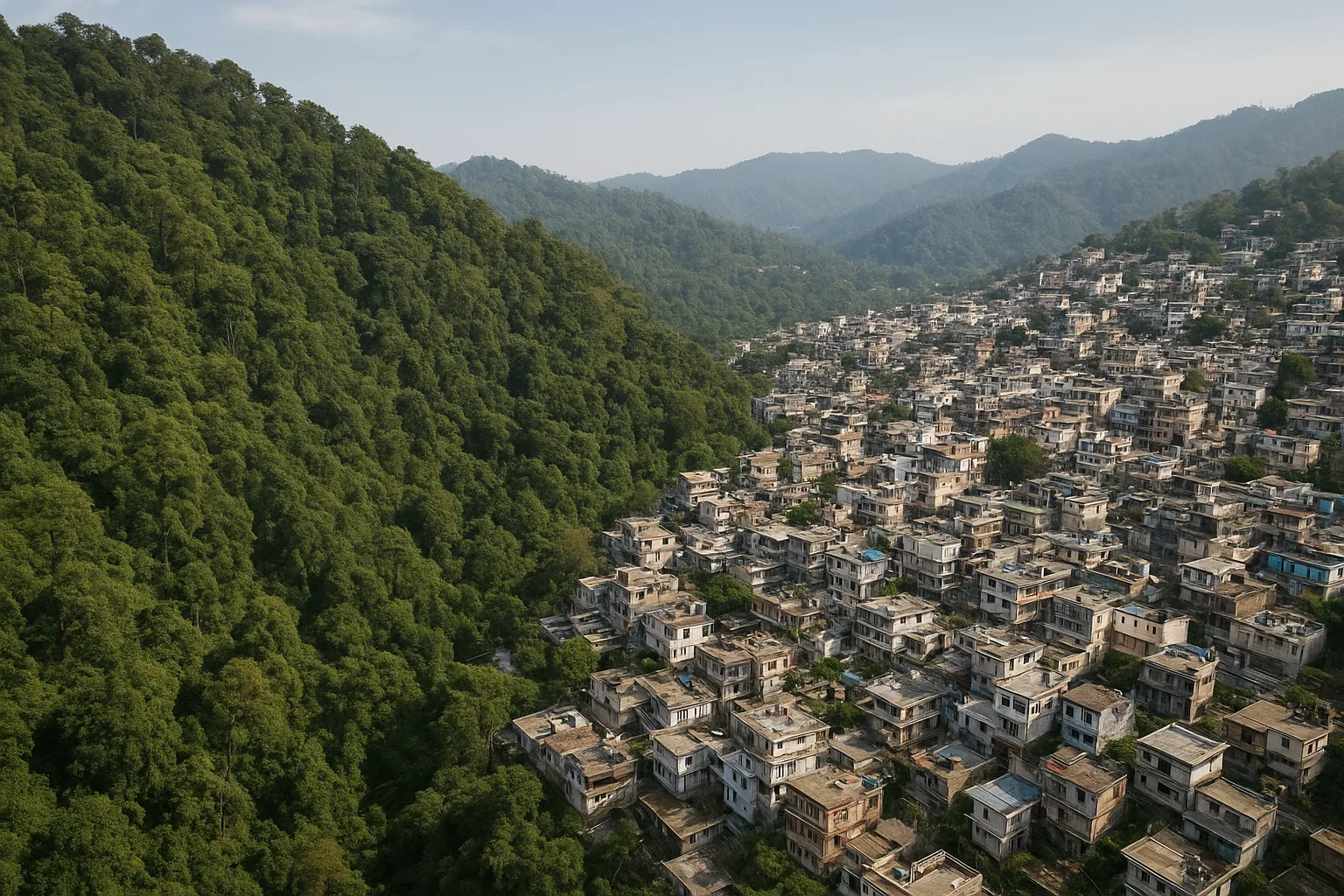
Ironically, even as Solan’s rivers and springs once defined its landscape, water scarcity emerged as a defining crisis. Local elders remember a time when the Ashwani Khad and Giri rivers ran full year-round, nourishing villages from Arki to Dharampur. By the 1980s, unchecked deforestation and over-extraction began to show their effects. Springs dried up, and groundwater levels fell. In the summer months, tankers rumbled through the streets, delivering water to desperate households.
Events such as the 2006 drought underscored the fragility of Solan’s hydrology. The growing urban population and thirsty industries placed competing demands on limited water resources. The Sirsa river, once a lifeline, carried the burden of both sewage and industrial runoff, threatening agriculture and public health alike.
Soil Erosion and the Fragile Hills
Solan’s hills, steep and geologically young, have always been prone to landslides. Yet, in recent decades, the risk has grown alarmingly. The replacement of deep-rooted oaks with shallow-rooted pines, combined with road construction and unplanned development, has destabilized whole slopes. Monsoon rains now trigger frequent landslips, blocking roads and endangering villages from Kasauli to Parwanoo.
Historical accounts record that in the 1970s and 1980s, landslides began to claim not just fields but entire hamlets. The district’s vulnerability was starkly revealed during the cloudburst of August 2010, which swept away roads and bridges in the Solan region, cutting off remote communities. Soil erosion, once a slow process, had become a clear and present threat.
Wildlife in Retreat and Conservation Efforts
Solan’s forests once teemed with barking deer, leopards, and pheasants. Today, wildlife sightings are rare outside protected pockets like the Majathal Sanctuary. Habitat loss, poaching, and the encroachment of farmland have pushed many species to the margins. The call of the Himalayan monal, once common in the upper reaches, is now an elusive sound.
Yet there are stories of resilience and advocacy. Foresters such as Smt. Shanta Devi, one of the district’s first female range officers in the 1980s, pioneered community reforestation programs. NGOs and local schoolchildren organized annual plantation drives, reviving native species along eroded slopes. The Himachal Pradesh Forest Department’s recent “Van Mahotsav” campaigns, though limited in scale, reflect a growing awareness that Solan’s natural legacy can only endure through collective stewardship.
Air, Noise, and the New Urban Reality
For much of its history, Solan was known for its clear air and tranquil rhythms. Today, residents speak of a different reality. The expansion of the BBN corridor has brought a surge in vehicular traffic, while brick kilns and factories emit pollutants into the valley air. During winter, a haze settles over Solan town, and the once-crisp mornings are tinged with the smell of burning waste.
Noise pollution, too, has become a daily companion. Markets buzz with the sounds of motorcycles and construction, and the serenity that once drew colonial officers to the hills now seems a distant memory. The district’s new prosperity has exacted a subtle, yet pervasive, environmental cost.
Looking Forward: Solan’s Environmental Crossroads
Solan’s environmental history is not merely a catalogue of loss—it is a testament to adaptation, struggle, and the enduring bond between people and land. The district’s challenges are formidable: water scarcity, deforestation, pollution, and the pressures of development threaten its ecological character. Yet, the story is still being written.
Across Solan, local leaders, teachers, and young activists are reimagining what sustainability can mean for their home. Rainwater harvesting, organic farming, and eco-tourism projects have begun to take root, drawing on both tradition and innovation.
The environmental trials of the past century have left indelible marks on Solan’s landscape and communities. But they have also fostered a new sense of stewardship—one that blends the wisdom of old with the urgency of the present. As the district charts its way forward, the lessons of history remain a vital guide, reminding all who call Solan home that the health of the land is inseparable from the fate of its people.
Previous: Tourism and Heritage Attractions of Solan
Next: Preserving Cultural Identity Amid Rapid Development