
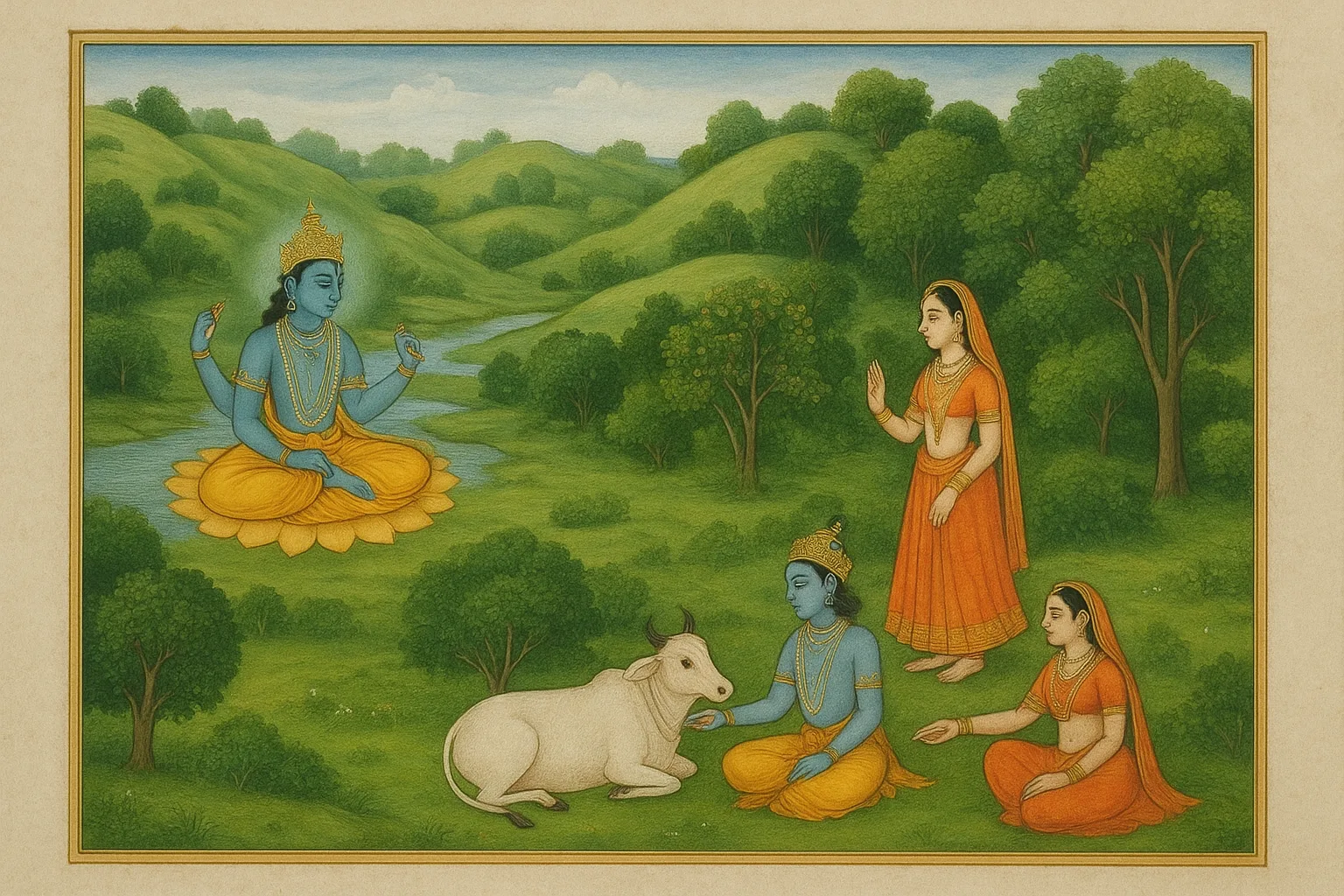
Series: History of Kangra, Himachal Pradesh, India
Phase 5: Modern Era — Part 25 of 30
This article appears within a continuing historical series that follows the western Himalayas into the modern era. With the end of princely rule and the integration into independent India, long-standing social and political patterns were reconfigured. This phase examines how development, state formation, and memory interact with inherited landscapes, shaping contemporary life while carrying forward echoes of the past.
Mists Over the Valley: An Artist’s Dawn
Before sunrise, the Kangra valley’s cedars and terraced fields seem to float above the Beas River, shrouded in blue-grey mist. It is the late 18th century, and within the stone walls of the royal Kangra fort, a handful of artists gather around oil lamps. They grind minerals into vivid pigments—malachite for green, lapis for blue—while a hush falls over the court, expectant. This is not merely art; it is the forging of identity, faith, and memory upon handmade paper. Kangra painting, now a byword for poetic beauty, was once a revolution in brushwork, born of a unique confluence of power, migration, and devotion.
Kangra’s Ancient Setting: Land of Crossroads and Kings
The Kangra valley, nestled in the shadow of the Dhauladhar range, has always been a land of passage. By the 11th century, it was already renowned for its wealth and sacred shrines, most notably the ancient temple of Devi at Jawalamukhi. The valley appeared in regional gazetteers as a coveted prize; its fort had withstood waves of invaders—Ghaznavids, Mughals, Sikhs—each leaving an imprint on the local culture and courtly life.
Unlike the arid plains below, Kangra’s hills nurtured distinct communities: Rajput clans tracing their ancestry to legendary solar and lunar dynasties; Brahmins who tended to temple rituals; and artisan guilds skilled in weaving, metalwork, and miniature painting. Oral traditions speak of rajas and rishis, blending myth and history in tales retold by village elders. But it was the political shifts of the 18th century—when the Mughal empire waned and Pahari hill states asserted independence—that set the stage for the Kangra painting tradition’s flowering.
Painted Devotion: The Roots of Pahari Art
Pahari painting, the broader tradition to which Kangra belongs, emerged in the hill courts stretching from Jammu to Garhwal. Earlier styles—known as Basohli and Guler—were marked by bold colors and almost abstract forms. These workshops flourished under the patronage of minor kings, who valued art as a sign of prestige and piety. When wars and invasions displaced artists from Mughal ateliers in Delhi and Lahore, many migrated north, bringing refined techniques and Persian influences with them.
For the rulers of Kangra, art was not just ornamentation. It became a subtle vehicle for affirming local identity, Hindu devotion, and royal legitimacy. The Bhagavata Purana, Ramayana, and especially the lyrical tales of Krishna and Radha were favorite themes—part sacred story, part coded commentary on courtly life. The Kangra rajas, especially Sansar Chand (r. 1775–1823), cultivated a circle of artists whose work would soon eclipse all others in grace and naturalism.
The Kangra School: Technique and Transformation
When people speak of Kangra painting, they evoke a style of unprecedented delicacy. Faces became softer, landscapes lush and luminous. The painters abandoned the angularity of Basohli, favoring gentle curves and transparent washes that captured the region’s subtropical light. Using squirrel-hair brushes, they rendered intricate textiles, jewelry, and foliage with obsessive care.
Yet, the Kangra school was not just a matter of style. It reflected a profound shift in outlook: an embrace of shringar rasa, the aesthetic of romantic love and sensual longing. Courtly narratives and religious allegories often intertwined, blurring boundaries between divine and human passion. It was art as drama, inviting the viewer into an intimate world where gods and mortals mingled among flowering trees and moonlit pavilions.
Artists and Patrons: The Living Workshop
The names of individual Kangra artists are mostly lost to history, but family lineages—such as the celebrated Seu-Nainsukh atelier—carried workshop traditions across generations. Masters trained sons and nephews, each adding subtle innovations to the inherited canon. Local chronicles record the comings and goings of painters between courts—Guler, Chamba, Mandi—spreading ideas across the hills.
Royal patronage was essential. Maharaja Sansar Chand’s support enabled the creation of expansive series—dozens, sometimes hundreds, of paintings narrating a single epic. The artists’ lives, though rarely described in official histories, can be glimpsed in the surviving works: fingerprints on the margins of folios, hurried sketches on the reverse of finished scenes, and notations in dog-eared sketchbooks. The workshop was a world apart, a meeting place for poetry, music, and the visual imagination.
From Courts to Collectors: The Fate of Kangra Painting
The 19th century brought upheaval. With the coming of the Sikhs, and later the British, Kangra’s political autonomy eroded. Courtly patronage waned; painting ateliers declined, and many masterpieces were sold or carried away to distant collections. Yet, even in decline, Kangra’s artists adapted—producing devotional images for local temples, or miniatures for colonial officials fascinated by the “picturesque” East.
Oral traditions persisted, preserving knowledge of pigments and motifs long after the courts fell silent. Early British gazetteers, such as those compiled by Henry Barnes and others, noted the “delicate brushwork” and “matchless grace” of Kangra paintings, though often without understanding their deeper cultural roots. Today, surviving works—scattered in museums from Chandigarh and Delhi to London—bear silent witness to a vanished world, their colors still vivid after centuries.
Legacy and Living Tradition
Kangra painting is not just an artifact; it remains a living tradition. Contemporary artists in Himachal Pradesh continue to study the old techniques, reviving natural pigments and hand-made paper in their ateliers. In village homes, old miniatures are still displayed during festivals or family gatherings, a reminder of ancestral glory. Local museums and cultural trusts work to preserve and teach this heritage, linking the valley’s storied past to its modern identity.
As we walk through the Kangra valley today, the legacy of its art is everywhere: in the blossoming orchards, in the songs of wandering bards, in the reverence for beauty that shapes local life. The next installment in this series will follow the valley’s painters into the era of colonial rule and cultural rediscovery, tracing how Kangra’s artistic soul survived—and reemerged—through times of turmoil and change.
Previous: Tea Gardens and Economy of Kangra
Next: Tourism and Heritage in Kangra