
Series: History of Kangra, Himachal Pradesh, India
Phase 5: Modern Era — Part 24 of 30
This article appears within a continuing historical series that follows the western Himalayas into the modern era. With the end of princely rule and the integration into independent India, long-standing social and political patterns were reconfigured. This phase examines how development, state formation, and memory interact with inherited landscapes, shaping contemporary life while carrying forward echoes of the past.
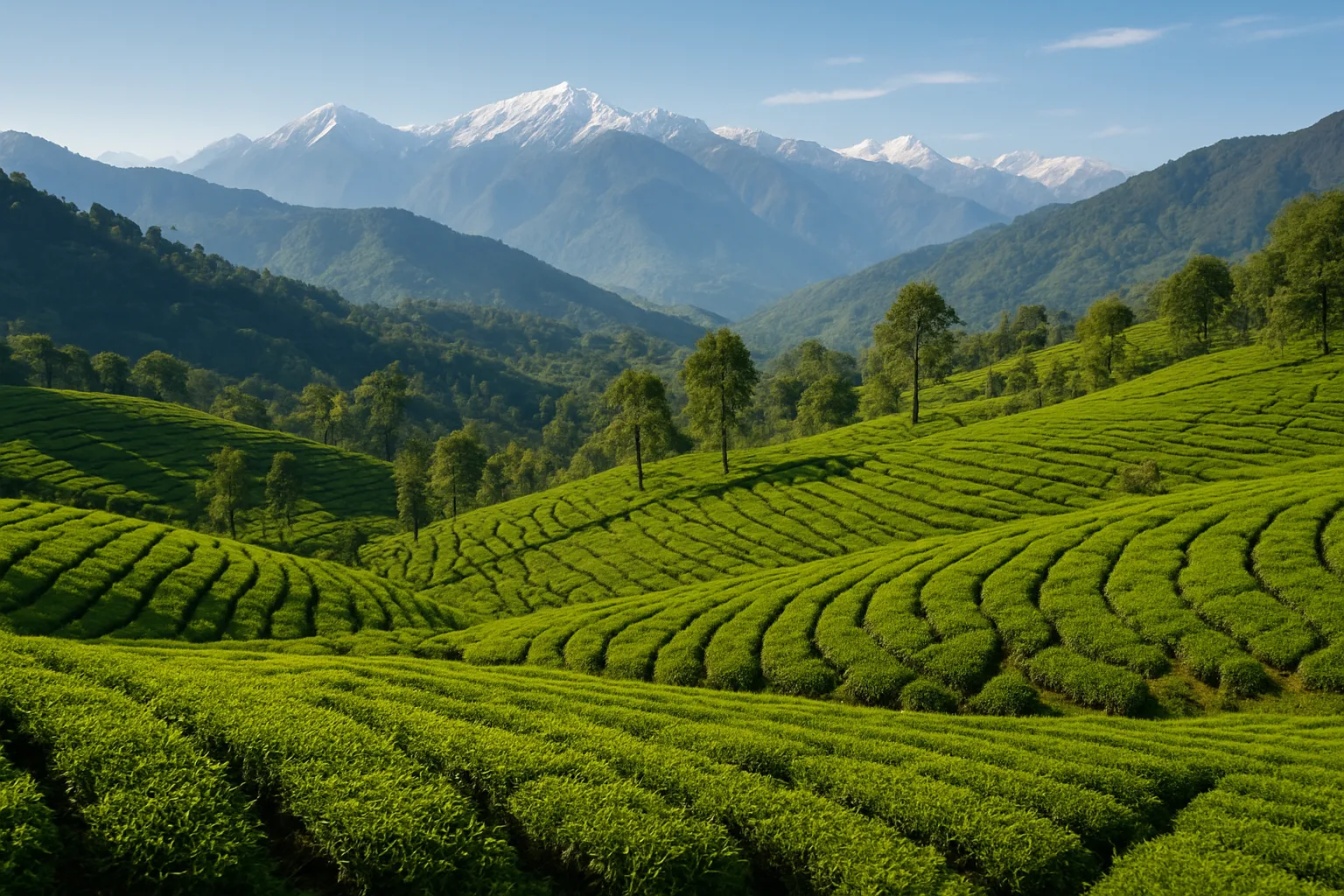
Mist Over the Valley: A Scene from Kangra’s Tea Heartland
The day begins softly in Palampur. Wisps of silver mist cling to the undulating slopes, where rows of low, green bushes stretch as far as the eye can see. Pluckers in bright shawls move with practiced rhythm, their baskets filling with the day’s first leaves. The gentle hush is interrupted only by birdsong and the distant rumble of a truck heading towards the factory. This is the Kangra valley—where tea is more than a crop. It is the spirit of the land, woven through generations, livelihoods, and memory.
Early Roots: A Valley Shaped by Geography and Exchange
Long before the first tea sapling found its place in Kangra’s soil, the valley was a hub of movement and encounter. Nestled against the Dhauladhar range, Kangra’s fertile plains and terraced hillsides supported early settlements. Oral traditions recall ancient communities—Katoch Rajputs, Gaddis, Gujjars—whose roots run deep in the region. Rivers like the Beas shaped trade routes, bringing goods and ideas from the plains of Punjab and beyond.
According to regional gazetteers and early chronicles, Kangra’s position as a crossroads fostered both agriculture and commerce. Its strategic forts and temples—especially the fabled Nagarkot (Kangra Fort)—were as much economic centers as symbols of power. Over centuries, the valley became known for grains, millets, and pulses, traded along trails that threaded through the hills toward Tibet, Kashmir, and the Gangetic plains. While mythology colors much of Kangra’s earliest history, these patterns of exchange are grounded in the archaeological and documentary record.
Transformation Under Empire: The Arrival of Tea
The 19th century brought dramatic change. In 1846, following the Anglo-Sikh wars, the British annexed the region. It was an era hungry for new commodities and revenues. British botanists, noting the valley’s altitude, rainfall, and loamy soil, saw parallels with Darjeeling and Assam—sites where their experiments with tea had begun to pay dividends.
By 1852, the first tea nurseries were established near Nagrota and Palampur. Planters—some local, many outsiders—cleared slopes and experimented with the Chinese Camellia sinensis variety. The resulting “Kangra tea” soon gained notice for its light, floral character. By the 1880s, Kangra tea was winning medals at expositions in London and Amsterdam. The valley’s economic landscape was shifting: tea estates multiplied, and a new class of estate managers and laborers emerged alongside traditional agriculturalists.
Communities and Labor: The Human Fabric of Tea
The rise of tea transformed not just landscapes but societies. Oral histories from the villages surrounding Palampur, Baijnath, and Dharamshala recall how families adapted—some leasing land to estate owners, others joining the new labor force. The British introduced systems of wage labor and estate management unfamiliar to the region’s customary agricultural rhythms.
Gaddis and Gujjars, traditionally pastoralist, began to diversify their livelihoods. Migrant workers arrived from the plains, drawn by the promise of steady income. The tea gardens became sites of both cooperation and contest: while some local families prospered as small estate owners, many laborers faced hard conditions and limited mobility. British gazetteers and estate records—dry but revealing—trace these shifting patterns of landholding and class.
Earthquakes, Adversity, and the Resilience of Kangra Tea
Nature, too, played a decisive hand. The earthquake of 1905 devastated Kangra, destroying estates, factories, and villages alike. Many British planters abandoned their holdings, and tea production plummeted. Yet the valley’s people endured. Over decades, local families and entrepreneurs reclaimed and revived the tea estates. By the mid-20th century, Kangra tea had become a symbol of resilience, even as India itself moved toward independence and land reforms began to redistribute estate lands.
Through it all, tea remained both an economic mainstay and a cultural marker. Festivals, songs, and rituals grew up around the cycles of planting and harvest. The Kangra Cooperative Tea Factory, founded in the 1960s, marked a turning point: for the first time, small growers could collectively process and market their tea, strengthening local livelihoods.
The Modern Economy: Revival and Innovation
In recent years, Kangra tea has found new champions. Protected Geographical Indication (GI) status, granted in 2005, affirmed its unique character. Young entrepreneurs experiment with organic and specialty teas, reviving ancient techniques and connecting directly with global markets. The valley’s economy, though still dependent on tea, now embraces tourism, education, and artisanal crafts alongside its famous brew.
Yet the legacy of the tea gardens endures—in the landscape, in daily life, and in the pride of Kangra’s people. The rhythms of plucking and processing mark the seasons, linking past to present in ways both quiet and profound.
Legacy and Looking Forward
The story of Kangra’s tea gardens is one of adaptation, encounter, and resilience—an inheritance shaped by geography, empire, and community. These ancient roots continue to nourish the region’s identity and economy, even as new challenges and opportunities arise.
As we move forward in this series, we’ll explore how modern Kangra balances tradition and innovation, and how the echoes of its history shape the valley’s place in contemporary India.
Previous: Arrival of the Tibetan Government-in-Exile
Next: Kangra Painting Tradition Explained