
Series: History of Hamirpur, Himachal Pradesh, India
Phase 5: Modern Era — Part 26 of 30
This article appears within a continuing historical series that follows the western Himalayas into the modern era. With the end of princely rule and the integration into independent India, long-standing social and political patterns were reconfigured. This phase examines how development, state formation, and memory interact with inherited landscapes, shaping contemporary life while carrying forward echoes of the past.
Evening Lights Across the Ridgeline
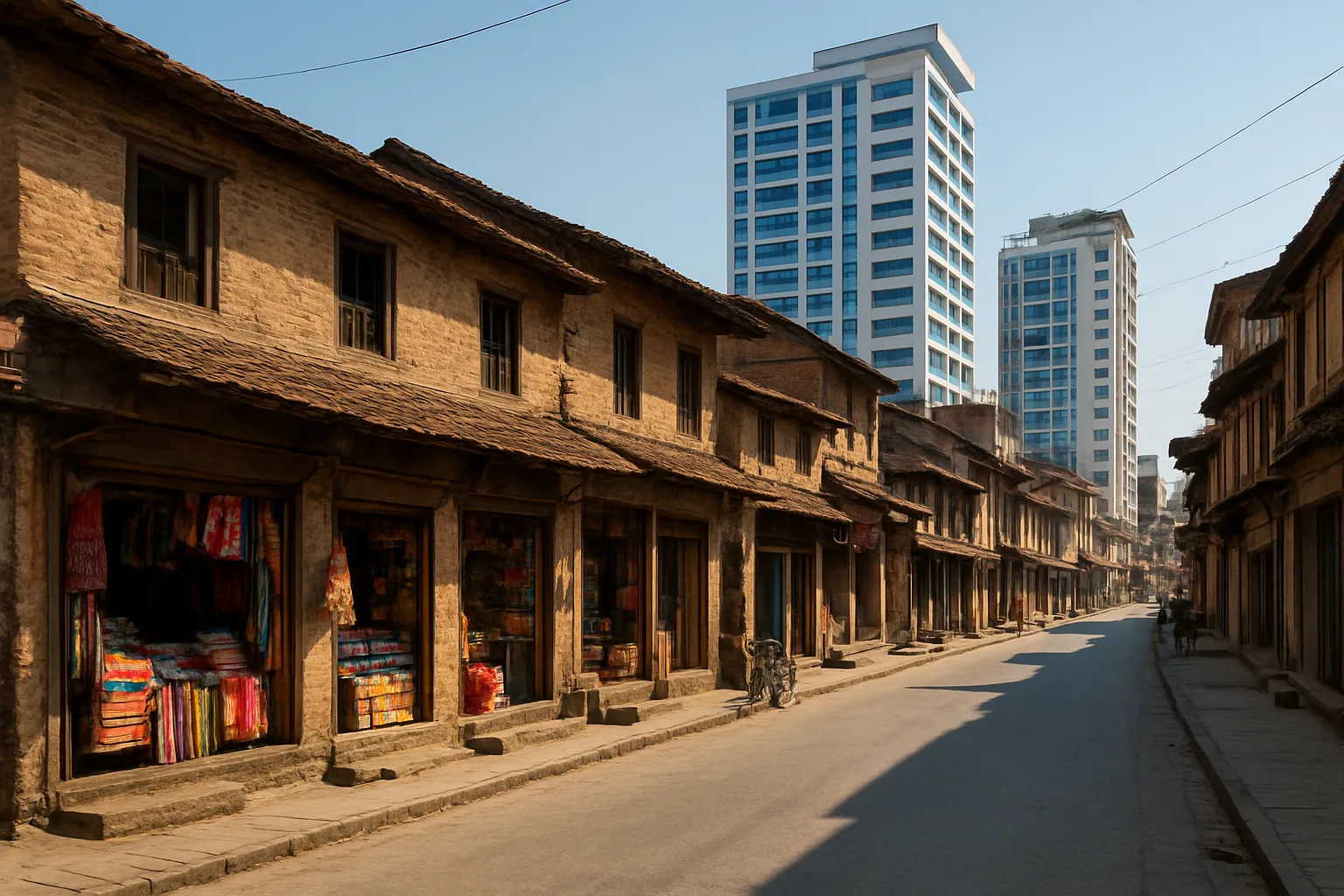
The sun dips behind the low hills, casting a golden haze over Hamirpur’s main bazaar. Shopkeepers roll down shutters with a practiced efficiency, their movements a blend of old habit and new hurry. Motorcycles weave between fruit vendors and schoolchildren. In the distance, the outlines of new apartment blocks rise above the tiled rooftops, casting long shadows across a town that, until recently, moved at the pace of the seasons. Hamirpur, once a quiet administrative outpost on the cusp of the Punjab hills and central Himachal, now thrums with the pulse of urban aspiration. The transformation is undeniable, yet beneath the surface, the echoes of older worlds linger—sometimes in the very stones beneath the growing roads.
From Hilltop Hamlet to Administrative Anchor
Hamirpur’s story is inseparable from the broader sweep of Himachal’s hill country. The region’s earliest settlements, as preserved in oral memory and a handful of archaeological finds, were little more than hamlets perched atop defensible ridges. These clusters of homes, built from mud and stone, owed their existence to natural springs and the safety of height. Local tradition, retold by elders and recorded in early 20th-century gazetteers, holds that the plains below were once thick with forests and wild animals, making the hills both sanctuary and barrier.
While the myths of ancient rajas and divine protectors swirl through village tales, historical inference places Hamirpur’s emergence as a significant settlement in the late medieval period, as the Katoch dynasty of Kangra extended its influence southward. The town itself is named after Raja Hamir Chand, a Katoch ruler whose reign in the 18th century marked a period of consolidation for the region. The establishment of small forts and administrative posts—some of which still leave traces in local place names—anchored Hamirpur’s place in the growing network of hill states.
Communities at the Crossroads
For centuries, Hamirpur’s landscape was shaped by communities whose lives revolved around agriculture, animal husbandry, and seasonal trade. The Gaddis, known for their transhumant shepherding, passed through the area’s higher slopes, while settled castes—Rajputs, Brahmins, and artisans—formed a tapestry of villages that clustered around temples and water sources. Belief systems here were pragmatic yet deeply spiritual, blending Hindu traditions with local deities (devtas), whose shrines still dot the hillsides.
The main routes that wound through Hamirpur connected not only villages but cultures. Traders brought salt and cloth from the plains, exchanging them for ghee, honey, and hill produce. The river crossings—especially the Beas and its tributaries—were both bridges and boundaries, marking the limits of influence for various hill chieftains. Over time, these interactions fostered a cosmopolitanism, subtle but real, that set the stage for Hamirpur’s later growth as a town of convergence.
Colonial Interlude and the Seeds of Change
The 19th-century arrival of British colonial administration brought both disruption and opportunity. After the First Anglo-Sikh War (1845–46), the British incorporated the region into the Kangra district. District gazetteers from the late 1800s describe Hamirpur as a “minor but promising” settlement—its bazaar growing, its fairs drawing hill folk from miles around. New roads, built to move troops and goods, began to tie Hamirpur more firmly to the world beyond.
This period also saw the rise of educational institutions, often missionary or government-run, seeding a new aspiration among local families. While the majority still tilled fields or tended livestock, an emerging class of clerks, teachers, and petty officials began to dream of life outside the rhythms of rural tradition. The first signs of urban lifestyle—a tea shop here, a government bungalow there—foreshadowed deeper changes to come.
Post-Independence: Town on the Move
The decades following India’s independence in 1947 were transformative for Hamirpur. As Himachal Pradesh gained statehood in 1971, administrative reorganization elevated Hamirpur to district headquarters. This single act poured new energy into the town—government offices, banks, and transport hubs sprang up, drawing villagers from surrounding areas in search of work and opportunity.
Hamirpur’s main market expanded rapidly, with concrete replacing mud and thatch. Educational institutions like the Government College (established in 1965) attracted students from across the region, infusing the town with youthful ambition. The arrival of buses and, later, private vehicles shrank distances, making Hamirpur a nexus for commerce, education, and healthcare. Yet, for all its newfound bustle, the town retained a core shaped by its hill heritage: extended families, religious festivals, and the enduring authority of local councils.
Lifestyles in Transition
The most striking changes in Hamirpur over the past five decades have unfolded in daily life. Where once the rhythms of sowing and harvest dictated the calendar, now the school year and workweek set the pace. Satellite television and the Internet, arriving in the 1990s and 2000s, opened windows to the wider world. Young people, especially, have begun to move between tradition and modernity with increasing ease—wearing jeans to college, yet returning for the annual village fair in ancestral dress.
The town’s physical growth mirrors these social shifts. New neighborhoods sprawl along the ridges, their homes mixing traditional sloped roofs with concrete balconies. Cafés and coaching centers stand alongside centuries-old temples. Migration, both inward from rural villages and outward to Punjab, Delhi, and beyond, has reshaped family structures and aspirations. Yet many Hamirpuri households still gather for evening prayers, and the annual cycle of festivals continues to anchor community life.
Urban Aspirations and Enduring Roots
Today, Hamirpur’s urban identity is neither wholly new nor entirely divorced from its past. The town’s streets echo with the ambitions of students preparing for competitive exams and entrepreneurs opening new shops, yet the call of distant temple bells reminds all of deeper roots. Urban growth has brought challenges—pressure on resources, changing patterns of land use, and evolving social norms—but it has also fostered a remarkable resilience. The old and the new are not always in conflict; more often, they blend in ways that are distinctly Hamirpuri.
As we look ahead to the next chapter, which will explore Hamirpur’s role as a regional center in the age of digital connectivity and economic transition, the town’s enduring story remains one of adaptation—a place where memory and modernity meet, shaping the lives of those who call it home.
Previous: Roads, Connectivity, and Development in Hamirpur
Next: Traditional Culture in Today’s Hamirpur