
Series: History of Shimla, Himachal Pradesh, India
Phase 5: Modern Era — Part 28 of 30
This article appears within a continuing historical series that follows the western Himalayas into the modern era. With the end of princely rule and the integration into independent India, long-standing social and political patterns were reconfigured. This phase examines how development, state formation, and memory interact with inherited landscapes, shaping contemporary life while carrying forward echoes of the past.
Under the Cedar Canopy: An Early Morning in Shimla
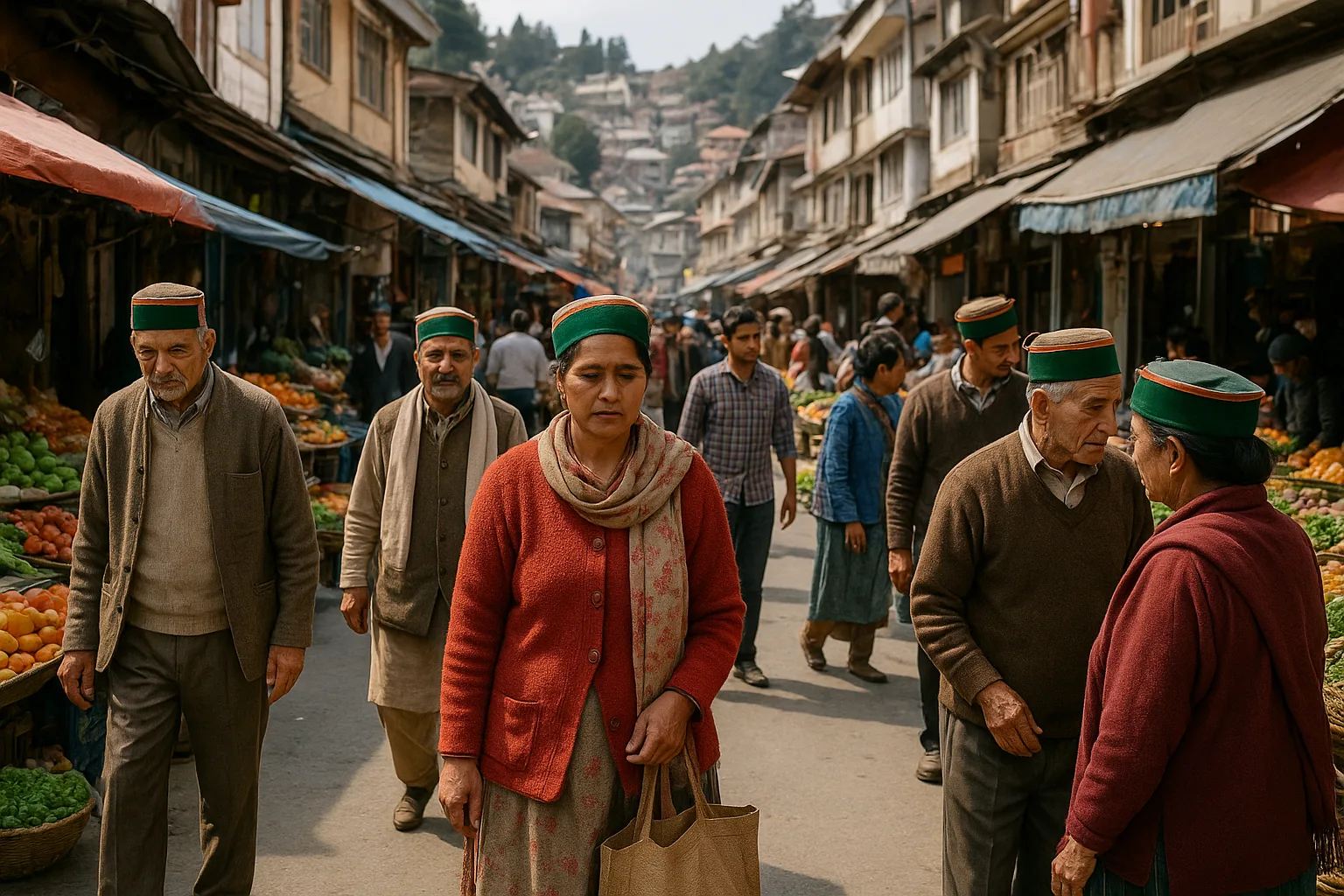
As dawn breaks above the ridges of Shimla, the city stirs to life beneath a soft veil of mist. The call of the koel echoes across steep lanes, its song mingling with the measured clang of temple bells and the distant rumble of a first bus winding up Cart Road. Here, in the heart of Himachal Pradesh’s capital, the lives of over two centuries of residents now overlap—descendants of ancient hill communities, families shaped by colonial history, and new arrivals drawn by education, work, and opportunity. The air is cool, carrying the scent of pine needles and wood smoke, as the city’s old and new neighborhoods begin their daily rhythms.
From Ancient Habitations to a Colonial Capital
Shimla’s story, as explored throughout this series, is rooted in the rugged highlands of the northwestern Himalayas. Historical records anchor the region as part of the erstwhile Hill States, once situated at the crossroads of trade and migration routes connecting Tibet, Punjab, and the central Himalayas. Oral traditions among local communities, particularly the Pahari-speaking peoples, recall settlements dating back centuries, their livelihoods entwined with the forests, terraced fields, and sacred groves that still shape the city’s outskirts today.
By the early nineteenth century, Shimla was a modest cluster of hamlets—such as Shyamala and the surrounding villages—inhabited by agriculturists, shepherds, and artisans. It was not until the British established their summer capital here in the 1820s that Shimla’s fate shifted dramatically. The colonial imprint remains evident in the city’s architecture, institutional framework, and diverse social fabric, providing a bridge between ancient traditions and modern urban life.
Communities and Continuity: Who Calls Shimla Home?
The population of contemporary Shimla is a mosaic. Indigenous Pahari communities, including the Kanets, Brahmins, Rajputs, and other local castes, maintain deep roots in the surrounding hills and the city’s older quarters. Their beliefs and customs, shaped by centuries of interaction with the land, continue to inform religious life, festivals, and the rhythms of rural neighborhoods on Shimla’s periphery.
The British era introduced a new array of residents: administrators, soldiers, traders, and service staff drawn from across the subcontinent. Anglo-Indian families, Punjabi traders, and Nepali workers—initially brought for construction and gardening—became integral to the city’s demography. Today, the city is further enriched by migrants from across Himachal and northern India, with communities settling for work in education, government, commerce, and tourism. This interweaving of old and new, local and migrant, is one of Shimla’s defining features in the present day.
Belief Systems and the Sacred Landscape
Religious life in Shimla is a palimpsest of belief, where ancient traditions coexist alongside modern expressions of faith. Temples dedicated to local deities—such as Shyamala Devi, from whom the city takes its name—dot the ridges and wooded slopes. Oral tradition holds that these shrines mark sites of spiritual power, visited for generations by villagers seeking blessings, healing, or protection from the elements. Seasonal festivals, including the famous Sair and Dussehra, remain focal points for community gathering and renewal.
The colonial period introduced new sacred sites: Christ Church on the Ridge and St. Michael’s Cathedral serve as enduring landmarks, their spires rising above bustling bazaars. Today, gurdwaras, mosques, and Buddhist monasteries also serve the city’s diverse population, reflecting the layered history of migration and settlement. Religious processions and public celebrations are common, often blending traditions in ways unique to the contemporary hill city.
Work, Commerce, and Changing Urban Life
Shimla’s residents have long adapted to the demands and opportunities of their mountainous environment. Historically, livelihoods revolved around agriculture, animal husbandry, and forest products—practices that persist in villages surrounding the urban core. However, the city’s transformation into an administrative, educational, and commercial hub has redefined the nature of work for many.
Government employment is a significant draw, with the state secretariat and numerous administrative offices headquartered in the city. Educational institutions—from colonial-era schools like Bishop Cotton and St. Edward’s to Himachal Pradesh University—attract staff and students from across the region. Hospitality and tourism, long central to Shimla’s economy, have grown further in recent decades, supported by hotels, cafes, and seasonal markets that cater to the influx of visitors.
Markets such as Lakkar Bazaar, Lower Bazaar, and the Mall remain vital centers of commerce, where descendants of old trading families work alongside new entrepreneurs. The crafts of woodwork, woolen textiles, and local foods provide continuity with the past, even as global goods and digital services reshape the economic landscape. Daily life here is marked by negotiation between tradition and innovation, preservation and adaptation.
Education, Public Life, and Social Mobility
The value placed on education in Shimla is a legacy of both local ambition and colonial policy. Historic institutions have produced generations of administrators, writers, scientists, and artists who shape public discourse in Himachal Pradesh and beyond. The city’s libraries, museums, and theaters foster a cultural life that is both cosmopolitan and deeply regional.
Public life in Shimla unfolds in layered spaces—the Ridge, Scandal Point, Annandale, and Jakhoo Hill—where residents gather for festivals, politics, or simple recreation. The press, local radio, and digital forums have become powerful platforms for civic engagement, debate, and the assertion of regional identity. Social mobility, while shaped by longstanding hierarchies, is increasingly influenced by educational achievement, migration, and economic diversification.
The Ecology of Urban Hills: Challenges and Adaptation
Life in contemporary Shimla is shaped by the city’s unique geography. The steep terrain, dense forest cover, and fragile soils have made urban planning and expansion a persistent challenge. Water scarcity, landslides, and the pressure of growing populations test both the resilience of residents and the capacity of local governance.
Yet, the city’s people retain a close relationship with their environment. Community-led initiatives for water conservation, forest protection, and waste management reflect both tradition and innovation. Sacred groves, urban parks, and tree-lined avenues are prized not only for their beauty, but for their ecological and cultural significance. As new challenges emerge, the adaptability of Shimla’s residents remains central to the city’s continuity.
Continuity and Change: The Living Heritage of Shimla
In the interplay of daily routines and historic memory, contemporary Shimla reveals itself as a city where past and present move in tandem. The descendants of ancient hill communities share streets and stories with newcomers; colonial structures house modern institutions; and old festivals find new meaning amid the rhythms of urban life. These continuities, shaped by centuries of adaptation and encounter, lend the city its distinctive character and resilience.
As the series turns next to the role of Shimla in shaping regional and national identity in the late modern era, the enduring patterns of community, belief, and adaptation in the city offer a living testament to the ways history is carried forward—not as a distant record, but as an ongoing practice of belonging and renewal.
Previous: Environmental Challenges Facing Shimla Today
Next: Balancing Governance and Heritage in the Capital City