
Series: History of Kullu, Himachal Pradesh, India
Phase 5: Modern Era — Part 24 of 30
This article appears within a continuing historical series that follows the western Himalayas into the modern era. With the end of princely rule and the integration into independent India, long-standing social and political patterns were reconfigured. This phase examines how development, state formation, and memory interact with inherited landscapes, shaping contemporary life while carrying forward echoes of the past.
A Valley at Dawn: The Fragile Promise of Kullu
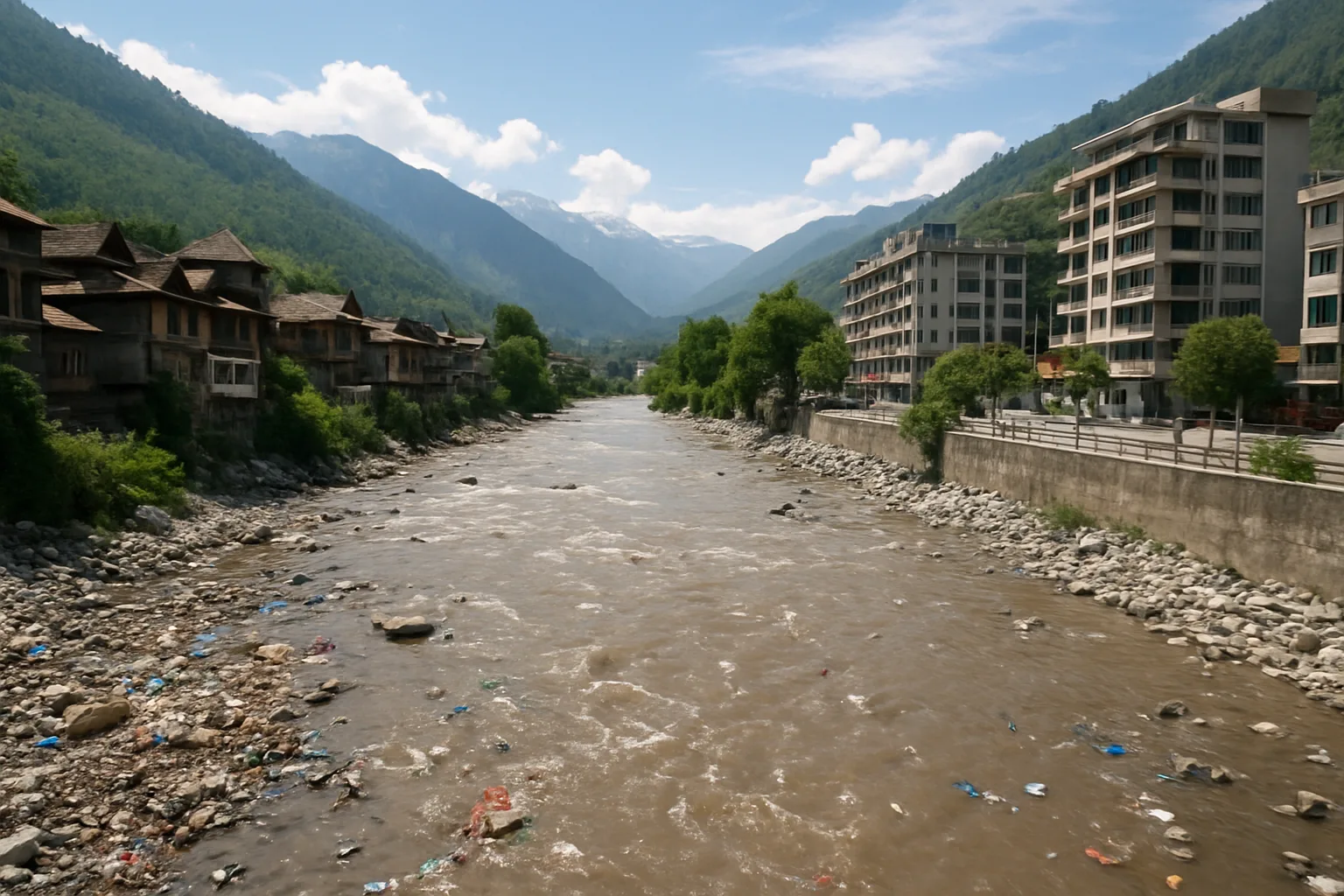
The sun rises over the Beas River, gilding apple orchards and pine forests with pale light. Even now, the air in Kullu carries a clarity rare in modern India—a reminder of a time when the valley’s rhythms were shaped almost entirely by nature’s hand. Yet, beneath the serenity, a sense of unease stirs. Forests that once seemed endless now thin at the edges. Rivers run muddier after the monsoon. The people of Kullu, long entwined with their land, are confronting challenges their ancestors scarcely imagined.
Echoes from the Past: Kullu’s Ancient Environmental Wisdom
Kullu’s history stretches back centuries, shaped by both myth and fact. Ancient oral traditions speak of the valley as a refuge—’Kulant Peeth,’ the end of the habitable world, where rivers and mountains offered sanctuary from chaos beyond. Early settlements clustered along the Beas and its tributaries, drawing sustenance from forests and fields.
While the Puranas and local legends imbue the landscape with a sacred aura, historical inferences—assembled from Chinese pilgrim accounts, Rajput chronicles, and regional gazetteers—depict a society acutely responsive to its surroundings. The earliest hill communities, including the Kulluites, Thakurs, and later Rajput settlers, developed complex systems of water management and forest use. The Deodar cedar, revered as the abode of gods, was protected by custom long before formal conservation arrived.
Trade, Migration, and Transformation: The Human Imprint
By the early medieval period, Kullu was no longer an isolated haven. Caravan routes threaded through its valleys, linking Tibet, Ladakh, and the Punjab plains. Traders, pilgrims, and armies passed, leaving new crops, crafts, and belief systems in their wake. The emergence of hill states—first semi-mythical chieftains, later documented Rajas—brought new pressures on land, as forests were cleared for agriculture and fortifications.
Yet, for centuries, the valley’s relative inaccessibility insulated it from the full force of imperial exploitation. The Gazetteer of the Kangra District (1883) records that despite periodic floods, landslides, and local famines, the people of Kullu maintained a delicate balance with their environment, guided by ritual, necessity, and a cautious respect for the valley’s limits.
Modernity Arrives: Roads, Dams, and Growing Strains
The twentieth century changed everything. As British administrators and engineers built roads through the mountains, Kullu opened to the outside world at an unprecedented pace. The post-independence era brought new ambitions: hydroelectric dams rose on the Beas and Parvati, promising power and prosperity, but also flooding villages and altering riverine ecologies.
With the expansion of apple orchards and commercial agriculture, forests fell more rapidly. Migration surged, as both opportunity and hardship drew people to and from the valley. Seasonal tourism, once a trickle, became a flood—straining water supplies, burdening waste systems, and further fragmenting wildlife habitats. Local NGOs and elders recall how, within a single generation, the once-clear sightlines from village to ridge began to blur beneath a haze of dust and smoke.
Climate Change: New Uncertainties on Ancient Ground
Today, the environmental challenges facing Kullu are no longer confined to the valley’s boundaries. Warming temperatures have shortened winters and reduced snowfall in the high pastures. Glaciers feeding the Beas and Parvati rivers retreat with each passing year. Monsoon rains arrive erratically, triggering devastating floods and landslides—events that local memory once counted as rare but now occur with alarming frequency.
Scientists and Himachali farmers alike observe a shifting calendar. Apple harvests, once reliably timed, stumble as blossoms arrive too early or too late. Native forests struggle against invasive species. Even sacred groves, protected for centuries by faith and taboo, feel the encroachment of roads and reckless development. The sense of environmental security that anchored Kullu’s myth and history is now haunted by uncertainty.
Community, Resistance, and Adaptation
Yet, resilience remains a hallmark of the Kullu valley. Across its villages and towns, new forms of stewardship emerge. Women’s collectives replant lost forests; panchayats regulate water and grazing rights with renewed vigor; temple committees invoke both tradition and science to protect sacred rivers. Some families experiment with organic farming, and a few adventurous entrepreneurs invest in eco-tourism, hoping to marry livelihood with conservation.
Resistance, too, has a long pedigree here. When the Parbati hydro projects threatened to submerge ancient shrines and farmlands, villagers mobilized, drawing national attention to their plight. While not every campaign succeeds, the spirit of community action—rooted in both ancient Panchayat traditions and modern activism—endures.
The Roots Run Deep
From the stories whispered by the Beas to the annual processions of the valley’s deities, Kullu’s relationship with its environment has always been more than practical. It is spiritual, historical, and fiercely local—a heritage born of adaptation, reverence, and struggle. The environmental challenges facing Kullu today are formidable, but they are not wholly new. Each generation, in its own way, has negotiated the balance between necessity and restraint, between innovation and memory.
As we move forward in this series, we will trace how Kullu’s people—descendants of ancient settlers, Rajput dynasties, and mountain traders—continue to shape their destiny in the face of new pressures. The next chapter will explore the dynamic forces of tourism and migration in reshaping Kullu’s social and economic landscape, and how the valley’s deep roots might guide its uncertain future.
Previous: Manali’s Rise from Village to Global Tourist Hub
Next: Apple Farming and Economic Change in Kullu