
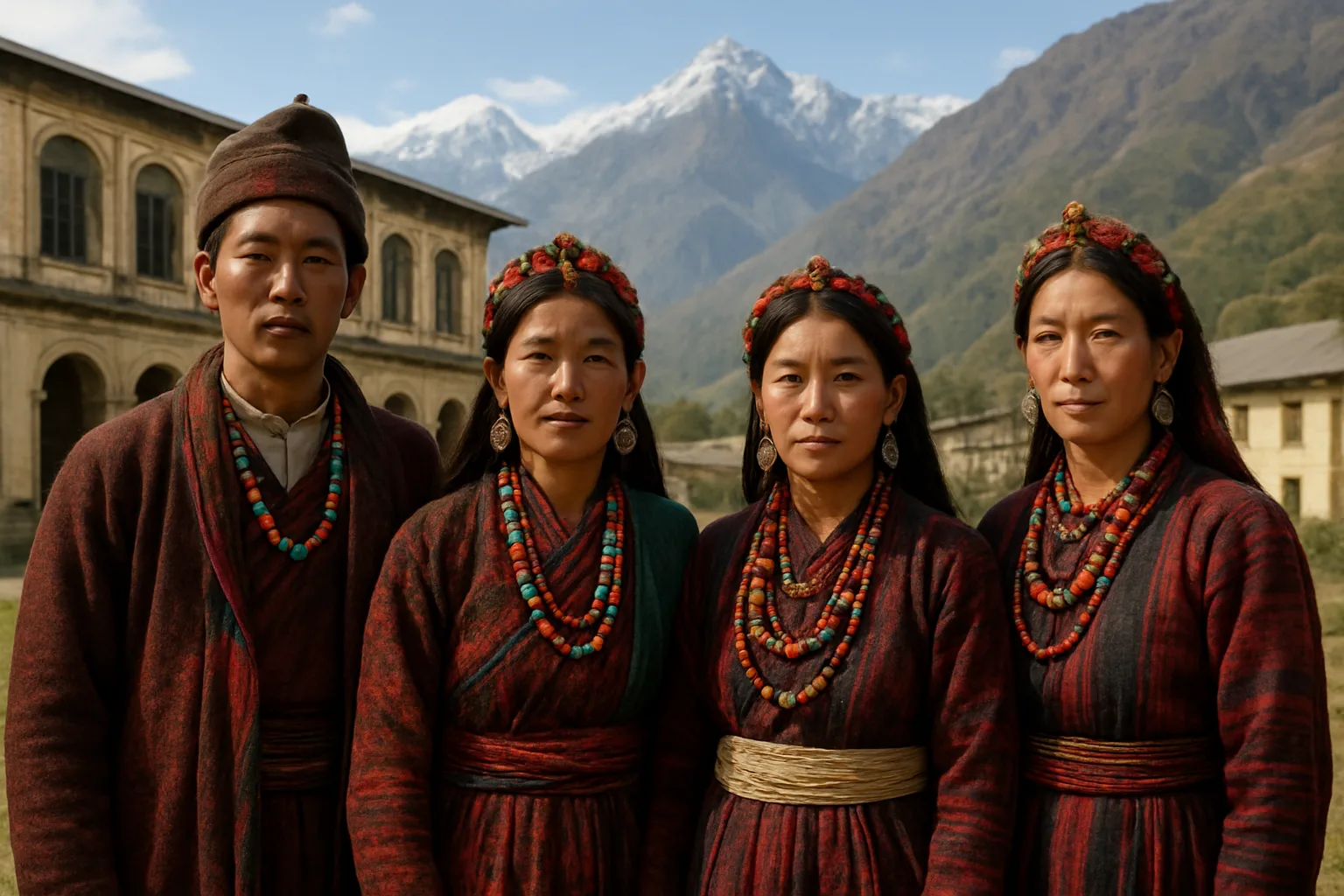
Series: History of Lahaul & Spiti, Himachal Pradesh, India
Phase 4: British Period — Part 19 of 30
This article is part of a wider series tracing the transformation of the western Himalayas under colonial influence. As British authority extended into the hills, existing political systems were restructured through treaties, administration, and new forms of governance. This phase considers how colonial rule reshaped society, economy, and space while leaving lasting imprints on local identity.
Twilight in the High Valleys: 1860s Lahaul-Spiti
It is late autumn in the valleys of Lahaul and Spiti. The chill sharpening the air is more ancient than memory itself. Smoke curls from stone-roofed houses in Kyelang, while prayer flags flutter above, their faded colors whispering mantras into the wind. In this moment, the world feels untouched—but beneath the surface, the rhythms of tribal life have begun to adjust to a new presence: the British colonial administration, whose reach, though distant, is now felt even at these Himalayan heights.
Frontiers of Empire: Colonial Arrival and Administrative Reach
For centuries, Lahaul and Spiti remained on the periphery of every kingdom and empire. Isolated by geography, the region’s communities—predominantly Bodh, Swangla, and Gaddi, among others—lived by a calendar marked by the seasons, migration, and pilgrimage. Oral traditions recall ancestors crossing frozen passes, forging kinship networks across valleys, and venerating mountain spirits. Historical inference, however, situates the earliest modern settlements in the wake of the Tibetan Buddhist expansion, with Lahaul emerging as a trade conduit between Ladakh and the plains of Punjab.
The advent of the British in the mid-19th century, following the Treaty of Lahore (1846), brought formal incorporation of Lahaul-Spiti into the Punjab Province. The colonial gaze, recorded in early gazetteers and the reports of British officers like A. W. Crooke and Major Hay, appraised the region less as a strategic prize than as a remote outpost—difficult, beautiful, and quietly resistant to outside control.
Communities Amidst the Clouds: Bodh, Swangla, and Gaddi Life
Each valley held its own story. The Bodh (or Bhotia) of Spiti, with their deep-rooted Buddhist traditions, were defined by monastic festivals, polyandry, and intricate irrigation systems that coaxed barley and peas from stony soil. The Swangla of Lahaul, often described in colonial records as “semi-nomadic,” managed flocks and cultivated terraced fields, sustaining themselves through harsh winters and scant summers. Gaddi shepherds, though more numerous in neighboring Chamba, traversed the high meadows here, their seasonal migrations a living link to distant pasts.
Belief systems blended Bon and Vajrayana Buddhism with local animist rituals. Oral epics—sung by elders around winter fires—spoke of mountain deities, legendary ancestors, and the perpetual negotiation between humans and the unforgiving landscape. Mythology and custom were not merely stories; they were survival guides, evolving with each generation.
Trade, Tribute, and the Shadow of the State
Long before colonial rule, Lahaul and Spiti’s position at the crossroads of Central Asia, Tibet, and the Indian plains made them natural participants in trans-Himalayan trade. Salt, wool, and borax traveled south; grains and cloth moved north. The ancient Hindustan-Tibet Road, later formalized by the British, threaded through these valleys, linking them to the great caravan routes.
Hill states—Kullu, Ladakh, and Chamba—exerted loose influence at times, extracting tribute or exacting loyalty, but local autonomy remained robust. Early chronicles, such as those preserved in the Buddhist monasteries of Tabo and Key, describe a world where alliances were fluid and borders porous. The arrival of colonial administrators introduced new systems of taxation and record-keeping, but the region’s remoteness blunted the sharper edges of imperial law. Village headmen (nambardars), often selected by consensus, mediated between the people and the colonial state, translating edicts into practical, locally intelligible rules.
Oral Tradition Meets Written Record: Documenting Identity
While British officers mapped the valleys and enumerated populations, much of what was known about Lahaul-Spiti’s communities continued to live in oral tradition. Stories of the legendary Gyalpo kings, or of Padmasambhava’s passage through Spiti, were recounted alongside the names of British surveyors in the collective memory. The gap between oral history and written record was navigated daily—sometimes with pride, sometimes with unease.
Colonial records often misunderstood or oversimplified local social structures, flattening the complexity of kinship, marriage, and inheritance customs. Polyandry, for instance, was noted with anthropological curiosity but seldom understood as a rational adaptation to limited arable land and harsh climate. The coexistence of oral and written traditions remains a testament to the resilience of local identity in the face of external scrutiny.
Festivals and Seasons: Continuity and Change
The calendar of Lahaul-Spiti was, and remains, shaped by the demands of altitude and climate. Villages clustered around Buddhist monasteries—Tabo, Key, Gemur—organized communal labor for sowing and harvest, and celebrated festivals that drew entire valleys together. Losar (New Year), Fagli, and Chaam masked dances provided both spiritual renewal and social cohesion.
Under colonial oversight, certain festivals became occasions for tax collection or census, but the core of these traditions endured. The performance of ancient rituals—whether the lighting of butter lamps or the recitation of clan genealogies—affirmed a continuity that neither empire nor modernity could erase.
Negotiating Modernity: Education, Administration, and Resistance
By the early 20th century, colonial policies began to introduce rudimentary schools, new administrative divisions, and the first hints of road-building. While some families welcomed the prospects of education, others viewed these changes warily, fearing erosion of traditional authority and knowledge. The mountain passes remained both literal and symbolic boundaries—gateways to outside influence, but also to potential disruption.
Resistance in Lahaul-Spiti was rarely dramatic; there were no major rebellions, but subtle forms of negotiation and adaptation. Local leaders bargained for favorable terms, delayed compliance, or quietly subverted unpopular policies. The region’s harsh terrain and strong communal bonds served as natural defenses against rapid change.
Echoes into the Present: Enduring Legacies of the High Valleys
Today, the villages of Lahaul and Spiti continue to draw on the deep reservoirs of tradition established during the colonial period. The prayer flags still flutter, and the mountain gods are still honored. Yet, the memory of British oversight—its censuses, its roads, its attempts to classify and control—remains woven into the fabric of local life.
This legacy shapes debates over development, identity, and autonomy in the 21st century. The story of Lahaul-Spiti’s tribal communities under colonial rule is not one of passive endurance, but of active negotiation—of choosing what to preserve and what to adapt.
In the next part of the series, we will follow the valleys into the era of Indian independence, exploring how the departure of the British and the birth of new nationhood reshaped the highlands and their peoples.
Previous: Restricted Access and Isolation During British Rule
Next: End of Princely and Colonial Influence in Lahaul–Spiti