
Series: History of Kullu, Himachal Pradesh, India
Phase 4: British Period — Part 19 of 30
This article is part of a wider series tracing the transformation of the western Himalayas under colonial influence. As British authority extended into the hills, existing political systems were restructured through treaties, administration, and new forms of governance. This phase considers how colonial rule reshaped society, economy, and space while leaving lasting imprints on local identity.
On the Dusty Tracks of the Himalaya: 1840s Kullu
The morning air over the Beas River is crisp, laced with cedar and woodsmoke. It is the late 1840s, and the valley of Kullu—once a near-mythic land of kings, pilgrims, and traders—awakens not just to another day, but to the slow, grinding song of pickaxes on stone. British engineers, with their surveyor’s chains and theodolites, stand among startled local villagers. The first roads of the colonial era are being carved into the ancient bones of the Himalaya.
Kullu Before the British: Remoteness and River Paths
Long before the British arrived, Kullu’s isolation was both a curse and a blessing. Oral traditions, carefully preserved in the tales of village elders and religious festivals, speak of a land protected by formidable mountains—soaring walls that shielded communities from invasions, but also kept them apart from the wider world. Ancient trade routes traced the natural contours of river valleys, especially along the Beas, connecting scattered hamlets and hilltop temples.
Historical inference, based on regional gazetteers and early chronicles, suggests that for centuries, movement in and out of Kullu was arduous and seasonal. The rough footpaths—sometimes only animal tracks—were shaped by necessity, not design. Pack animals carried salt, wool, and medicinal herbs to distant markets, while pilgrims and traders braved landslides, snow, and swollen rivers.
Ancient Trade and Early Hill States
Kullu’s strategic location nestled it between Tibet, Ladakh, and the Punjab plains. From at least the early medieval period, it participated in a network of trans-Himalayan trade, exchanging pashmina, borax, and musk for grains and cloth. Communities here, including the Kullvi, Thakurs, and various Pahari castes, drew both identity and livelihood from these exchanges.
The emergence of small hill states—Kullu, Mandi, and Lahul among them—added a political dimension to these routes. Local rajas levied taxes on caravans and maintained rest houses (sarais) along the way. Yet, until the British period, these connections remained precarious, dictated by weather and war as much as by commerce.
The British Arrival: Motives and Methods
After the First Anglo-Sikh War of 1845–1846, the British East India Company annexed territories across the Punjab Himalaya. Kullu, with its fabled beauty and strategic passes, drew their gaze. For administrators and military officers, connectivity was not just a matter of economic potential, but of imperial necessity. They needed roads to move troops, collect taxes, and survey resources.
Initial reports from British officers—preserved in the Punjab Gazetteer—describe Kullu’s communication as “confined to narrow paths, impassable to wheeled traffic.” The colonial project aimed to change this, both by improving existing tracks and by engineering entirely new arteries across the mountains.
Building Roads: Labor, Landscape, and Local Response
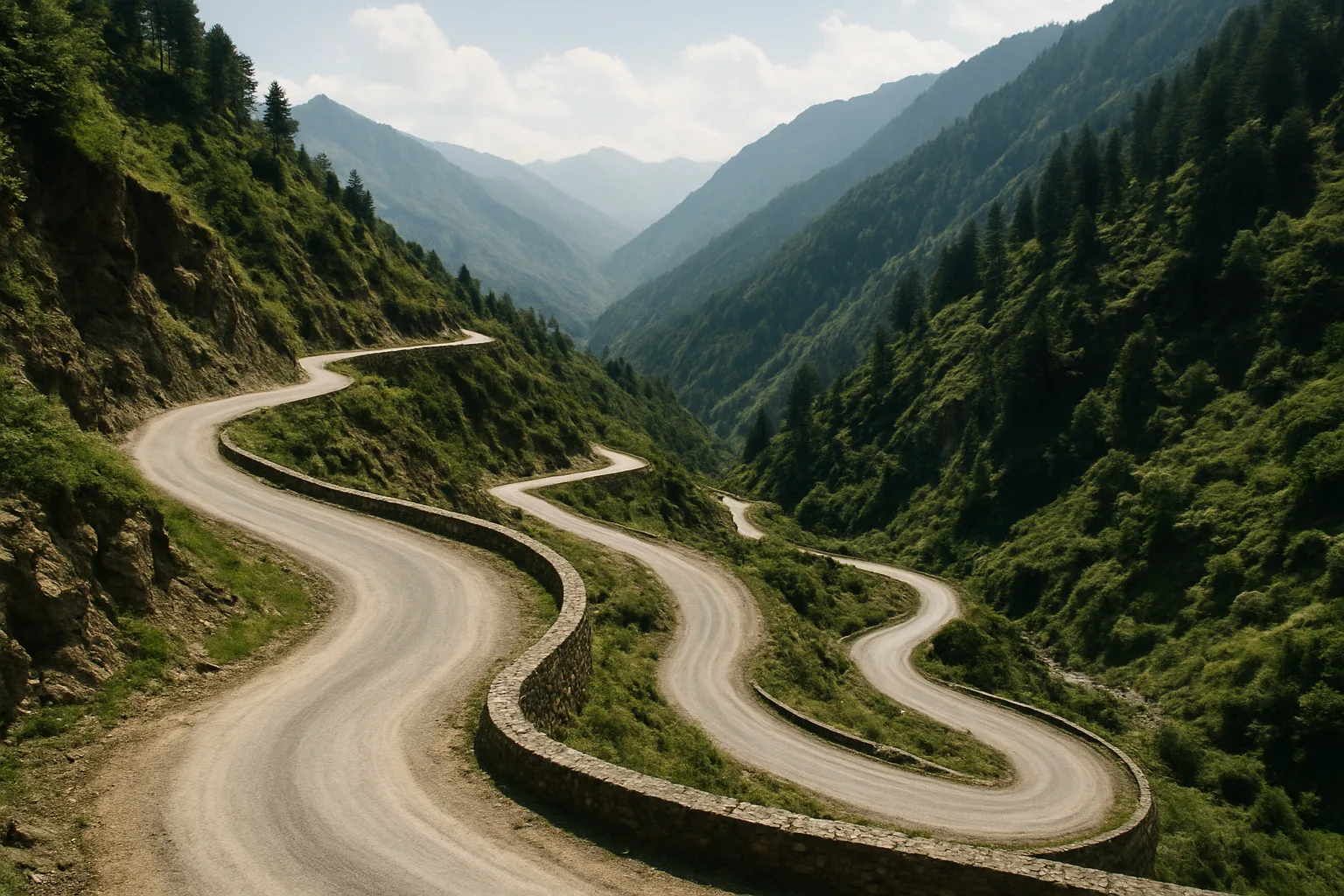
Between 1850 and 1880, the British undertook a series of ambitious road-building campaigns. The main trunk route from Mandi to Kullu town, painstakingly blasted through gorges and terraced onto cliffs, became the region’s first all-weather road. Its construction drew on both imported labor and local villagers, often through corvée (forced) labor policies, which bred quiet resentment as well as curiosity.
Travelers’ diaries from the time evoke scenes of mule trains and British officers navigating hairpin turns, while village children watched in awe—or suspicion—from the safety of the fields. The new roads reshaped the landscape, cutting through forests and opening once-hidden valleys. Bridges over the Beas and Parvati rivers became symbols of a new era, but also flashpoints for local debate about change and tradition.
Transforming Trade, Society, and Identity
The impact of these roads was profound and immediate. Local traders, who had once relied on pack animals and seasonal crossings, now found themselves connected to the markets of Punjab and Shimla. Salt, tea, and manufactured goods flowed in; apples, wool, and herbs traveled out. The region’s famed Kullu shawls gained new markets, and itinerant traders from as far as Kashmir and Tibet became familiar presences in village bazaars.
Yet change came at a cost. The influx of outsiders, new administrative regulations, and cash crops challenged older customs and belief systems. Oral traditions recount stories of the first motorcars startling livestock and of elders lamenting the erosion of village boundaries. Still, many Kullvi saw opportunity: new schools, postal services, and, eventually, the telegraph followed the same roads, knitting together a valley that had long prized its independence.
From Isolation to Interconnection
By the late 19th century, Kullu’s transformation was clear. Its markets thrived, its festivals drew outsiders, and its valleys, once remote, pulsed with the rhythms of a wider world. Gazetteers of the period note a “remarkable improvement in the prosperity and composition of the district.” The old footpaths survived, but now ran alongside or beneath the engineered roads of empire. The Beas continued its timeless journey, but along its banks, new bridges and rest houses stood as markers of change.
As the British era waned and the 20th century approached, the legacy of these roads—physical and cultural—became inseparable from Kullu’s modern identity. The region’s openness to outside influences, coupled with its fierce commitment to tradition, remains rooted in these formative decades of road, trade, and connectivity.
Echoes Today and the Road Ahead
Today, as buses and jeeps wind along mountain highways, the ghosts of those first British roads linger. The patterns of trade and migration they set in motion continue to shape Kullu’s economy and society. Old sarais may have crumbled, but the networks they once supported have evolved into vibrant towns and tourism hubs. In every market, and on every mountain pass, the echoes of the 19th-century transformation are unmistakable.
In the next part of our series, we’ll follow these roads into the turbulent decades of the late colonial period, as Kullu’s people navigated the challenges of reform, resistance, and the coming of independence.
Previous: Impact of British Rule on Kullu’s Traditional Society
Next: Kullu and the Indian Freedom Movement