
Series: History of Kullu, Himachal Pradesh, India
Phase 4: British Period — Part 18 of 30
This article is part of a wider series tracing the transformation of the western Himalayas under colonial influence. As British authority extended into the hills, existing political systems were restructured through treaties, administration, and new forms of governance. This phase considers how colonial rule reshaped society, economy, and space while leaving lasting imprints on local identity.
A Valley at the Edge of Empire
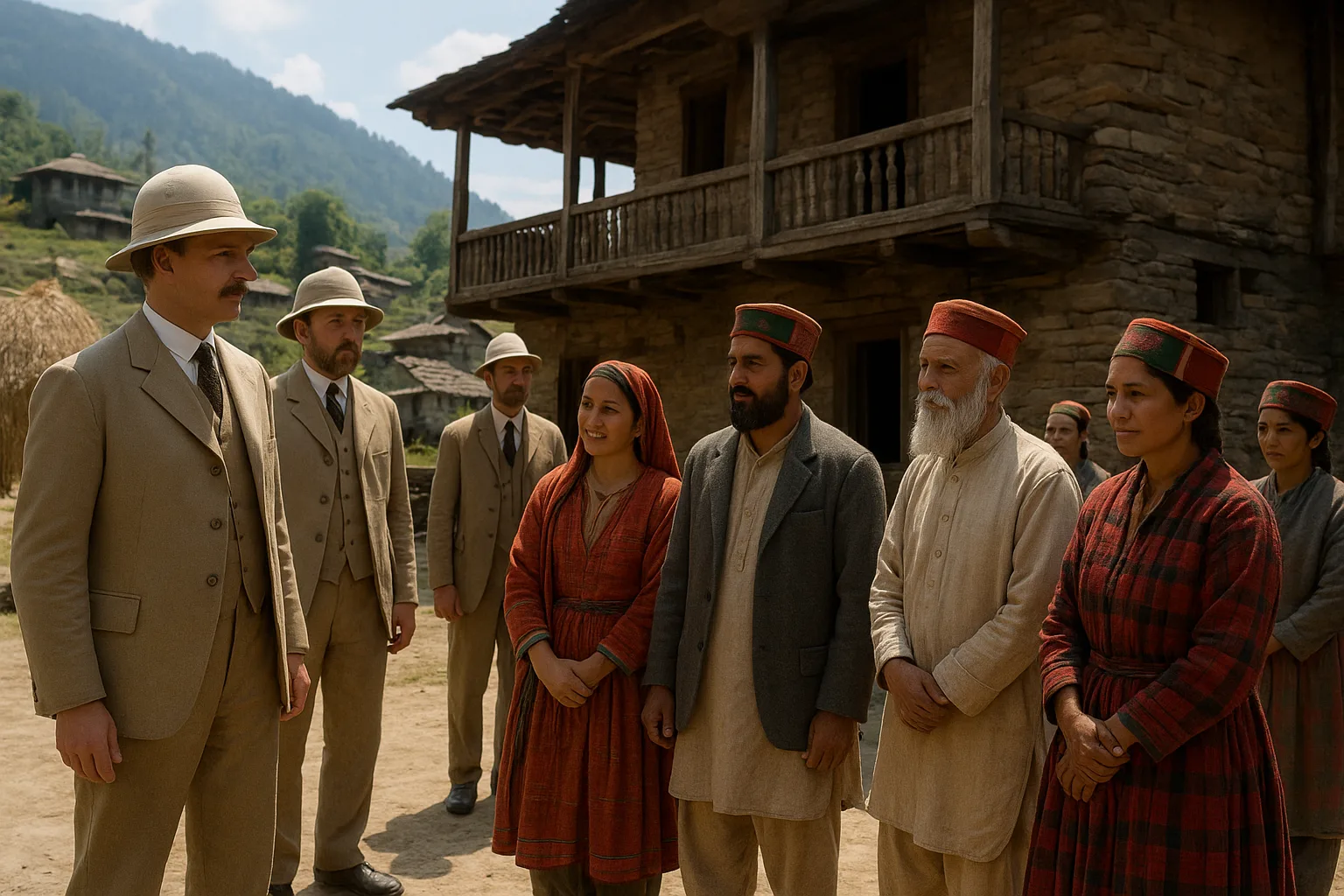
The year is 1846. Above the Beas River, beneath the shadow of the snow-laden Pir Panjal, Kullu’s morning is pierced by the distant bugle of British sepoys. Villagers, whose families have tilled these terraced fields for centuries, pause and listen—the sound is unfamiliar, distinctly foreign. The British, now newly ensconced in the Punjab hills after the First Anglo-Sikh War, are strangers to these slopes. Their arrival will ripple through every corner of Kullu’s old society.
Before the Raj: Kullu’s Tapestry of Tradition
Long before colonial officers set foot in the valley, Kullu’s world revolved around its deotas (local gods), clan elders, and ancient fairs. Oral traditions—remembered in fireside tales and sacred songs—speak of the Pandavas’ wanderings, the founding of the first rajas, and the coming of the Nag devtas. Yet, as gazetteers like A.C. Barnes’ 19th-century accounts remind us, beneath the myth ran a complex society shaped by Himalayan geography and history.
Kullu’s settlements clustered along riverbanks and trade paths, interlinking families and small kingdoms. The valley’s people—predominantly Rajputs, Brahmins, and artisans—lived by rhythms of the seasons and the festivals of their deities. The raja’s court sat at Naggar, dispensing justice through customary law, while distant passes carried wool, salt, and stories from Ladakh and Tibet. The landscape itself was a participant: every grove and stream might be sacred, each village bound by mutual obligations codified through oral agreements and reinforced by ritual.
The British Arrive: New Powers, New Rules
The Treaty of Lahore in 1846 ceded Kullu from the Sikh Empire to British hands. For the first time, the valley’s isolation was breached by systematic rule from Shimla and Lahore. The local raja, once the living embodiment of both temporal and spiritual authority, was reduced to a pensioner under British oversight.
The British set to work mapping the land, cataloguing its people, and, crucially, introducing new systems of taxation and administration. Where once tax had been a matter of negotiation between ruler and ruled—often paid in kind, and fluctuating with the harvest—now it became a fixed obligation, enforced by distant bureaucrats. The British gazetteers, with their lists and tables, captured the surface of Kullu’s society, but beneath, the old ways bent under mounting pressure.
Disrupted Hierarchies and the Quiet Resentment
One of the most profound changes was the erosion of traditional power structures. The British distrusted the ancient panchayat councils and the hereditary authority of the raja’s men. Instead, they installed their own revenue officials, reshaping village leadership with new priorities and loyalties.
For centuries, authority in Kullu was a negotiation between raja, priest, and community headman. The British, however, privileged written agreements and direct taxation, undermining customary rights to forest, pasture, and even temple lands. Many local leaders found themselves irrelevant or co-opted. Discontent simmered—rarely erupting as open rebellion, but instead as a persistent, often silent resistance. People evaded new taxes, clung to old rituals, and found subtle ways to assert their autonomy within the imposed order.
Belief, Ritual, and the Changing Sacred Landscape
Kullu’s world was never simply material. The valley’s deotas, worshipped in elaborate annual processions, bound communities together as much as any raja. The British, with their Protestant sensibilities and preference for rational administration, were bewildered by the power of the gods in local life. Early district officers documented, but rarely understood, the authority of temple councils and the seasonal migrations of sacred idols across the hills.
Colonial policies often inadvertently threatened these traditions. Forest regulations, for example, restricted access to wood needed for temple construction and festival fires. Missionaries and district officers alike saw local beliefs as superstition—yet the people of Kullu found ways to preserve their rituals, sometimes by adapting them outwardly to British expectations while preserving their inner logic. The sacred landscape contracted, but never vanished.
Economy, Mobility, and Shifting Livelihoods
Historically, Kullu’s economy was woven into the fabric of the greater Himalayan world. Trade routes tied the valley to Ladakh, Tibet, and the Indian plains, exchanging wool, silver, and salt. British rule, however, brought new roads, new markets, and—eventually—new crops. The British encouraged apple and potato farming, subtly drawing Kullu into the orbit of colonial commerce.
Land tenure, once determined by custom and community, became a matter of legal title and survey. This brought both opportunity and hardship: some prospered, others lost ancestral claims for want of paperwork. The cash economy deepened class divisions, as those with access to market and legal knowledge found themselves newly empowered.
Everyday Life: Negotiating the Colonial Encounter
Despite the upheavals, much of daily life in Kullu continued in familiar patterns. Families gathered for the Dussehra fair, still one of the largest in the Himalayan region. Fields were sown and harvested with techniques passed down through generations. Yet change was everywhere—in the coins used in the bazaar, the new uniforms of local police, the unfamiliar rules about forest use.
Oral memory records not just resentment but moments of adaptation and even advantage. Some villagers found work as porters or guides for British explorers. Others used the courts to settle old scores, wielding colonial law for local ends. The encounter was not one-sided; tradition and modernity mingled, sometimes uneasily, sometimes creatively.
Legacy: Tradition Transformed, Not Erased
Today, echoes of these colonial-era transformations are everywhere in Kullu. The Dussehra fair still draws thousands, but now alongside tourists and traders from distant cities. Apple orchards, once an experiment, define the landscape. Village councils and local gods retain their authority, though their powers have shifted and adapted to new political realities.
The British period did not erase Kullu’s traditions. Instead, it forced the valley’s people to rethink, defend, and—sometimes—reinvent what it meant to belong to these mountains. The story of adaptation and endurance, begun in the days of the first colonial bugles, continues to shape the valley’s identity.
In the next chapter of this series, we follow Kullu’s journey through the late colonial decades, as the winds of Indian nationalism begin to stir and new voices call for self-rule in the hills.
Previous: Colonial Administration and Revenue Systems in Kullu
Next: Roads, Trade, and Connectivity During British Times